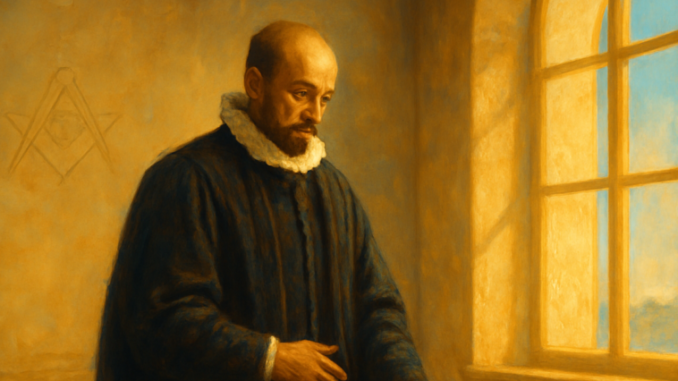
In 1580, Michel de Montaigne wrote a remarkable essay that turned the educational thinking of his time upside down. What began as a letter to the Countess Diane de Foix evolved into a fundamental critique of sixteenth-century schooling. While his contemporaries focused on rote transmission of knowledge, Montaigne argued for something radically different: the formation of a discerning, free, and morally strong individual. His ideas would go on to influence educators and philosophers for centuries — and, less widely known, they helped shape the Masonic ideal of the searching, self-improving human being.
A World in Turmoil: The Historical Context
The France in which Montaigne lived was torn apart by religious wars between Catholics and Huguenots. Education at universities and colleges was dominated by scholastic methods: students memorized vast quantities of texts without truly understanding them. Latin and Greek were the languages of instruction, and the primary goal was to produce scholars who could cite classical authorities on command. Montaigne had experienced this system firsthand at the Collège de Guyenne in Bordeaux, one of the finest schools of the era. Yet looking back, he found it deeply wanting.
Montaigne’s father, Pierre Eyquem de Montaigne, had already taken an unconventional approach by ensuring his son spoke nothing but Latin from the cradle. The household servants and the family tutor were instructed to speak only Latin with the young Michel. This early immersion gave him a head start in his studies, but it also planted the seeds of skepticism toward forced learning methods. In his essay, he would go on to advocate a more natural, more humane approach to education.
Forming the Mind, Not Filling It
Montaigne’s central thesis is as simple as it is revolutionary: the purpose of education should not be to fill the head with facts, but to form it for independent thinking. He draws a sharp distinction between knowledge and wisdom. Knowledge can be accumulated, but wisdom must be cultivated through experience, reflection, and practice. A child who can recite a thousand quotations but holds no opinion of its own has not, in Montaigne’s eyes, been truly educated.
Education is not about filling a vessel, but about lighting a flame — one that empowers the individual to think and judge for themselves.
Montaigne uses a powerful metaphor of digestion: just as the body must convert food into its own flesh and blood, the mind must transform knowledge into personal insight. Simply storing up other people’s ideas is like swallowing food without chewing it. The result is not nourishment but dead weight. The true student absorbs ideas, processes them critically, and makes them part of their own thinking. For anyone who has sat in a Masonic lodge and reflected on the symbolic working of the rough ashlar into something purposeful, this metaphor carries particular resonance.
The Role of the Teacher
Montaigne devotes considerable attention to the choice of a good teacher. This figure should not be authoritarian, but rather a guide who challenges the student to think for themselves. The ideal teacher alternates between explanation and questioning, encouraging the student to explore different viewpoints and embrace doubt as an instrument of growth. This approach calls to mind the Socratic method, where the philosopher led his interlocutors to insight through questions rather than by imposing answers.
Particularly striking is Montaigne’s emphasis on the character of the teacher. A teacher with well-developed judgment is far more valuable than one who merely possesses book learning. The child learns not only from what the master says, but from how the master lives. This brings us to a parallel that Freemasons will immediately recognize: the Apprentice-Fellowcraft-Master relationship within the lodge, where experience and character are transmitted through example and mentorship rather than mere instruction. The Masonic tradition has always understood that the most profound lessons are caught, not taught.
Practical Wisdom Over Theoretical Knowledge
One of the most recognizable elements of Montaigne’s educational philosophy is his emphasis on practical wisdom. He advocates for children to travel, encounter foreign cultures, and practice social engagement. Books are valuable, but the world itself is the greatest school. By traveling and meeting people from different backgrounds, the child learns to put things in perspective and recognize its own prejudices.
Several key principles emerge from Montaigne’s vision. Physical education is just as important as intellectual development. The child must learn to cope with adversity and discomfort. Virtue and integrity rank above mere scholarly achievement. And judgment must be trained through careful weighing of evidence, not through memorization.
Montaigne draws on examples from classical antiquity to reinforce his arguments. He references Plutarch’s descriptions of how Spartan children were hardened through deprivation, and how Alexander the Great was schooled by Aristotle not only in philosophy but in practical affairs. The lesson is clear: a complete human being is not formed by books alone, but by life itself. This echoes the Masonic understanding that the lodge room is a laboratory for life — a place where abstract principles are tested against real human experience.
Character Formation as the Highest Goal
For Montaigne, the ultimate aim of education is not the creation of a scholar, but the formation of a good human being. Knowledge without virtue is dangerous; a sharp intellect without a moral compass can do more harm than good. This insight resonates deeply with the Masonic tradition, in which the rough stone is not polished to shine for its own sake, but to serve a greater whole — to find its proper place in the edifice of a just and harmonious society.
Montaigne insists that the child must learn to examine its own behavior with the same critical eye it applies to the ideas of others. Self-knowledge is the key to wisdom. Here we hear the echo of the ancient Delphic maxim that could well be inscribed above the entrance to any Masonic lodge: Know Thyself. The education Montaigne envisions is one that enables the individual to develop this self-knowledge — not through drill and repetition, but through guided discovery.
From the Sixteenth Century to the Lodge Today
Montaigne’s ideas would later inspire thinkers such as John Locke and Jean-Jacques Rousseau, each of whom shaped Enlightenment thinking about education in their own way. But his influence reaches further than the history of pedagogy. The Masonic tradition, which took its modern form in the early eighteenth century, drew heavily on Enlightenment ideals — the primacy of reason, the cultivation of moral character, and the belief that every individual has both the right and the responsibility to think freely.
When we consider Montaigne’s vision alongside Masonic practice, the parallels are hard to miss. The lodge does not fill its members with dogma. It provides symbols, rituals, and a community of fellow seekers — and then asks each Brother to do the interior work of interpretation and self-improvement. The Worshipful Master does not dictate truth; he facilitates a process of discovery. The lectures and charges are not meant to be memorized and repeated mechanically, but to be internalized and lived. Montaigne would have understood this approach instinctively.
In an age of information overload, where facts are always a search query away, Montaigne’s insistence on the difference between knowing and understanding feels more relevant than ever. For Freemasons, his essay is a reminder that the true work of the Craft is not the accumulation of Masonic knowledge — the memorization of ritual, the cataloguing of degrees — but the slow, patient transformation of the self into something wiser, more compassionate, and more free.
Montaigne’s essay on education, written over four centuries ago, remains a powerful meditation on what it means to truly learn. His vision of education as the formation of a free, morally grounded mind rather than a repository of facts speaks directly to the Masonic ideal of the seeking individual — the Brother who enters the lodge not to receive answers, but to learn how to ask better questions. In the ongoing work of shaping the rough ashlar, Montaigne remains an unexpected but invaluable guide, reminding us that the goal was never knowledge for its own sake, but the building of a life worth living.
Copyright text & image: devrijmetselaar.nl
Texts are based on the ideas and content of the author of devrijmetselaar.nl, reviewed, corrected, and supplemented with the assistance of OpenAI. Images are created based on the ideas of the author of devrijmetselaar.nl using OpenAI/DALL-E.
Frequently Asked Questions
What was Montaigne's main critique of sixteenth-century education?
Montaigne criticized the scholastic methods of his time that relied on rote memorization of texts without true understanding. He argued that education focused too heavily on having students memorize classical authorities and cite them on command, rather than developing their ability to think independently and form their own judgments.
What is the key difference between knowledge and wisdom according to Montaigne?
According to Montaigne, knowledge can be accumulated through memorization, but wisdom must be cultivated through experience, reflection, and practice. He believed that true education should develop wisdom and independent thinking, not merely accumulate facts. A student who can recite quotations but cannot think for themselves has not been truly educated.
How did Montaigne's educational philosophy influence Freemasonry?
Montaigne's ideas about forming free, discerning, and morally strong individuals who engage in self-improvement and independent thinking helped shape the Masonic ideal of the searching, self-improving human being. His emphasis on personal development and the cultivation of wisdom aligns with Masonic principles of individual growth and enlightenment.


Be the first to comment