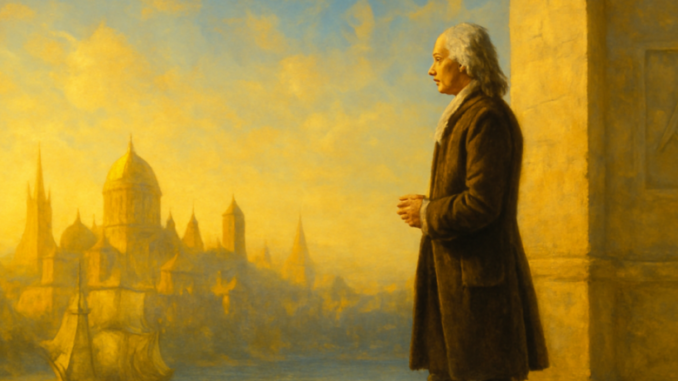
Somewhere in the heart of Voltaire’s satirical masterpiece Candide lies a hidden valley where gold rolls across the roads like gravel and children play with gemstones as though they were marbles. This is El Dorado — a place that appears on no map yet dwells deep within human consciousness. Voltaire was not merely painting a fairy-tale kingdom. He was holding up a mirror, asking a question that resonates across centuries: what does our longing for a perfect world reveal about who we really are?
Discovering the Undiscoverable Land
Candide and his companion Cacambo reach El Dorado only after a long and perilous journey through hostile terrain. They drift along a river that carries them into a valley surrounded by unscalable cliffs. Voltaire chose this route with deliberate care: the hidden paradise cannot be reached through the usual paths of ambition or conquest. The river carries them there passively, as if in an act of surrender to the unknown. This symbolism speaks to a deeper truth about spiritual discovery — the highest things are not seized but received.
In El Dorado, the travelers encounter a society that defies everything they have ever known. There is no poverty, no injustice, no religious coercion. The inhabitants know neither war nor courts of law, for there are no conflicts to settle. Gold and precious stones — the very things for which people elsewhere kill and die — hold no value here. Children toss them aside carelessly once their game is over.
The Relativity of Value
Voltaire uses El Dorado to pose a fundamental question about what we consider valuable. In Candide’s European world, everything is determined by scarcity, possession, and power. Gold is precious because people are willing to kill for it. In El Dorado, that logic simply does not exist. The inhabitants cannot fathom why outsiders are so attached to shiny pebbles.
El Dorado reveals that our deepest values are not universal truths but constructions we sustain by believing in them.
This insight carries direct relevance for the Masonic understanding of symbolism. In the lodge, brethren work with symbols such as the rough ashlar, the compasses, and the square. These objects hold no extraordinary value in themselves. Their meaning arises because people collectively invest them with a deeper layer of significance. Just as gold is worthless in El Dorado, a rough stone outside the context of the lodge is merely a lump of matter. It is the human mind that creates symbolic value — and it is the human community that sustains it.
The King Without a Crown
One of the most striking passages in this section of Candide describes the meeting with the King of El Dorado. Candide expects pomp and ceremony, but instead finds a ruler who embraces his guests as equals. There is no court protocol, no bowing or scraping. The king governs not through force but through wisdom and personal example. Voltaire presents here an ideal of leadership grounded in inner qualities rather than outward display.
For Freemasons, this image naturally evokes the figure of the Master who does not rule but serves — whose authority derives not from titles but from character. The crown that need not be worn is the crown that is truly earned. In the symbolic language of the lodge, one might say that the highest degree is invisible to anyone who looks only at externals. True Masonic leadership, like the kingship of El Dorado, is recognized by its fruits rather than its trappings.
Why Candide Leaves
The most telling moment in this part of the story is not the arrival in El Dorado but the departure. Candide decides to leave the perfect society, his pockets loaded with bags of gemstones. He wants to return to the ordinary world to find his beloved Cunégonde and to become rich and powerful among people who actually place value on gold.
Voltaire shows us something profound here: the utopia does not fail — it is the human being who fails the utopia. Candide cannot remain in a world where his European values are meaningless. He chooses the familiar struggle over an unfamiliar peace. This may be Voltaire’s sharpest observation of all: we carry our imperfections with us wherever we go.
From a Masonic perspective, this is a humbling reminder. The work of self-improvement is not completed by arriving at a destination. A brother may sit in the most beautifully appointed lodge, surrounded by the most profound symbols, and still carry within himself the rough edges he has yet to smooth. The temple is not a place to escape from oneself but a place to confront oneself.
The Utopia as Inner Work
Viewed through a symbolic lens, El Dorado is not a geographical location but a state of consciousness. It represents the possibility of a life free from greed, fear, and conflict. The fact that Candide cannot remain there suggests that this state is not achieved by arriving somewhere but through inner transformation.
Freemasonry holds a strikingly similar concept in the work upon the rough ashlar. The perfect cubic stone is not something one finds or purchases. It emerges through patient labor upon oneself — stone by stone, day after day, chisel stroke by chisel stroke. El Dorado, in this sense, is a foreshadowing of what one might become, not a destination one simply reaches. It is the vision of the perfected self, always beckoning, always just beyond the next stroke of the gavel.
Voltaire’s Critique of His Own Age
Behind the apparent lightness of the story lies razor-sharp social criticism. Voltaire wrote during an era of colonial expansion, religious oppression, and aristocratic caprice. El Dorado is his commentary on what Europe could be if it were willing to let go of its obsessions. The absence of priests declaring people heretics, the absence of judges condemning the innocent, the absence of generals starting wars — Voltaire draws in negatives what he misses in his own world.
Yet Voltaire is no naive dreamer. By having Candide leave El Dorado, he acknowledges that utopias are fragile — not because they are impossible, but because human beings cannot endure them. This realism elevates Candide beyond satirical fairy tale into genuine philosophical exploration of human nature and its limits.
For Freemasons living in a world of imperfection, this realism is essential. The lodge does not promise a perfect world. It offers tools for understanding the imperfect one — and for working, gradually and persistently, toward something better. Voltaire’s satire and Masonic philosophy share a common starting point: clear-eyed honesty about the human condition, coupled with an unwillingness to surrender to cynicism.
El Dorado remains one of the most compelling images in European literature — not despite its unreachability, but because of it. Voltaire invites us to examine why we cling to values that make us unhappy and what might happen if we dared to release them. For those who read with symbolic eyes, El Dorado is not a place on a map but a mirror in which we see both our limitations and our potential. It is the perfect ashlar glimpsed from afar, reminding us that the journey inward is the only journey that truly matters — and that the work, as every Mason knows, is never finished.
Copyright text & image: devrijmetselaar.nl
Texts are based on the ideas and content of the author of devrijmetselaar.nl, reviewed, corrected, and supplemented with the assistance of OpenAI. Images are created based on the ideas of the author of devrijmetselaar.nl using OpenAI/DALL-E.
Frequently Asked Questions
What is El Dorado in Voltaire's Candide and why is it significant?
El Dorado is a hidden valley in Voltaire's satirical novel Candide where gold and precious stones are worthless, poverty does not exist, and there is no injustice or conflict. Voltaire uses this utopian setting as a mirror to reflect on human nature and values, asking what our longing for a perfect world reveals about ourselves. The significance lies in how Voltaire critiques society by showing an alternative where conventional measures of wealth and power hold no meaning.
How does Voltaire use El Dorado to explore the concept of value?
Voltaire demonstrates that value is not absolute but constructed through collective belief and scarcity. In El Dorado, gold and gemstones are treated as worthless toys because they are abundant and not scarce. This contrasts sharply with European society where people kill and die for these same materials. The novel suggests that our deepest values are not universal truths but rather constructions we sustain by believing in them, revealing the relative and subjective nature of what we consider precious.
What is the connection between El Dorado and Freemasonry symbolism?
The article draws a parallel between El Dorado's relativity of value and Masonic symbolism. In Freemasonry, objects like the rough ashlar, compasses, and square hold no intrinsic worth but gain profound meaning through collective investment and interpretation within the lodge. Just as gold is worthless in El Dorado, these objects are merely physical matter outside their symbolic context. Both demonstrate that the human mind creates meaning and value through shared understanding and belief rather than inherent properties.

Be the first to comment