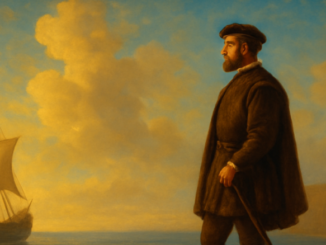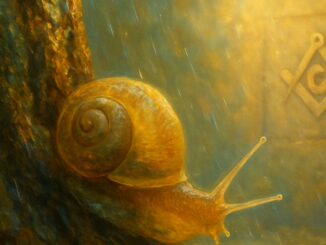
A camouflaged tree snail blending into wet bark in a tropical rainforest
Philosophy & Ethics

Invisible Tree Snails and Ethics: When Hiding Is Wisdom

Imagine walking through a tropical rainforest as the first drops of rain begin to fall. Everything around you shifts and transforms. And there, on a tree trunk barely an arm’s length away, a snail disappears right before your eyes — not by crawling away, but by changing color until it blends perfectly into the wet bark. Biologists recently announced the discovery of a new species of tree snail with exactly this ability. It sounds like magic, but it’s evolution. And it raises a question that sits at the very heart of Freemasonry: when is it ethically right to make yourself invisible? The Art of Disappearing The newly discovered species, found in the rainforests of Southeast Asia, possesses a remarkable adaptive ability. The moment raindrops touch its skin, specialized pigment cells activate, rendering the snail nearly invisible against the backdrop of wet bark. This isn’t a conscious decision on the snail’s part — it’s a finely tuned survival mechanism that has evolved over millions of years. Predators searching for an easy meal simply look right through it. What makes this discovery truly fascinating isn’t just its biological complexity. It’s the deeper question it raises about visibility and vulnerability. When do you […]

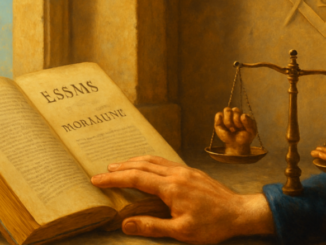
An open antique book with Masonic square and compasses in candlelight
Freemasonry & Connection

Montaigne on Intentions: The True Measure of Our Inner Work

It is late in the evening. A Freemason sits alone in his study, a yellowed book open before him. He reads a passage by a sixteenth-century French thinker and feels the words reaching across the centuries, as though they were written for him personally. The question that surfaces is at once simple and unsettling: not what he has done, but why he did it. In that moment, two traditions touch — separated by four hundred years, yet united in the same search for sincerity. The Heart of Montaigne‘s Essay In one of his brief but penetrating essays, Montaigne argues that our actions cannot be separated from the intentions behind them. The results of what we do may shine in the eyes of the world, but the true value lies in what moved us when we began. A good deed performed out of vanity carries a very different weight than the same act born of genuine compassion. Montaigne invites us to look beyond the surface — past the praise and criticism of others — into the quiet chamber of our own conscience. This is no idle thought experiment. Montaigne warns that we are remarkably skilled at deceiving ourselves. We construct noble […]

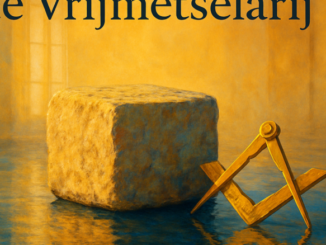
Rough ashlar stone symbolizing personal growth and resilience in Freemasonry
Personal Development & Leadership

Chance and Vulnerability: Two Perspectives on Fate

A man falls asleep in his tent on a beach in the Netherlands. Morning approaches, the sea murmurs, and life seems peaceful. Then the unthinkable happens: a maintenance tractor drives over his tent. The news is shocking — not just for its tragedy, but for what it reveals about the fragility of human existence. How do we process such random events? And does it matter whether we have spent time consciously examining our own character? Two worldviews, two perspectives on the same brutal reality. The Outsider: Chance as Chaos For many people, an accident like this simply confirms the randomness of life. The world is unpredictable, even dangerous, and we are at the mercy of forces beyond our control. This response is deeply human and entirely understandable. We look for someone to blame, for explanations, for ways to reassure ourselves that something like this could never happen to us. The outsider — here meaning someone unaccustomed to systematic self-reflection — tends to experience fate as something purely external. It is something that happens to you, something you react to, but over which you have little influence. Personality is seen as more or less fixed: you are who you are, and […]

Stone fortress wall symbolizing Masonic steadfastness and inner strength
Freemasonry & Connection

When Your Walls Fall: Montaigne and the Art of Steadfastness

Imagine you’re under pressure. Maybe it’s a conflict at work, a fracture in a friendship, or a season when everything seems to be crumbling around you. You feel besieged — surrounded by circumstances you can’t fully control. In moments like these, a single question emerges: how do you stand your ground without losing yourself? Michel de Montaigne, the sixteenth-century philosopher, wrestled with exactly this question in his short but powerful essay on the commander of a besieged fortress. His reflections offer surprisingly practical guidance for anyone seeking steadfastness and human connection in times of adversity. The Heart of the Dilemma In this essay, Montaigne describes a situation that appears military on the surface but is universal at its core. A commander of a besieged fortress must choose: when do you negotiate, when do you hold firm, and when do you yield? It’s not just about walls of stone — it’s about the inner walls we build when we feel threatened. The philosopher asks what honor, courage, and wisdom truly mean when the pressure becomes unbearable. You may never have commanded a garrison, but you’ve almost certainly faced your own version of this dilemma. Think of a moment when you had […]

Symbolic image of hands connecting across time representing Masonic brotherhood
Freemasonry & Connection

Montaigne on Connection: When Our Soul Reaches Beyond

An old man sits in silence beside the bed of his dying friend. No words remain — only the warmth of a hand resting upon a hand. And yet he feels something within himself reaching beyond this moment, beyond this room, beyond his own boundaries. It is precisely this mystery that the sixteenth-century philosopher Michel de Montaigne sought to understand: how our emotions can transcend our bodies and our time, and what that reveals about the nature of human connection. The Question Montaigne Asked In his essay Whether Our Emotions Carry Themselves Beyond Us, Montaigne examines a riddle that every thoughtful person has encountered at some point. Why do we worry about what will happen after we die? Why do we feel sorrow now for future losses, or joy for events we will never live to witness? It seems irrational, yet it is profoundly human. Montaigne suggests that the soul is not imprisoned within the boundaries of the body or a single lifespan. It extends outward — toward others, toward the future, toward ideals larger than ourselves. This insight touches a fundamental truth about human existence: we are not isolated islands. Our emotions, our worries, and our dreams weave themselves […]

Freemason in contemplation with square and compasses symbolizing mindfulness
Spiritual Traditions

Mindfulness in Freemasonry: The Art of Inner Awareness

In a world dominated by speed and distraction, mindfulness offers a powerful counterbalance. While Freemasonry doesn’t explicitly label it as such, mindfulness plays a crucial role in the practice of rituals, symbolism, and reflection within the Craft. It invites Freemasons to be fully present in the moment and to consciously work on the rough ashlar of their character. Mindfulness in Masonic Rituals One of the most striking aspects of Freemasonry is its use of ritual. Masonic rituals are carefully designed to draw Brethren out of their daily routines and guide them into a concentrated, almost meditative state of mind. The tracing board at the center of the lodge, the checkered floor, and the lesser lights all symbolize a balance between opposing forces — light and darkness, good and evil. Freemasons are encouraged to seek this balance not only in the world around them but also within themselves. This is the very essence of mindfulness: awareness of one’s inner processes and the pursuit of harmony. Symbolism as a Guide to Awareness Freemasons work on themselves through the language of symbolism. The square and compasses remind us of measure and justice, while the rough ashlar represents the ongoing journey of personal refinement. […]

Vrijmetselarij - Montaigne over moed en menselijkheid
Michel de Montaigne

Montaigne on Courage and Humanity

In the opening chapter of his Essays, Michel de Montaigne immediately shows what kind of thinker he is. He offers no rules, no instructions, and no moral conclusions. He observes. He compares. And he invites the reader to think for themselves. His central idea is simple, yet unsettling: completely different attitudes can sometimes lead to the same outcome. Humility may work. Fearless courage may also work. But just as often, neither does. With that, Montaigne sets the tone. Anyone looking for fixed answers will not find them here. No fixed formula for right action Montaigne describes situations in which people seek mercy from a victor. Sometimes by pleading and submitting. Sometimes by standing firm and refusing to show weakness. At times this evokes compassion. At other times, respect. And sometimes it provokes even greater cruelty. His point is clear: human behavior cannot be reduced to rules. What moves one person may irritate another. What inspires admiration today may provoke jealousy tomorrow. For those interested in Freemasonry, this feels familiar. Freemasonry does not promise ready-made answers but teaches how to deal with complexity. Not by judging, but by understanding. Compassion and admiration One of the most striking moments is Montaigne’s honesty […]

Vrijmetselarij - Poetry Evening: Who Am I?
Reflection

Poetry Evening: Who Am I?

Who am I? The gatherings after my initiation have been quite unique, not in any way standard. This is the second evening, dedicated to Poetry. A brother previously introduced the Poetry evening, focusing on poetry with a Masonic meaning. I was tasked with selecting a poem that holds personal significance and can be interpreted Masonically. The chosen poem is: Who Am I? This is quite challenging, being only two weeks into my apprenticeship. Nonetheless, I have made an effort and presented the following. Please note that certain parts have been abbreviated to avoid revealing aspects of the Initiation ritual, preserving the experience for future Freemasons. Presentation: Who Am I? Worshipful Master, Esteemed Brothers,Two weeks ago, I was initiated as an Apprentice. A new world is unfolding before me. I have been asked to recite a poem and provide a Masonic interpretation.Worshipful Master, Esteemed Brothers, I am not yet able to offer a Masonic interpretation, given my brief time as an Apprentice. I hope for your understanding. However, I can explain why I chose this poem. The initiation left a profound impression on me, and I am processing these experiences daily. The chamber of reflection made a significant impact. Sitting alone, […]