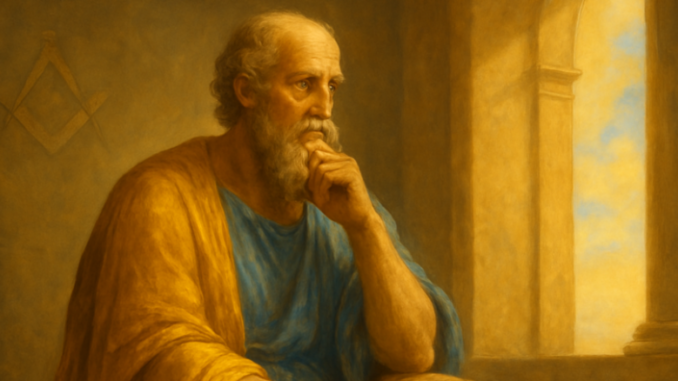
What does it truly mean to be temperate? And why does this concept seem so elusive, even to the sharpest minds? In Plato’s dialogue Charmides, Socrates and his interlocutors wrestle with precisely this question. The answer they seek turns out to be remarkably close to the heart of Masonic values: self-knowledge, inner balance, and the honest acknowledgment of what we do and do not know.
What Is Temperance, Really?
In the Charmides, Socrates meets the young Charmides, a man praised for both his beauty and his composed character. Socrates poses what seems like a straightforward question: what is temperance? But the answers that follow reveal just how complex this concept truly is.
Charmides offers his first attempt: temperance is acting calmly and deliberately. But does that mean a quick, sharp mind is inherently intemperate? Surely not. Then perhaps temperance is a sense of modesty or shame? That, too, proves insufficient — shame can lead to both good and bad outcomes.
Critias, the older cousin of Charmides, enters the conversation with a deeper suggestion: temperance is knowing yourself. This echoes the famous inscription at the Oracle of Delphi — “Know thyself.” Yet even this definition does not fully withstand the Socratic method. What does it actually mean to know yourself? And how does self-knowledge relate to knowledge of other things?
Why Does the Dialogue End Without a Definitive Answer?
Perhaps the most fascinating aspect of the Charmides is that the dialogue ends in what philosophers call aporia — a state of perplexity or impasse. Socrates and his companions never arrive at a definitive definition of temperance. Is this a failure? Quite the opposite.
Plato shows us that the search itself has value. The willingness to honestly admit that you do not fully understand something is, paradoxically, an expression of temperance. You know what you do not know. True temperance begins where the illusion of omniscience ends — in the honest recognition of the limits of your own knowledge.
How Does This Resonate With Masonic Values?
Freemasonry has a rich tradition of self-reflection and inner growth. When a candidate first enters the lodge, he is asked to leave his prejudices and certainties behind. This ritual process mirrors exactly what Socrates demonstrates in the Charmides: the willingness to examine your own assumptions and, when necessary, let them go. The Masonic pursuit of light and knowledge is not a matter of collecting facts — it is an ongoing exercise in intellectual and moral humility.
The virtue of temperance, as Plato explores it, aligns seamlessly with the Masonic concept of inner measure. A Freemason strives for balance: not too much, not too little. The square and compasses, central symbols in Freemasonry, remind every Brother to keep his passions in check and to measure his actions against reason and justice. Temperance is the inner compass that makes this calibration possible.
What Can We Learn From the Socratic Method?
The Socratic method — the art of asking questions to arrive at deeper understanding — is closely akin to the way Freemasons engage with one another. In the lodge, knowledge is not handed down from above; it is explored collectively. Brothers are invited to test their own thoughts against those of others, not to win an argument, but to draw closer to truth together.
This requires courage — the courage to admit that you might be wrong, that your understanding is incomplete. Socrates himself embodies this attitude. He claims no wisdom, yet pursues it tirelessly. His conversation with Charmides and Critias is not a power struggle but a shared exploration. This ideal of fraternal dialogue, where hierarchy gives way to mutual respect and collective inquiry, lies at the heart of both Plato’s philosophy and the Masonic tradition.
Why Does Temperance Remain So Relevant?
In a world filled with snap judgments and loud convictions, temperance offers a counterweight. It asks us to pause before we act, to listen before we speak, to reflect before we judge. For Freemasons, this is not an abstract virtue — it is a daily practice. Every ritual, every meeting, every conversation with a Brother is an exercise in being temperate.
Consider the core elements that connect Plato’s exploration to the Masonic path:
- Self-knowledge — the foundation of all wisdom
- Intellectual humility — knowing what you do not know
- Inner balance — finding equilibrium between extremes
- Fraternal dialogue — seeking truth together
The Charmides ends without a definitive answer, but it offers something far more valuable: an invitation to continue the conversation. This is precisely what Freemasonry offers its members — not dogmas, but a path. A path of continual self-improvement, guided by the ancient wisdom that true knowledge begins with knowing yourself.
Plato’s Charmides teaches us that temperance is not a destination but an ongoing journey. It is the virtue that enables us to look at ourselves honestly, to acknowledge our limitations, and yet to keep searching. For Freemasons, this is familiar ground. The lodge is not a school where answers are dispensed — it is a workshop where questions are raised. In that spirit, the Charmides invites us to keep the conversation about virtue and self-knowledge alive, with our Brothers and with ourselves.
Copyright text & image: devrijmetselaar.nl
Texts are based on the ideas and content of the author of devrijmetselaar.nl, reviewed, corrected, and supplemented with the assistance of OpenAI. Images are created based on the ideas of the author of devrijmetselaar.nl using OpenAI/DALL-E.
Frequently Asked Questions
What is temperance according to Plato's Charmides?
In Plato's dialogue, Socrates and his interlocutors explore various definitions of temperance, including acting calmly and deliberately, possessing modesty, and knowing oneself. However, the dialogue never arrives at a single definitive answer. Instead, Plato demonstrates that true temperance involves the honest acknowledgment of the limits of one's knowledge and the willingness to admit what you do not understand.
Why does the Charmides dialogue end without a clear definition of temperance?
The dialogue ends in aporia, a state of philosophical perplexity, but this is not considered a failure. Rather, Plato shows that the search for understanding itself has value. The willingness to honestly admit that you do not fully understand something—to know what you do not know—is paradoxically an expression of temperance itself. True temperance begins where the illusion of omniscience ends.
How does the philosophy in Charmides connect to Freemasonry?
The Masonic pursuit of self-reflection and inner growth mirrors the process demonstrated in the Charmides. When candidates enter a lodge, they are asked to leave their prejudices and certainties behind, just as Socrates encourages his companions to examine their assumptions. Both traditions emphasize that the pursuit of light and knowledge is an ongoing exercise in self-examination rather than the mere collection of facts.


Be the first to comment