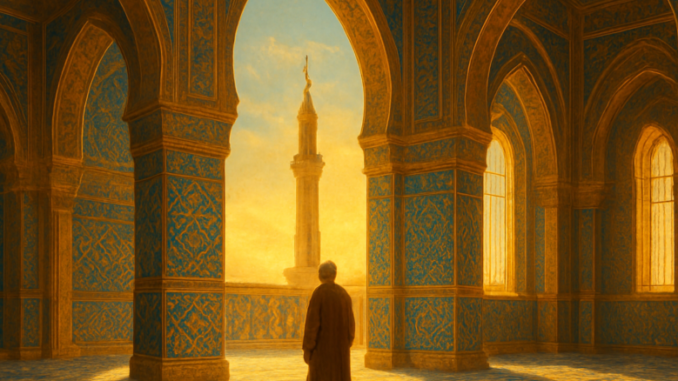
What does it truly mean to repent? Not as a fleeting pang of guilt, but as a profound inner turning that transforms your entire being? The ninth surah of the Quran, known as At-Tawbah — The Repentance — confronts the reader with precisely this question. Its themes of self-examination, broken promises, and the courageous return to one’s deepest values carry striking parallels with the spiritual journey at the heart of Freemasonry.
Why Does This Surah Break With Tradition?
The very first thing that sets At-Tawbah apart is its opening — or rather, the absence of one. It is the only surah in the entire Quran that does not begin with the customary invocation, “In the name of God, the Most Gracious, the Most Merciful.” Islamic scholars have debated this omission for centuries. Some believe the gravity of its content warrants the departure. Others view it as a continuation of the preceding surah. Whatever the explanation, the effect is immediate: the reader senses that something weighty is about to be discussed, something that tolerates no gentle preamble.
The surah was revealed during a turbulent period, shortly before the death of the Prophet Muhammad. It addresses loyalty, broken covenants, and the possibility of returning to a righteous path. The Arabic word tawba literally means “to return” or “to turn back.” Repentance, in this context, is not a passive feeling of regret but an active movement of the soul back toward its source.
What Can a Seventh-Century Text Teach the Modern Seeker?
It is fair to wonder what relevance an ancient scripture holds for contemporary life. The answer lies in the universality of its themes. Every person experiences moments of straying from their own values, of falling short in relation to themselves or others. The question is never whether you can return, but how. At-Tawbah teaches that sincere repentance is always possible — provided it is accompanied by a genuine change in behavior.
Repentance is not a moment of weakness but an act of courage: the conscious choice to face your own shadow and still move forward.
This idea resonates deeply with the Stoic philosopher Marcus Aurelius, who wrote in his Meditations that every new day offers the chance to begin again, to act in accordance with reason and virtue. Plato, too, emphasized self-knowledge as a prerequisite for moral improvement. The Quranic call to repentance fits seamlessly into this broader philosophical tradition of self-reflection — a tradition that also runs through the very core of Masonic thought.
Repentance and the Masonic Journey of Self-Improvement
At the heart of Freemasonry lies the inner journey. The Entered Apprentice is encouraged to work upon himself just as a stonemason works upon the rough ashlar. This inevitably requires acknowledging one’s own imperfections. Without that acknowledgment, no growth is possible. In a sense, every Lodge ritual is an invitation to a form of inner reckoning — a pause to reflect on who you are and who you might become.
Freemasonry does not prescribe a fixed doctrine of sin or guilt, but it does emphasize honesty with oneself. You cannot shape the rough stone if you refuse to see its flaws. This aligns closely with the Quranic message: repentance without honest self-confrontation is hollow. Only when you truly recognize where you have gone astray can you find the way back.
The symbolic tools of the Craft — the gavel, the square, the compasses — all point toward the same principle: deliberate, conscious refinement of character. Repentance, understood as tawba, is essentially the spiritual equivalent of picking up the gavel and returning to work on the stone you may have neglected.
Brotherhood, Broken Trust, and the Hard Work of Restoration
A striking aspect of At-Tawbah is its emphasis on community. Repentance is not merely a private matter between the individual and the Divine — it also concerns one’s relationships with others. Broken promises must be honored anew. Damaged trust must be painstakingly rebuilt. This is arduous work, but it is the only path toward genuine wholeness.
Freemasonry places enormous value on brotherhood and sisterhood. The bond between members is founded on mutual trust and candor. When that bond is damaged, restoration does not happen automatically. It demands from everyone involved the willingness to acknowledge mistakes and begin again. In this sense, brotherly repentance may be the most difficult — yet also the most valuable — form of inner reckoning.
Both traditions remind us that community is not built on the illusion of perfection. It is built on the shared commitment to honesty, accountability, and the courage to repair what has been broken.
Is Repentance a Sign of Weakness or of Strength?
This question strikes at the heart of many spiritual traditions. In a culture that celebrates self-assurance and success, admitting one’s faults can easily be perceived as weakness. But both the Quranic tradition and Masonic philosophy point in a different direction entirely. It takes courage to look your shortcomings in the eye. It takes character to draw real consequences from that encounter and to change your behavior accordingly.
The French essayist Michel de Montaigne wrote extensively about the human tendency toward self-deception. He insisted that true wisdom begins with recognizing one’s own ignorance and fallibility. Those who believe themselves perfect leave no room for growth. Those who show repentance open the door to genuine improvement.
Within the Lodge, this principle is embodied in the progression through degrees. Each degree invites the Mason to confront deeper layers of self-knowledge. The journey is never finished; the stone is never fully polished. And it is precisely this ongoing willingness to see oneself clearly — imperfections and all — that constitutes real strength.
Key Lessons From This Exploration
At-Tawbah is not a comfortable surah. It confronts the reader with uncomfortable truths about human shortcomings and the necessity of change. But therein lies its power. Repentance, understood as an active return to one’s deepest values, is not an endpoint but a new beginning — the first step on a path of continual refinement.
Several core insights emerge from this exploration. First, repentance is an active turning, not passive regret. Second, self-knowledge is a prerequisite for moral growth. Third, restoring brotherly bonds requires radical honesty. And fourth, courage stands at the very heart of sincere inner reckoning. These principles are shared across the Quranic tradition, Masonic philosophy, and the broader lineage of Western ethical thought.
For Freemasons and spiritual seekers alike, At-Tawbah offers a mirror — not to condemn yourself, but to know yourself. And in that knowledge lies the possibility of transformation. The ninth surah of the Quran invites a universal form of self-reflection that connects believers and non-believers, those who work the rough ashlar in the Masonic tradition and those who walk other paths of inner growth. The willingness to acknowledge your own shadow is the first step toward light. Repentance is never a final destination — it is the gateway to renewal.
Copyright text & image: devrijmetselaar.nl
Texts are based on the ideas and content of the author of devrijmetselaar.nl, reviewed, corrected, and supplemented with the assistance of OpenAI. Images are created based on the ideas of the author of devrijmetselaar.nl using OpenAI/DALL-E.
Frequently Asked Questions
What does repentance mean in the context of the Quran and Freemasonry?
Repentance, or 'tawba' in Arabic, means 'to return' or 'to turn back.' It is not a passive feeling of regret but an active movement of the soul back toward its source and one's deepest values. In both Quranic teaching and Freemasonry, repentance represents a profound inner transformation and a courageous act of self-examination, requiring genuine change in behavior rather than fleeting guilt.
Why does the Surah At-Tawbah begin differently from other surahs in the Quran?
At-Tawbah is the only surah that does not begin with the customary invocation, 'In the name of God, the Most Gracious, the Most Merciful.' Islamic scholars have debated this omission for centuries, with some believing the gravity of its content warrants the departure. This unusual opening signals to the reader that something weighty and serious is about to be discussed, requiring no gentle preamble.
How is the message of a seventh-century text relevant to modern seekers today?
The relevance lies in the universality of its themes. Every person experiences moments of straying from their own values and falling short in relation to themselves or others. At-Tawbah teaches that sincere repentance is always possible, and this message aligns with broader philosophical traditions from Stoicism to Plato, all emphasizing self-reflection, self-knowledge, and the continuous opportunity for moral improvement.



Be the first to comment