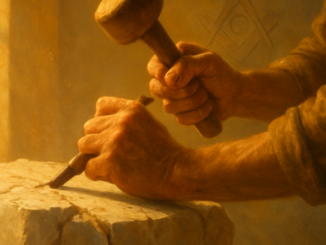
Rough ashlar stone in a Masonic lodge symbolizing self-improvement and anger control
Freemasonry & Society

Revenge and Forgiveness: What Freemasons Learn from Anger

In a quiet lodge, a man sits with his head bowed. His hands are still trembling from a conflict that nearly pushed him to the edge that afternoon. Around him, brothers stand in silence — waiting, listening. No one judges, no one rushes. Slowly, he finds the words he couldn’t find outside. This is the moment when anger makes room for something else. When Anger Takes Over A recent news story from Belgium shocked many: a fired dentist deliberately drove his Porsche into his former practice. It was an act of pure destruction, born from deep hurt and uncontrollable rage. Fortunately, no one was killed, but the damage — both material and human — was immense. Events like these raise uncomfortable questions. How does someone reach that breaking point? And more importantly, what could have been done to prevent it? In today’s society, anger seems to dominate more and more. Social media amplifies outrage, conflicts escalate faster than ever, and a pervasive sense of powerlessness drives people to desperate acts. The dentist who used his car as a weapon is not a monster from another world. He is the product of a society that offers too little space for processing […]


Rough ashlar stone symbolizing forgiveness and inner transformation in Freemasonry
Islam

Forgiveness as a Spiritual Building Block in Freemasonry

In the year 622 CE, a small community of believers fled from Mecca to Medina. This hijra, or emigration, marked not only the beginning of a new calendar but also a turning point in the history of forgiveness as a spiritual concept. Among the surahs revealed during this period, we find Ghafir — literally, The Forgiver. This fortieth chapter of the Quran bears a name that points directly to one of the most fundamental qualities humanity has ever attributed to the divine: the capacity to forgive. For Freemasons, who strive toward moral refinement and inner transformation, this ancient text offers surprisingly rich insights. A Name with Ancient Roots The surah takes its name from the third verse, in which the divine attribute of forgiveness takes center stage. In early Islamic tradition, surahs were often named after a striking word or theme in their opening verses. Ghafir, in Arabic, means “the one who covers” or “the one who removes” — a reference to the removal of sins. This etymology resonates with older Semitic traditions in which forgiveness was understood as a form of spiritual purification. The fortieth surah belongs to the so-called Meccan revelations and was revealed during a time of […]

Ancient open book with light symbolizing forgiveness in Freemasonry and the Quran
Islam

Forgiveness in the Quran and Freemasonry: Surah Ghafir

In 1143, the English scholar Robert of Ketton completed the first Latin translation of the Quran, commissioned by Peter the Venerable, Abbot of Cluny. This monumental work opened a window for medieval Europe onto a rich spiritual tradition that had remained largely unknown. Among the surahs that resonated in Latin for the first time was the fortieth: Ghafir — meaning “The Forgiver” or “The One Who Pardons.” Nearly nine centuries later, this surah still invites us to reflect on one of the most universal spiritual principles: forgiveness as a path to inner liberation. The Historical Context of Surah Ghafir Surah Ghafir belongs to the Meccan revelations, meaning it dates from the early period of the prophetic mission, before the migration to Medina in 622 CE. During this turbulent era, the young Muslim community was a small minority surrounded by hostility. The message of this surah addressed the fundamental question that occupies every searching mind: how does the human being relate to the divine, and which qualities make that connection possible? The title “The Forgiver” refers directly to the opening verses, in which God’s forgiveness and mercy are proclaimed. In the Arabic tradition, “al-Ghafir” is one of the ninety-nine beautiful names […]

Ancient letter symbolizing forgiveness and Masonic brotherhood
Christianity

The Epistle to Philemon: Symbolism of Forgiveness & Brotherhood

A letter of just 25 verses, written on a papyrus scroll small enough to hold in one hand. Yet this tiny document contains one of the most profound lessons on human dignity and reconciliation in all of biblical literature. Paul’s Epistle to Philemon tells the story of a runaway slave, a creditor, and a mediator. But look deeper, and you’ll discover a symbolic edifice that touches the very heart of what it means to live together as brothers. A Chain and an Embrace Consider two images side by side. The first: a man in chains, imprisoned in Rome, writing by the flickering light of an oil lamp. The second: that same man welcoming a runaway slave named Onesimus — not as an inferior, but embracing him as a beloved brother. The entire symbolism of the Epistle to Philemon lies in the tension between these two images. The physical chains of the prisoner are transformed into a spiritual bond of equality. Paul of Tarsus likely wrote this letter around the year 60 AD, during his Roman imprisonment. Onesimus, the runaway slave of the wealthy Philemon, had found his way to Paul and undergone a profound conversion. Now Paul sends him back […]