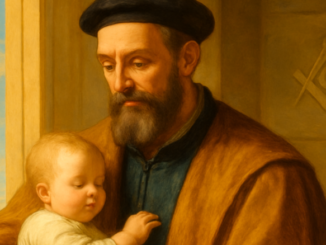
Montaigne on Fatherly Affection and the Masonic Ideal
What does it truly mean to be a father — not merely in the biological sense, but as a spiritual creator? In the eighth essay of the second book of his famous Essays, Michel de Montaigne tackles a question that is both deeply personal and universally human: why do fathers love their children, and is that love always returned? Going far beyond sentimentality, Montaigne explores the hidden forces behind parental attachment and draws a striking comparison between two forms of fatherhood — the physical and the intellectual. It is a comparison that resonates powerfully within Freemasonry, where the question of what a person truly leaves behind lies at the heart of the Craft. Love as a Natural Impulse Montaigne opens his essay with the proposition that parental affection is one of the most natural feelings a human being can experience. He regards it as a universal given, woven into human nature and observable even in the animal kingdom. Yet Montaigne is no romantic. He asks whether this affection is always reasonable, whether it sometimes degenerates into blind adoration, and whether fathers truly know their children or merely see a projection of themselves. The essay is dedicated to Madame d’Estissac, a […]