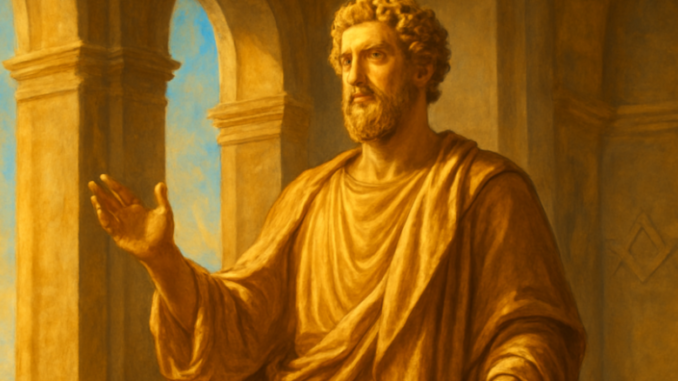
A candle flickers as a Freemason sits in silence after the evening’s labor. In his hands rests a worn copy of the Meditations. He reads a passage from Book VII — about people who do harm without realizing it — and recognizes something familiar, something discussed in lodge: how do you respond to injustice without losing your own inner balance? Marcus Aurelius, the Roman emperor-philosopher who lived nearly nineteen centuries ago, turns out to be remarkably relevant for anyone seeking moral clarity.
The Heart of Book VII: Justice in the Face of Evil
In the seventh book of his Meditations, Marcus Aurelius wrestles with a question that occupies every thoughtful person: how should you respond to those who do wrong? The emperor, who dealt daily with intrigue, betrayal, and human weakness, chose an unexpected path. Rather than anger or retaliation, he advocated understanding. Not because wrongdoing should be condoned, but because anger damages one’s own soul.
Marcus Aurelius writes that those who do evil act out of ignorance about what is truly good. This idea, which traces back to Socrates and Plato, forms the backbone of his approach. Evil is not a deliberate choice of wrong over right, but a mistake made by someone who cannot see the good. From this perspective, compassion becomes more fitting than revenge.
The Freemason and the Rough Ashlar
For Freemasons, this philosophy resonates directly with the symbol of the rough ashlar. Every person enters the world as unworked material, full of imperfections and rough edges. The Freemason’s labor consists of continually refining that stone — working on personal virtue and character. Marcus Aurelius’ insight that wrongdoers act out of ignorance fits seamlessly here: they simply have not yet worked their stone, or have lost their way in the process.
This perspective frees us from the impulse to judge. In the lodge, the Freemason learns that he does not stand above his brethren, but beside them. Everyone struggles with their own demons, their own blind spots. The question is not who has made the most progress, but whether each person is willing to continue the work.
Justice Without Vengeance
Marcus Aurelius draws a crucial distinction that is also alive within Freemasonry: justice is not the same as retribution. Acting justly means doing what is right because it is right — not to punish others or to avenge yourself. The Stoic philosopher repeatedly warns that anger and vindictiveness poison one’s own soul, regardless of what the other person may deserve.
True justice asks that we do good for the sake of good itself, not as a reaction to the wrongs of others.
In Masonic terms, this translates into the pursuit of moral perfection as an end in itself. The square and compasses remind every brother that his actions must be upright and within proper bounds — not because the outside world demands it, but because inner integrity lies at the very heart of the Masonic ideal.
Brotherhood and Forgiveness
One of the most challenging passages in Book VII concerns forgiving those who wrong us. Marcus Aurelius encourages us to remember that we ourselves also make mistakes, that we are all part of the same human fabric. This thought echoes through the Masonic commitment to brotherly love — the recognition that every person, despite their flaws, is part of the great work of building a better world.
The lodge provides a practice space for this attitude. Brothers from different backgrounds, with different opinions and temperaments, come together. Friction is inevitable. But Masonic tradition teaches that growth becomes possible precisely through that friction — provided one is willing to look beyond the first impulse of irritation. Marcus Aurelius would likely have felt at home in a lodge.
The Search for Inner Light
Central to both the Meditations and Freemasonry is the search for light and knowledge. For the Stoic, this is the light of reason — the ability to see clearly what is truly of value. For the Freemason, light symbolizes the triumph over ignorance and the ongoing journey toward wisdom. In both traditions, this light is not a destination but a direction, a compass for daily conduct.
Several shared principles emerge when we place these traditions side by side: self-reflection as a daily practice, virtue as a personal responsibility, brotherhood despite human shortcomings, and justice without bitterness. These are not abstract ideals — they are practical commitments that shape how a person moves through the world.
Marcus Aurelius ended many of his meditations with a reminder of impermanence. Everything passes — fame, wealth, even injustice. What remains is the quality of one’s own soul, the question of whether one has lived in accordance with the highest values. For the Freemason, this translates into the question that lingers after every lodge evening: did I contribute something to the building today?
What Marcus Aurelius Teaches Us Today
The relevance of Book VII lies not in abstract philosophy but in the practical art of living. In a world full of outrage and division, Marcus Aurelius offers an alternative: the choice not to be dragged along by other people’s mistakes. This is not passivity or indifference — it is an active choice for inner freedom. The Freemason recognizes in this the core of his own pursuit: to change the world not through force, but through example.
The Meditations of Marcus Aurelius and Freemasonry share a fundamental conviction: that human beings are capable of improving themselves, and that virtue is not a side matter but the very core of a meaningful life. Book VII reminds us that justice begins with ourselves, that understanding is more powerful than anger, and that the true battle is not fought against others but within our own hearts.
For those who seek a connection between ancient wisdom and living tradition, this meeting point between Stoicism and Freemasonry offers rich material for reflection. The rough ashlar awaits the chisel. The candle still burns. And the work — as Marcus Aurelius knew and every Freemason affirms — is never finished.
Copyright text & image: devrijmetselaar.nl
Texts are based on the ideas and content of the author of devrijmetselaar.nl, reviewed, corrected, and supplemented with the assistance of OpenAI. Images are created based on the ideas of the author of devrijmetselaar.nl using OpenAI/DALL-E.

Be the first to comment