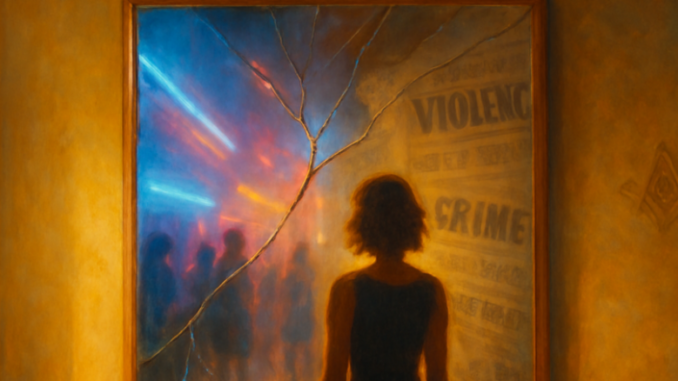
A middle-aged man sits at his kitchen table, shaking his head at yet another news report about a drug-related killing. ‘Terrible,’ he mutters over his morning coffee. That same evening, at a party, he accepts a pill from a friend without a second thought. The moment of moral reflection has vanished like mist in the sun. This everyday scene touches on a profound question that philosophers and spiritual traditions have posed for centuries: how can we truly know ourselves — and what do we do with that knowledge?
The Modern Moral Contradiction
Many Western societies find themselves in a peculiar moral split. On one hand, there is genuine horror at the violence fueled by the drug trade — assassinations, threats against journalists, lawyers murdered in broad daylight. These events shake our collective conscience. On the other hand, recreational drug use is deeply woven into weekend culture. This contradiction raises a fundamental question: how do we relate to our own role in the larger picture?
It is easy to point the finger at criminal organizations, at failed policy, at someone else. It is far more difficult to turn the mirror toward ourselves. And it is precisely in that movement — the courage to look at our own shadow side — that we find a spiritual challenge that Freemasonry has placed at its center for centuries.
Know Thyself: The Oldest Wisdom
Above the entrance to the Temple of Apollo at Delphi stood the famous words Gnothi seauton — know thyself. This maxim, which Socrates adopted as his life’s motto, also forms a cornerstone of Masonic work. In the lodge, the Brother is continually invited to examine his own thoughts, motives, and actions. Not to condemn himself, but to grow in awareness.
The philosopher Plato described in his dialogues how human beings are often trapped in a cave of illusions, convinced of their own righteousness while seeing nothing but shadows. It takes courage to leave the cave and step toward the light. That courage begins with the willingness to face our own contradictions.
Spiritual growth begins where pointing at others ends and the honest conversation with oneself begins.
The Rough Stone and the Invisible Connection
In Freemasonry, the Entered Apprentice works on the “rough ashlar” — a symbol of the imperfect self that can be refined through labor and reflection. This work is not a theoretical exercise; it demands concrete application in daily life. The question “Am I contributing to good or to harm?” is not abstract — it touches every choice we make.
That pill at a party may seem like a harmless individual choice. But the Freemason is trained to look further, to trace the invisible lines that connect actions to consequences. Johann Wolfgang von Goethe, himself a Freemason and one of the great minds of the Enlightenment, wrote about the importance of taking responsibility for the whole — not merely for one’s own comfort.
Every individual act, however small it may appear, sends ripples through a vast and interconnected web. The rough ashlar reminds us that we are always works in progress, and that honest self-assessment is the chisel with which we shape ourselves.
No Condemnation, But Awareness
It would be a misunderstanding to think that Freemasonry wags a moralistic finger. The tradition holds no dogmas about what is or is not permitted. What it does offer is a method of self-examination — a space in which difficult questions can be asked without rushing to judgment. The lodge is a workshop, not a courtroom.
The Roman philosopher Seneca wrote to his friend Lucilius that wisdom begins with acknowledging one’s own weaknesses. Not to punish oneself, but to grow from that honest starting point. This idea resonates powerfully with the societal paradox surrounding drug use: it is not about guilt, but about consciousness.
Freemasonry encourages its members to sit with discomfort rather than explain it away. The tension between what we believe and how we behave is not something to be resolved quickly — it is something to be explored deeply, with patience and humility.
The Question That Lingers
Spirituality, as understood in the Masonic tradition, is not an escape from the world but a deeper engagement with it. It demands the courage to ask uncomfortable questions. What does it mean when I feel revulsion at violence, yet simultaneously sustain a chain that feeds that violence? How does my individual pleasure relate to collective suffering?
These are not questions with simple answers. Freemasonry does not pretend to have those answers either. What it does offer is a tradition of shared reflection, in which Brothers help each other dig deeper, look further, and become more honest — first and foremost with themselves.
The core principles at work here are worth stating plainly: self-knowledge as the foundation of moral action; the courage to acknowledge one’s own contradictions; seeing the connection between individual choices and collective consequences; and reflection without condemnation — growth without dogma.
An Invitation to Inner Work
The next time the news confronts us with the darker sides of society, we can choose not to look only outward. The Masonic tradition invites a parallel movement: turning our gaze inward. Not out of self-punishment, but out of a desire for authenticity. For only those who truly know themselves can contribute to a world in which fewer shadows hold sway.
The tension between public outrage and private behavior is not unique to the drug trade — it is a universal human theme. Freemasonry offers no ready-made solutions, but it does offer a centuries-old method for engaging with such paradoxes. Through the work on the rough ashlar, through the ongoing conversation with ourselves and with our Brothers, a clearer vision slowly emerges — of who we are and who we aspire to become.
In this spiritual labor may lie the key to a society in which we no longer speak with two voices. The rough stone will never become perfectly smooth, but it is in the honest, persistent effort of shaping it that we find meaning — and perhaps, in time, a greater coherence between what we say we believe and how we actually live.
Copyright text & image: devrijmetselaar.nl
Texts are based on the ideas and content of the author of devrijmetselaar.nl, reviewed, corrected, and supplemented with the assistance of OpenAI. Images are created based on the ideas of the author of devrijmetselaar.nl using OpenAI/DALL-E.
Frequently Asked Questions
What is the main moral contradiction the article highlights about drug violence and recreational drug use?
The article points out that Western societies express genuine horror at drug-related violence and organized crime, yet many of the same people casually use recreational drugs on weekends. This contradiction reveals a disconnect between condemning the drug trade's violence while personally participating in drug consumption, raising questions about our complicity in a larger system.
How does Freemasonry address the challenge of self-knowledge mentioned in the article?
Freemasonry places the ancient maxim 'Know Thyself' (Gnothi seauton) at its center, inviting members to examine their own thoughts, motives, and actions through lodge work. This practice encourages Masons to look at their own 'shadow side' and contradictions rather than simply pointing fingers at others, viewing self-examination as essential to spiritual growth.
What does the 'rough ashlar' symbolize in Freemasonry, and how does it relate to the article's message?
The rough ashlar represents the imperfect self that can be refined through labor and reflection. In the context of this article, it symbolizes the ongoing work of personal refinement and the need to ask concrete questions about one's own actions in daily life, such as 'Am I contributing to good or to harm?' rather than treating self-improvement as merely theoretical.

Be the first to comment