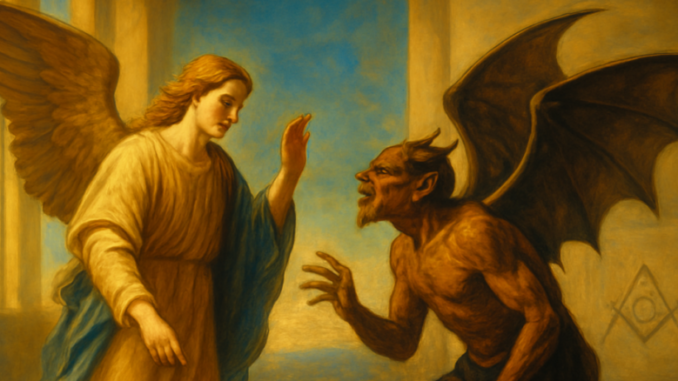
You’ve read the thriller or watched the film. The suspense, the mysterious symbols, the secret societies. Dan Brown’s bestseller Angels & Demons has captivated millions of readers with tales of the Illuminati and their alleged war against the Catholic Church. But how much of that symbolism is actually real? And what do Freemasons have to do with any of it? If you’ve ever wondered where the line falls between gripping fiction and historical fact, this article offers practical tools to help you tell the difference for yourself.
What Are Ambigrams — and Why Are They So Fascinating?
In Angels & Demons, ambigrams play a central role. These are words or designs that can be read from multiple orientations — most commonly, they look the same when turned upside down. In the novel, branding irons featuring this property are presented as ancient Illuminati symbols. The fascinating thing about ambigrams is that they do exist as an art form, but they are modern typographic creations from the twentieth century, not relics of a bygone era.
The ambigrams in the book were specially designed for the novel by a contemporary graphic artist named John Langdon (whose surname, not coincidentally, Brown borrowed for his protagonist). They are not historical artifacts — they are artworks crafted to heighten the story’s tension.
This immediately raises a practical question: how do you tell when a symbol is genuinely historical and when it’s a modern invention? A solid rule of thumb is to always verify the source. Authentic historical symbols can be traced through museum collections, academic publications, and archived records. If a symbol only appears in fiction or on the internet without a verifiable origin, caution is warranted.
The Historical Illuminati: Fact Versus Fiction
The real Order of the Illuminati was founded in 1776 in Bavaria by Adam Weishaupt, a professor of law. The order pursued Enlightenment ideals — rationalism, the fight against superstition, and opposition to the unjust exercise of power. These goals were very much in step with the broader Enlightenment movement that included thinkers like Voltaire and Immanuel Kant.
The Illuminati did use symbolism, but it consisted primarily of classical emblems such as the Owl of Minerva — the Roman goddess of wisdom — and geometric forms representing knowledge and reason. There were no sinister branding irons, no ambigrams, and no grand conspiracies against the Vatican.
After just ten years, the order was banned by the Bavarian government. There is no credible historical evidence that the Illuminati have continued to exist as an organization since then. The spectacular symbols and rituals Dan Brown describes in Angels & Demons are literary inventions, not historical documentation. This isn’t a criticism of the book as a work of art — but it is an essential distinction for anyone who wants to understand what actually happened.
Freemasonry and the Illuminati: A Common Confusion
One of the most persistent misconceptions is that the Illuminati and Freemasonry are the same organization, or that one grew out of the other. While it’s true that Adam Weishaupt joined a Masonic lodge and recruited some of its members into his order, they are two distinct organizations with different goals and structures.
Freemasonry is not a secret society with hidden agendas. It is a fraternity that places personal development and ethical conduct at its core, open to people of all beliefs. Freemasons use symbolism as a teaching tool for moral and philosophical reflection. The square and compasses, the rough and smooth ashlar, the Temple of Solomon — these symbols invite contemplation about virtue, self-improvement, and brotherhood. They are not secret codes for wielding power, but instruments for inner work.
This differs fundamentally from how secret societies are portrayed in thrillers. Where fiction needs villains and conspiracies, real Masonic symbolism is designed to encourage questions and self-examination — something far less dramatic but infinitely more meaningful.
Practical Symbol Literacy: How to Tell Fact from Fiction
As a reader or viewer, you can take several concrete steps to separate fiction from reality whenever you encounter symbols linked to Freemasonry or other societies:
Look for academic sources. University publications, historical archives, and recognized museums offer reliable information. If a claim can’t be verified through any of these channels, treat it with skepticism.
Check the dating. Many supposedly ancient symbols turn out, upon closer inspection, to be modern creations. The ambigrams in Angels & Demons are a textbook example.
Ask the source directly. Masonic lodges are generally willing to answer questions about their symbolism and history. Transparency is far more common in Freemasonry than popular culture would have you believe.
Be skeptical of sensational claims. If something sounds too thrilling to be true, it usually is. Extraordinary claims require extraordinary evidence — a principle that both the Enlightenment and Freemasonry hold dear.
This approach doesn’t just help you evaluate thriller plots. It also serves as a compass for navigating the many online theories about secret societies. Critical thinking is ultimately a skill that both the Enlightenment tradition and Freemasonry champion.
Why Fiction Still Has Value
None of this means that Angels & Demons has no value. Good fiction sparks curiosity, and curiosity is the first step toward knowledge. Many people have gone on to explore real history, symbolism, and philosophy because Dan Brown’s novels piqued their interest. The key is to use that curiosity as a starting point for further inquiry — not as an endpoint.
Within Freemasonry itself, symbolism is never presented as literal truth. It is offered as an invitation to reflect. A symbol is a door, not a wall. It invites you to ask questions, not to accept answers blindly. In that sense, even fictionalized symbols can serve a purpose: they remind us that meaning doesn’t reside in the symbol itself, but in the interpretation we bring to it.
The ambigrams and Illuminati storylines in Angels & Demons are masterful literary inventions — not historical documents. The real Illuminati were a short-lived Enlightenment movement, and Freemasonry is an entirely separate organization with a rich tradition of moral and philosophical reflection. By thinking critically about sources and symbolism, you can draw the line between thrilling fiction and historical truth for yourself. And in doing so, you practice the very skill that both the Enlightenment and Freemasonry value above almost all others: the willingness to question, to seek, and to understand.
Copyright text & image: devrijmetselaar.nl
Texts are based on the ideas and content of the author of devrijmetselaar.nl, reviewed, corrected, and supplemented with the assistance of OpenAI. Images are created based on the ideas of the author of devrijmetselaar.nl using OpenAI/DALL-E.

Be the first to comment