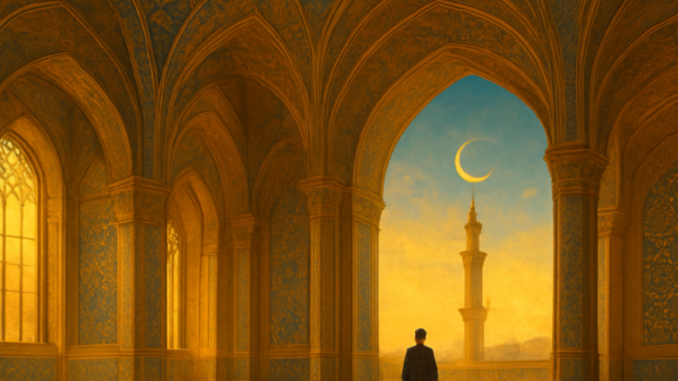
What if thunder is not merely a meteorological event, but a voice speaking to those willing to listen? The thirteenth chapter of the Quran, known as Ar-Ra’d — The Thunder — presents us with a paradox that strikes at the heart of every spiritual quest: how can something that instills fear simultaneously be a sign of grace? This question resonates deeply within Masonic philosophy, where confronting our deepest uncertainties is often the very first step toward genuine insight.
A Paradox as a Point of Departure
The Thunder opens with a powerful assertion: the cosmic phenomena surrounding us are not random occurrences, but signs for those who reflect. The thunder rolling across the sky, the lightning illuminating the night, the rain awakening barren earth — according to this Quranic chapter, all of these are invitations to contemplation. But here the paradox emerges: the same thunder that commands awe also inspires fear. The same force that destroys also brings life.
This ambiguity is not a contradiction to be resolved, but a wisdom to be embraced. The Freemason recognizes this pattern immediately. In the lodge, the candidate is confronted with darkness before light is bestowed. The rough stone must be shaped with tools that could just as easily destroy as form. It is precisely this tension between opposites that makes growth possible.
Thunder as an Inner Calling
In Ar-Ra’d, we read how the thunder expresses praise of the divine, alongside the angels who stand in awe. It is a striking image: a force of nature that does not merely exist, but actively participates in a cosmic harmony. For the modern reader, accustomed to meteorological explanations, this may sound strange. But what if we read this not literally, but as a metaphor for something deeper?
Thunder then becomes a symbol for those moments in life when we are suddenly jolted awake. A loss, a revelation, an encounter that changes everything — these are the thunderclaps of existence. Masonic philosophy recognizes this as the moment when the veil is lifted, when the seeker realizes there is more than the superficial. Spinoza, whose philosophy has inspired many Freemasons, spoke of understanding nature as a path toward the divine. Seen this way, thunder is neither punishment nor warning, but an invitation to deeper understanding.
Reading the Signs: A Shared Discipline
A central theme in The Thunder is the distinction between those who perceive the signs and those who remain blind. The chapter asserts that creation is full of clues, but only those who open their hearts and minds can decipher them. This is not an elitist position — it is a call to active engagement with reality.
Spirituality begins where the superficial gaze ends: in the willingness to suspect a deeper order behind the visible.
Freemasonry shares this vision entirely. The symbols in the lodge — the compass, the square, the rough and smooth ashlar — become meaningful only for those willing to look beyond their material form. Just as The Thunder speaks of mountains, rivers, and crops as signs, the Freemason regards the tools of the builder’s craft as windows into moral and spiritual truths. It is not about the object itself, but about what it reveals to those who look with attention.
The Counterweight: The Dangers of Self-Conceit
The Thunder also carries a warning. The chapter describes how some reject signs out of arrogance, how they mistake truth for falsehood. This is not a threat — it is a psychological insight. Those who are convinced they already know everything close themselves off from further growth. The thunder rolls past unheard.
Here the Quran touches on a universal human question that also preoccupied Plato and Aristotle: the relationship between knowledge and humility. Freemasonry warns equally against intellectual and spiritual pride. The true master is not the one who knows all the answers, but the one who continues to ask the right questions. In the ritual context, this is embodied by the eternal incompleteness of the temple: the work is never finished, the quest never ends.
Synthesis: Thunder as Teacher
When we read The Thunder as a contemplative text — freed from dogmatic interpretations — a rich spiritual landscape unfolds. The elements of nature become teachers, the cosmos becomes a temple, and humanity is invited to find its place within it. This is precisely the movement that Freemasonry makes: from the profane to the sacred, from the external to the internal, from chaos to order.
Thunder reminds us that spiritual growth is rarely comfortable. It demands a willingness to be shaken, to release old certainties, to enter the darkness with the confidence that light will follow. Goethe, himself a Freemason, wrote about this very principle in his Faust: only through confrontation with darkness can one truly appreciate the light.
What remains is not a definitive answer, but an invitation to further reflection. The Thunder poses a question to each of us: are we willing to read the signs that surround us every day? Do we hear in the unexpected turns of life a call to growth, or do we let the thunder pass unheard? Freemasonry offers no ready-made answers, but it does offer a method — the willingness to listen again and again, to look, and to build toward who we might become. Ar-Ra’d speaks a language that reaches beyond religious boundaries. It invites every seeker to view the world as a book full of signs, waiting for those who will read with an open heart and a sharp mind. For the Freemason, this is no foreign concept, but a familiar truth: the outer world and the inner world are mirrors of each other, and the path to wisdom begins with the willingness to truly see.
Copyright text & image: devrijmetselaar.nl
Texts are based on the ideas and content of the author of devrijmetselaar.nl, reviewed, corrected, and supplemented with the assistance of OpenAI. Images are created based on the ideas of the author of devrijmetselaar.nl using OpenAI/DALL-E.
Frequently Asked Questions
How does Freemasonry relate to the Quranic chapter Ar-Ra'd (The Thunder)?
According to the article, Freemasonry and the Quranic chapter Ar-Ra'd share a common philosophical theme: embracing the tension between opposites as a path to spiritual growth. Just as thunder simultaneously inspires awe and fear, the Masonic lodge confronts candidates with darkness before revealing light, and uses tools that can both destroy and form. Both traditions view this paradox not as a contradiction to resolve, but as wisdom to embrace for genuine insight and transformation.
What does the article mean by thunder as a metaphor rather than a literal meteorological event?
The article suggests that thunder should be understood as a symbol for transformative moments in life—such as loss, revelation, or life-changing encounters—rather than merely a weather phenomenon. These 'thunderclaps of existence' represent moments when the veil is lifted and seekers realize there is more to reality than the superficial. This metaphorical reading aligns with Spinoza's philosophy, which many Freemasons find inspirational, viewing thunder as an invitation to deeper understanding rather than punishment or warning.
How does the paradox in Ar-Ra'd connect to Masonic initiation?
The article explains that Ar-Ra'd presents a paradox: the same force (thunder) that inspires fear also brings grace and life. This directly parallels Masonic initiation, where candidates face darkness before receiving light, and encounter tools that could destroy or refine the rough stone. The article argues that this tension between opposites—where something simultaneously destructive and creative—is precisely what makes spiritual growth possible in both Freemasonry and Quranic wisdom.


Be the first to comment