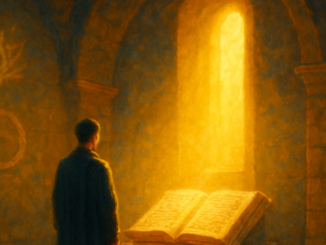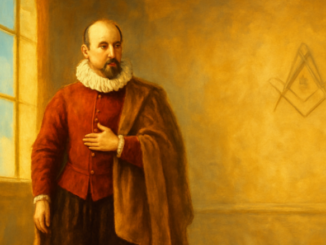
Montaigne's tower study with candles and manuscripts symbolizing self-reflection
Michel de Montaigne – The Essays

Montaigne and the Philosophy of Feelings That Transcend Us

It is a cool evening in 1572. In his tower study in Bordeaux, a man sits hunched over yellowed manuscripts. Candle wax drips onto passages of Seneca, the margins filled with his own annotations. He asks himself: why do we grieve for people we barely knew? Why do our feelings reach beyond our immediate experience? This seemingly simple question would grow into one of the most penetrating essays of the Renaissance. Michel de Montaigne drew upon a rich philosophical heritage for this third essay — a heritage that continues to inspire Freemasons in their pursuit of self-knowledge to this day. The Stoic Legacy: Emotions Under the Microscope Montaigne’s inquiry into the reach of human feeling is deeply rooted in Stoic philosophy. Seneca, the Roman philosopher and statesman, was his most important teacher from across the centuries. In his letters to Lucilius, Seneca explored at length how emotions can overwhelm us and how we might deal with them wisely. The Stoic ideal of apatheia — freedom from disruptive passions — fascinated Montaigne, but he did not embrace it fully. Instead, he used it as a starting point for his own, more nuanced view of emotional life. The Stoics taught that our […]
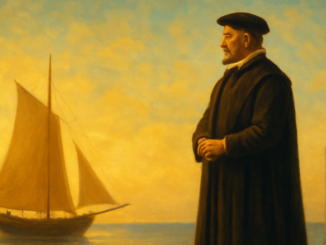
A symbolic mirror reflecting multiple faces representing Masonic self-knowledge
Freemasonry & Connection

The Mirror with Many Faces: Montaigne and Freemasonry

Imagine a mirror that doesn’t show one reflection, but a hundred. Every time you look, you see a different face — not because the mirror is broken, but because you yourself are constantly changing. This image captures the essence of what sixteenth-century philosopher Michel de Montaigne described in his reflections on the inconsistency of human action. And it is precisely this insight that reveals a striking kinship with the symbolic journey Freemasons undertake in their quest for self-knowledge. The Unstable Ground Beneath Our Feet Montaigne observed something we all recognize but rarely dare to admit: we are not the consistent beings we believe ourselves to be. Yesterday’s hero is today’s coward. The generous hand closes into a fist by morning. This is not a moral failing — it is a fundamental feature of human existence. We do not move in a straight line from birth to death, but in circles, spirals, and sometimes seemingly random patterns. Freemasonry begins from a remarkably similar starting point. The rough ashlar with which every Freemason symbolically begins their journey is not rough because it is flawed. It is rough because it has not yet been worked — because it has not yet become conscious […]

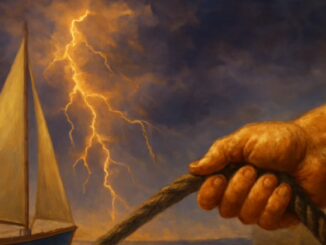
Thunderstorm over a harbor at night with lightning illuminating moored boats
Personal Development & Leadership

Storm and Character: What Thunder Reveals About Who You Are

The evening sky above the harbor turns purple, and the first flash of lightning illuminates the masts of moored boats. A man walks calmly to his vessel and unplugs the shore power cable. Behind him, other boat owners laugh: “That storm is nothing to worry about!” But when the morning sun breaks through the clouds, every single one of them has quietly done the same thing. Sometimes a single action says more about character than a thousand words. The Silence Before the Storm There is a peculiar moment just before a thunderstorm breaks. The wind drops, birds fall silent, and the air itself seems to hold its breath. In that instant of tension, something essential about human behavior reveals itself. Some people ignore the signs and carry on as if nothing is happening. Others take quiet precautions — not out of fear, but out of prudence. It is precisely this distinction that Freemasonry has explored for centuries: the difference between outward display and inner authenticity. The man who unplugs his shore power is not acting out of panic. He is following an inner compass that tells him: take responsibility for what you can influence, and accept what you cannot control. […]

Vrijmetselarij - De Betekenis van Gnosis in het Westen
Spirituality

The Meaning of Gnosis in the West

Gnosis is a word derived from Greek that simply means ‘knowledge.’ However, it is not ordinary knowledge, such as facts you learn in school. Gnosis refers to a deeper, spiritual form of knowledge. Moreover, it is a direct experience or insight into the divine and the truth of existence. It is an inner knowing that cannot be acquired through books or teachings but through personal experience and self-exploration. In the Western world, Gnosis is often associated with esoteric traditions like Gnosticism. This is a religious-philosophical tradition that emerged in the early centuries after Christ. Therefore, the Gnostics believed that the material world is imperfect. They proposed that there is a deeper, spiritual reality that we can access through self-knowledge and inner development. What does Gnosis mean for the Western individual? In the West, Gnosis has often been linked to mystical and esoteric traditions throughout history. Think of groups like the Cathars in the Middle Ages and Hermetic philosophy during the Renaissance. Furthermore, even Freemasonry and other symbolic societies have connections to Gnosis. These traditions emphasize that Gnosis is about self-discovery and finding inner truth. Today, Gnosis does not always carry a religious connotation. It is often seen as a path […]