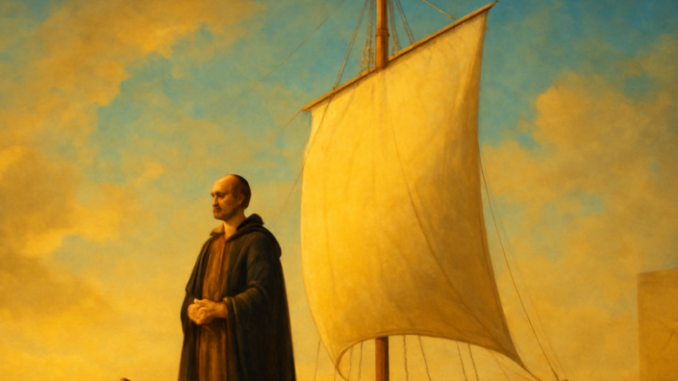
Have you ever wondered why a lie can sting so deeply, even when its content is entirely trivial? There’s something fundamentally violated when someone knowingly speaks an untruth — and you feel it in your bones. Michel de Montaigne, the sixteenth-century French essayist, grappled with the very same question. In his ninth essay, “On Liars,” he explores not merely what lying is, but why it is so reprehensible. To understand how he arrived at his insights, we need to look at the philosophical traditions that shaped his thinking: Stoicism, Skepticism, and Renaissance Humanism.
The Stoic Legacy: Truth as Virtue
Montaigne’s deep aversion to lying is firmly rooted in Stoic philosophy. Thinkers like Seneca and Epictetus regarded truthfulness not as a social convenience, but as a cardinal virtue. For the Stoics, human beings were fundamentally rational creatures, and lying represented a betrayal of that rationality. When you lie, they reasoned, you disturb the natural order of the logos — the universal reason that binds all things together.
Seneca, whose letters Montaigne studied with great devotion, wrote extensively about the relationship between one’s words and one’s character. A man who lies, Seneca argued, cannot truly know himself. This is precisely the insight Montaigne adopts when he describes the liar as someone who undermines his own memory and identity. The liar must constantly remember what he has fabricated, becoming entangled in a web of inauthenticity that grows ever more complex and fragile.
Plutarch: The Moral Mirror
Alongside Seneca, Plutarch was one of Montaigne’s most beloved authors. The Greek biographer and moralist offered a treasury of examples drawn from historical figures whose lives bore witness either to virtue or to moral decay. Plutarch used life stories as mirrors in which readers could recognize themselves and aspire to improvement.
In his essay on liars, Montaigne applies this very method. He reflects on his own poor memory and asks whether that weakness might make him susceptible to untruth. But unlike a forgetful person who lies out of laziness, Montaigne deliberately chooses transparency. From Plutarch he learned that self-knowledge is the beginning of all wisdom — and that self-knowledge demands an unflinching honesty with oneself.
“A liar must have a good memory, for he must remember what he has invented.”
Skepticism: Acknowledging the Limits of Knowledge
Perhaps even more influential than Stoicism for Montaigne was the Skeptical tradition. The Pyrrhonian skeptics, rediscovered during the Renaissance through the writings of Sextus Empiricus, taught that absolute certainty is unattainable. Montaigne’s famous motto — “Que sais-je?” (What do I know?) — is a direct expression of this philosophical heritage.
How does this relate to lying? For Montaigne, there is a crucial distinction between admitting ignorance and deliberately deceiving. The skeptic says: I do not know. The liar says: I know something — and then presents a fabrication as truth. The first is intellectual humility; the second is moral corruption. Precisely because so little can be known with certainty, it is all the more reprehensible to pretend knowledge of something that isn’t true.
Renaissance Humanism: The Dignity of Man
Montaigne wrote during the flowering of Humanism. The rediscovery of classical texts and the emphasis on human dignity formed the intellectual atmosphere he breathed. Humanists like Erasmus and Petrarch had paved the way for a philosophy that placed human potential at its center — viewing people not as inherently sinful creatures but as beings capable of greatness.
In this light, Montaigne’s fundamental rejection of lying becomes clear. A lie is an assault on human dignity — both the dignity of the person being deceived and of the deceiver himself. The Humanist vision of friendship and community rests on mutual trust. Without truthfulness, no genuine connection is possible.
The Lodge as a Space of Truthfulness
You might wonder what all of this has to do with Freemasonry. The connection is more direct than you might think. In Freemasonry, the symbolism of building stands at the center of everything: building yourself, building community, building a better world. But every structure requires a foundation, and that foundation is truthfulness.
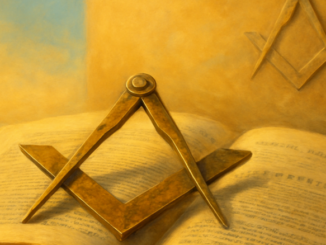
The symbolic working tools of the Freemason — the compasses and the square — are often explained as instruments for measuring and directing your conduct. But measurement only has meaning if you are honest about what you measure. A Brother who lies undermines not only his own integrity but the very structure of the Lodge as a whole.
Consider these symbolic connections: the compasses remind us to guard our boundaries in truth. The square represents uprightness in word and deed. The rough ashlar symbolizes the unrefined self, waiting to be perfected through honest reflection. Each tool calls us back to the principle that authentic self-improvement is impossible without truthfulness.
Montaigne’s essay touches the very heart of what it means to work on yourself. Like the Stoics and Humanists who inspired him, he invites us to examine our own speaking and our own silence — not out of fear of punishment, but from the understanding that truthfulness is the precondition for every genuine relationship, every real community, and every meaningful act of self-examination.
Montaigne’s essay on liars is not a moralistic treatise but an invitation to self-reflection, rooted in wisdom traditions that span millennia. From Seneca he learned that word and character are inseparable. From Plutarch, that self-knowledge begins with honesty. From the Skeptics, that acknowledging ignorance is no weakness — but deliberate deception most certainly is. And from the Humanists, that human dignity rests on trust. In Freemasonry, these insights find their symbolic resonance: every working tool reminds us that we can only build on a foundation of truth.
Copyright text & image: devrijmetselaar.nl
Texts are based on the ideas and content of the author of devrijmetselaar.nl, reviewed, corrected, and supplemented with the assistance of OpenAI. Images are created based on the ideas of the author of devrijmetselaar.nl using OpenAI/DALL-E.
Frequently Asked Questions
What is the connection between Montaigne's philosophy and Masonic principles?
Montaigne's emphasis on truthfulness and self-knowledge aligns deeply with Freemasonry's commitment to personal integrity and enlightenment. Both traditions value the pursuit of wisdom through honest self-examination and the cultivation of virtue, making Montaigne's insights particularly relevant to the Mason's path of moral development.
How does the Stoic concept of virtue relate to Freemasonry?
Stoicism's teaching that truthfulness is a cardinal virtue directly parallels Freemasonry's emphasis on honesty as a foundational principle of the Craft. Freemasons, like the Stoics, understand that virtue and rationality are inseparable, and that living with integrity strengthens both individual character and the bonds of brotherhood.
Why is self-knowledge important in both Montaigne's work and Freemasonry?
Both Montaigne and Freemasonry recognize that self-knowledge is the foundation of wisdom and moral improvement. Through honest self-reflection and the removal of self-deception, a Mason progresses toward enlightenment, much as Montaigne advocated for transparent self-examination as the path to authentic living.
How do Masonic rituals support the philosophical ideals discussed in Montaigne's essay?
Masonic rituals guide initiates through a journey of self-discovery and moral instruction, encouraging the same kind of honest introspection that Montaigne championed. The degrees of Freemasonry are designed to strip away illusion and pretense, allowing the initiate to build a life founded on truth and virtue.


Be the first to comment