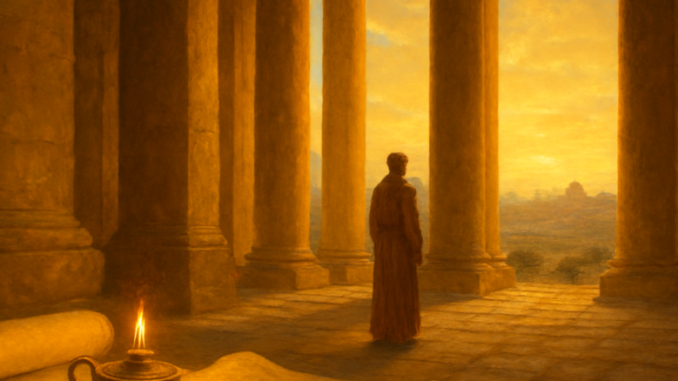
Imagine standing before the ruins of something that was once magnificent. Perhaps it’s a building, perhaps a relationship, perhaps a part of yourself you’ve long neglected. The foundations are still there, but the glory has faded. What do you do? Turn away and walk on — or pick up the first stone and start again? The brief biblical book of Haggai, just two chapters long, poses exactly this question. And the answers it offers resonate with striking power through the symbolism that Freemasons have cherished for centuries.
A Prophet Standing Between Rubble and Possibility
Haggai emerged during one of the most pivotal moments in the history of the Jewish people. After decades of exile in Babylon, a remnant of the nation returned to Jerusalem. What they found was a devastated city — and what struck them most deeply was the sight of Solomon’s Temple lying in ruins. This was no ordinary building. It was the spiritual heart of their community, the place where heaven and earth met in their experience of the divine.
Yet despite their return, something curious happened. Instead of rebuilding the Temple, the people turned their attention to their own houses. They made their private dwellings comfortable while the house that represented their deepest values remained a pile of rubble. Haggai was called to shake them awake. His message was less a condemnation than an invitation — a call to reconsider what truly matters.
The Temple as a Symbol of the Inner Self
For Freemasons, the image of the Temple carries a profound and particular significance. The building of King Solomon’s Temple is central to Masonic tradition — not as a historical event to be reconstructed, but as a symbol of an inner process. The Temple represents the individual, the structure you make of your own character. Every stone you lay, every corner you square, represents a step in your moral and spiritual development.
Haggai essentially asks us: how does your inner Temple stand? Are you pouring all your energy into the exterior of your life — comfort, convenience, appearance — while the sanctuary within you remains neglected? It’s a question that has lost none of its force across the millennia. You may recognize it in your own experience: the constant busyness of daily life, while the deeper questions remain unanswered and unexplored.
“Is it a time for you yourselves to dwell in your paneled houses, while this house lies in ruins?”
The Courage to Begin Again
What makes Haggai remarkable is that he doesn’t simply point out what’s missing. He encourages. He doesn’t say: look at how badly you’ve failed. He says: rise up, begin the work, and know that you are not alone in it. That message of encouragement is timeless. Rebuilding takes courage. It requires you to acknowledge that something is broken — and still believe that restoration is possible.
In Freemasonry, we understand this as an ongoing process. You don’t become a finished edifice overnight. You keep working, keep refining, keep adding new layers. Sometimes you must tear down what was poorly constructed and start over. That isn’t failure — it’s growth. Haggai reminds us that even after total destruction, rebuilding is possible, as long as you dare to lay the first stone.
Building Together Toward Something Greater
Another powerful element in Haggai is the emphasis on community. The prophet doesn’t speak to isolated individuals, each constructing their own private little temple. He addresses an entire people who must build together. The Temple is a collective project — an expression of shared values and united effort.
This resonates deeply with the ideal of brotherhood in Freemasonry. You don’t build alone. You stand shoulder to shoulder with others who pursue the same purpose. Each contributes his own stone; each has his own task. One is skilled in one craft, another in something different, but together you create something none of you could have achieved on your own. The Lodge, in this sense, is also a building site — a place where you work together on something that transcends the individual.
The Promise of a Greater Glory
Haggai contains a remarkable promise. Some of the elders who witnessed the rebuilding remembered the splendor of the first Temple and were disappointed that the new version seemed less impressive. The prophet answered with a vision: the glory of this new Temple would surpass that of the former one. Not through gold or silver, but through something far deeper.
This may be the very heart of Haggai’s message. True glory doesn’t reside in outward magnificence. It lives in the dedication with which you build, in the meaning you bring to the work, in the community that sustains it. A temple raised with love and conviction holds more value than the most lavish structure erected with indifference.
Your Ruins, Your Building Site
Perhaps you find yourself at such a moment right now. Perhaps there’s something in your life that calls out for rebuilding. It could be a relationship, a dream you set aside, an aspect of yourself you’ve neglected for too long. Haggai invites you to stop walking around the rubble and instead pick up the first stone.
Acknowledge what lies before you — without judgment. Dare to begin small. Seek companions who will build alongside you. Trust the process, not just the outcome.
The symbolism of Haggai isn’t confined to a single religion or tradition. It speaks to every person who has ever had to rebuild something. And that, ultimately, is all of us — at different stages of our lives. The question is never whether there are ruins. The question is always what you choose to do with them.
Haggai is a small book with an enormous message. It reminds us that the Temple that truly matters is the one we build within ourselves — and together with others. It asks us to examine our priorities, to summon the courage for reconstruction, and to trust that real glory is found not in outward appearance but in steadfast devotion. For Freemasons, and for anyone searching for deeper meaning, that invitation remains as powerful as ever: pick up the first stone, and begin.
Copyright text & image: devrijmetselaar.nl
Texts are based on the ideas and content of the author of devrijmetselaar.nl, reviewed, corrected, and supplemented with the assistance of OpenAI. Images are created based on the ideas of the author of devrijmetselaar.nl using OpenAI/DALL-E.
Frequently Asked Questions
What is the connection between the book of Haggai and Freemasonry?
In Freemasonry, the Temple symbolizes the individual's inner character and spiritual development rather than a physical structure. Haggai's call to rebuild the Temple serves as a powerful metaphor for Masons to focus on their moral and spiritual development, ensuring that their inner 'Temple' is not neglected while they pursue external comfort and convenience.
What does the Temple represent in Masonic tradition?
The Temple in Freemasonry represents the individual Mason and their personal character. Each stone laid and corner squared symbolizes a step in moral and spiritual development, making the Temple-building process a metaphor for the lifelong work of self-improvement that Masons undertake.
How does Haggai's message relate to modern Masonic practice?
Haggai's encouraging message that rebuilding is possible, even after devastation, aligns perfectly with Masonic philosophy. Rather than condemning failure, both Haggai and Freemasonry invite individuals to acknowledge what needs repair and begin the work of restoration with courage, knowing they are part of a community supporting their journey.
Is becoming a perfect Mason something that happens quickly?
No—Freemasonry, like Haggai's vision of rebuilding, is understood as an ongoing process of refinement. Masons recognize that personal development is lifelong work, continuously adding new layers of understanding and virtue rather than expecting to become a 'finished edifice' overnight.

Be the first to comment