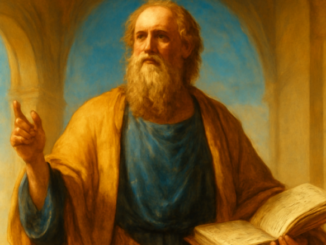
Plato’s Parmenides: The One and the Many in Freemasonry
When you open Plato’s Parmenides, you enter a world of thought where the apparent contradiction between unity and multiplicity is pushed to its very limits. Written around 370 BCE, this dialogue marks a turning point in Plato’s philosophical development — and it casts a revealing light on tensions that still echo through modern Freemasonry. How do the indivisible One and the visible world of diversity relate to each other? And what does this teach us about the way Brethren in the Lodge seek truth? The Eleatic Legacy: Parmenides as Teacher To understand Plato’s Parmenides, we first need to step back to the historical Parmenides of Elea, a fifth-century BCE thinker who defended a radical position: only the One — unchanging, indivisible Being — is real. Change, motion, and multiplicity are mere illusions produced by the senses. His student Zeno of Elea supported this claim with famous paradoxes that seemed to prove the impossibility of movement itself. Plato grew up in an intellectual environment where these Eleatic ideas still carried enormous weight. At the same time, he had learned from his own teacher Socrates that philosophy must never remain purely abstract — it must engage with the question of how to […]