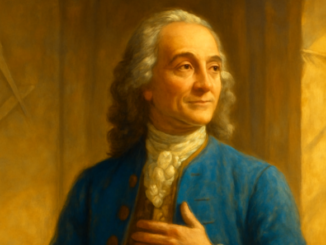
Voltaire writing by candlelight symbolizing Enlightenment tolerance and reason
Symbolism & Rituals

Voltaire and the Calas Affair: Philosophical Roots of Tolerance

In 1762, the Protestant merchant Jean Calas was executed in Toulouse on charges of murdering his own son. The trial was steeped in religious prejudice and judicial arbitrariness. Voltaire, deeply shaken by this judicial scandal, took up his pen and wrote his celebrated Traité sur la tolérance — Treatise on Tolerance. Yet this was no impulsive reaction. It was the culmination of centuries of philosophical thought on tolerance, reason, and human dignity. The intellectual heritage behind this essay reveals deep roots that continue to resonate in the principles of Freemasonry to this day. The Stoic Legacy: Universal Humanity The deepest roots of Voltaire’s thinking on tolerance reach back to the Stoic philosophy of antiquity. Thinkers such as Seneca, Epictetus, and Marcus Aurelius developed the concept of the cosmopolis — a world community in which all human beings share in the same universal reason. For the Stoics, every person, regardless of origin or creed, carried a divine spark within. Seneca wrote in his letters to Lucilius that we are all members of one great body and that nature has brought us forth as kindred. This idea formed a foundation upon which later arguments for tolerance could be built. Voltaire was an […]
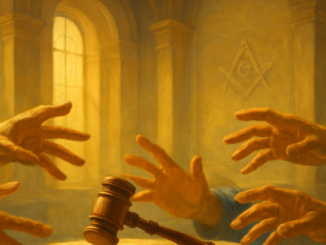

Gavel on a Masonic altar symbolizing leadership, trust, and accountability
Personal Development & Leadership

Leadership Under Pressure: Lessons from Football Politics

When allies turn away and calls for change grow louder, every leader’s authority hangs in the balance. The recent turmoil within world football’s governing body — where even the North and Central American confederation is now pushing for reform — raises a fundamental question: what truly makes a leader legitimate? And what happens when a brotherhood loses faith in the one who leads it? What Is Leadership Without the Consent of the Brethren? This may be the central question that arises both in world football governance and within any fraternal organization. A leader can hold titles, occupy seats of power, and make decisions — but without the moral consent of those he represents, his authority is hollow. Freemasonry has understood this principle for centuries. The Master of a lodge is not appointed by some higher authority; he is elected by his brethren. His power flows from trust, not from position. When regional federations now unite in their call for renewal, we are witnessing an ancient mechanism at work. It is not revolution — it is correction. A reminder that leadership must always serve the collective, never the other way around. Why Is Trust So Fragile in Large Organizations? As any […]

Neighbors connecting in community inspired by Masonic brotherhood principles
Personal Development & Leadership

Brotherhood in a Fragmented World: Lessons from Freemasonry

Last week, a 74-year-old man died alone in a Rotterdam apartment block. His body wasn’t discovered for three weeks — not because he lived in some remote area, but in a building with thirty neighbors. The story struck a raw nerve. We live closer together than ever before, yet we know each other less and less. Somewhere in this tension between proximity and alienation lies an urgent question: what happened to our sense of community? And what can we learn from a fraternity that has spent centuries experimenting with building meaningful bonds between strangers? The Vanishing Village Square Modern society is changing at breakneck speed. Studies consistently show that nearly half the population in developed Western nations reports feeling lonely at least some of the time. The numbers are highest among young adults and the elderly. These aren’t statistics about people living in isolated rural areas — they describe residents of cities and towns, surrounded by thousands of others. The traditional village square, where people naturally ran into each other, has been replaced by digital spaces where algorithms determine what we see and who we interact with. The chance encounter at the bakery, the chat over the garden fence, the […]