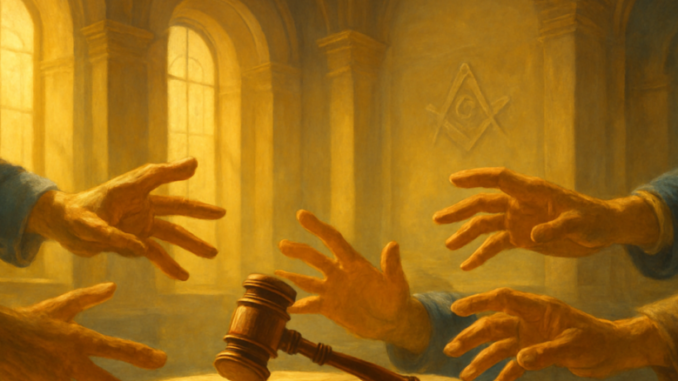
When allies turn away and calls for change grow louder, every leader’s authority hangs in the balance. The recent turmoil within world football’s governing body — where even the North and Central American confederation is now pushing for reform — raises a fundamental question: what truly makes a leader legitimate? And what happens when a brotherhood loses faith in the one who leads it?
What Is Leadership Without the Consent of the Brethren?
This may be the central question that arises both in world football governance and within any fraternal organization. A leader can hold titles, occupy seats of power, and make decisions — but without the moral consent of those he represents, his authority is hollow. Freemasonry has understood this principle for centuries. The Master of a lodge is not appointed by some higher authority; he is elected by his brethren. His power flows from trust, not from position.
When regional federations now unite in their call for renewal, we are witnessing an ancient mechanism at work. It is not revolution — it is correction. A reminder that leadership must always serve the collective, never the other way around.
Why Is Trust So Fragile in Large Organizations?
As any organization grows, the distance between leader and members widens. This is true for football federations, for corporations, and yes, for Masonic bodies as well. The philosopher Montesquieu warned long ago that power without counterbalance inevitably leads to abuse. Freemasonry addresses this through a carefully designed system of checks and balances: committees that provide oversight, rituals that reinforce humility, and the periodic rotation of officers.
World football is wrestling with precisely this challenge. When decision-making becomes opaque and regional voices feel ignored, the foundation begins to crumble — not through hostility, but through alienation. The North and Central American confederation raising its voice is doing exactly what a healthy brotherhood should do: communicating clearly when the course diverges from shared values.
Can a Brotherhood Survive Without Its Leader?
Absolutely. In fact, a brotherhood that is entirely dependent on a single individual is not really a brotherhood at all — it is a court. The strength of Freemasonry lies precisely in its ability to develop leaders, correct them, and when necessary replace them, without tearing the fabric of the organization apart.
True brotherhood outlives every leader, because its foundation is built not on personalities but on shared principles.
This insight is crucial for understanding the current football crisis. The call for change is not an attack on the sport itself but an effort to protect it from internal erosion. It is an act of love disguised as criticism.
What Can Freemasons Learn from This Moment?
For Freemasons, this situation holds up a mirror. The Craft encourages its members to regularly ask themselves: do our leaders serve the whole, or does the whole serve the leader? Masonic ritual reminds every brother that every position is temporary. The gavel that rests in your hand today will rest in another’s tomorrow. This fosters humility and prevents power from becoming fused with personal identity.
In world football, this reminder seems to have been lost. The current unrest is therefore not merely a political struggle but a moral lesson. Organizations that neglect their rituals of accountability ultimately pay the price in trust.
How Do You Rebuild Trust Once It Has Been Damaged?
This is perhaps the most difficult question of all. Johann Wolfgang von Goethe, himself a Freemason, wrote that trust grows slowly and perishes quickly. Restoration requires more than promises — it demands visible action, consistency over time, and the willingness to share power rather than consolidate it.
Freemasonry offers a simple yet powerful mechanism for this: transparency within ritual. Every action, every word spoken in the temple can be questioned and explained. There are no secret decisions made behind closed doors. What may appear mysterious from the outside is, from the inside, entirely open to discussion.
For world football, a similar openness could prove healing — not as a sign of weakness, but as a demonstration of strength. The federations now demanding change are essentially asking for exactly this: show us what is happening, involve us in setting the direction, treat us as brethren rather than subjects.
Is Change Always Improvement?
No — and here lies the nuance. Change for the sake of change is just as dangerous as stagnation for the sake of comfort. The art lies in discerning which changes serve the whole and which merely create new power structures. The wise brother asks not only “should this be different?” but also “will this be better?”
The coming months will reveal whether the call for renewal in world football leads to genuine improvement or simply produces new faces with old habits. But the conversation itself already holds value. It reminds us that no structure, however powerful, is immune to the voice of its members.
What is unfolding in world football today touches on timeless questions about power, trust, and community. Freemasonry does not offer ready-made answers, but it does provide a compass: leadership that serves, brotherhood that corrects, and rituals that remind us of the impermanence of every position. Whether we are talking about a football federation or a Masonic lodge, the lesson remains the same — a community is only truly strong when its members dare to speak and its leaders dare to listen.
Copyright text & image: devrijmetselaar.nl
Texts are based on the ideas and content of the author of devrijmetselaar.nl, reviewed, corrected, and supplemented with the assistance of OpenAI. Images are created based on the ideas of the author of devrijmetselaar.nl using OpenAI/DALL-E.
Frequently Asked Questions
How does Freemasonry ensure leaders remain accountable to their members?
Freemasonry has maintained for centuries a system where leaders are elected by their brethren rather than appointed from above, ensuring authority flows from trust and consent. The Craft employs checks and balances through oversight committees, ritualistic reminders of humility, and the periodic rotation of officers to prevent power from becoming concentrated or corrupted. This democratic structure ensures that leaders serve the collective and remain answerable to those they represent.
Why is leadership by consent important in fraternal organizations?
Leadership without the moral consent of members becomes hollow and ineffective, regardless of titles or positions held. Freemasonry understands that true authority comes from the trust and support of the brethren, not from administrative power alone. When members feel their voices are heard and values are respected, the organization remains strong and unified.
Can a Masonic lodge survive without its current leader?
Yes—in fact, a truly healthy Masonic lodge is designed to thrive regardless of individual leaders because its foundation rests on shared principles rather than personalities. Freemasonry's strength lies in its ability to develop leaders, provide guidance when needed, and transition leadership smoothly without disrupting the organization's core mission. A genuine brotherhood outlives every leader because it belongs to all its members.
How does Freemasonry prevent the kind of leadership crises we see in other large organizations?
Through its emphasis on transparency, regular member input, and a system of rotating leadership that prevents any single person from accumulating unchecked power. Freemasonry encourages members to regularly question whether their leaders serve the whole or whether the whole has begun to serve the leader. These built-in safeguards help maintain trust and alignment between leadership and membership values.


Be the first to comment