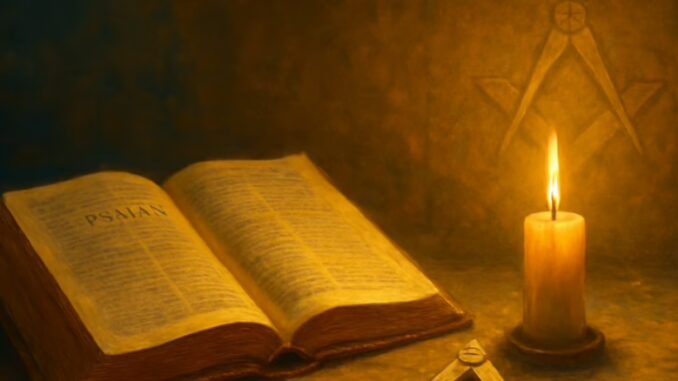
We all know those moments — a chaotic day spiraling out of control, a difficult decision that refuses to resolve itself, or a stretch of uncertainty that just won’t lift. The Psalms, a collection of 150 songs from the Old Testament, offer surprisingly practical guidance for exactly these situations. In Freemasonry, these ancient texts serve as a rich source of symbolism that can help you take concrete steps in your personal development. This article explores how to translate the imagery of the Psalms into everyday application.
The Psalms as a Toolbox for Life
Written over the course of centuries, the Psalms contain songs for every human experience: joy, sorrow, fear, gratitude, and wonder. For Freemasons, this is especially relevant because the Volume of the Sacred Law holds a central place in the lodge. The Psalms are often found open upon it as a symbol of wisdom and direction. But how do you translate ancient poetry into something meaningful for your life today?
The answer lies in recognizing universal patterns. When a psalmist sings of walking through a dark valley, you may recognize your own season of uncertainty. When the text speaks of building a house upon a rock, you can see the necessity of strong foundations in your own choices. That recognition is the first step toward practical application.
Light as a Compass in Darkness
One of the most powerful symbols in the Psalms is light. The well-known verse “Thy word is a lamp unto my feet, and a light unto my path” offers more than poetic beauty. In Freemasonry, light represents knowledge, insight, and awakening. This symbol invites a concrete action: take five minutes each morning to clearly formulate your intention for the day. What do you want to learn today? Which decision calls for illumination?
“The Lord is my light and my salvation; whom shall I fear?”
You can ask yourself this question quite literally when fear holds you back. Write down what you fear, then ask: what insight or knowledge could remove that fear? Seeking the light then becomes an active pursuit rather than a passive wish.
Building Your Inner Architecture
The building symbolism in the Psalms connects seamlessly with Freemasonry, where a person is regarded as a rough ashlar that must be shaped and refined. Psalm 127 declares that “except the Lord build the house, they labour in vain that build it.” This image invites reflection: are you working on your inner development with conscious attention, or are you laboring without direction?
In practical terms, you can translate this into a weekly self-evaluation. Ask yourself three questions:
First, which “stone” did I work on this week? What aspect of myself received attention? Second, was my foundation solid? Did I act in alignment with my values? And third, which room in my inner structure deserves attention next week?
This simple exercise transforms ancient symbolism into modern self-reflection — the kind of inner work that Masonry continually encourages.
Community as a Pillar of Strength
The Psalms are not merely personal songs; they were also sung in community. Psalm 133 celebrates brotherly harmony: “Behold, how good and how pleasant it is for brethren to dwell together in unity.” For Freemasons, this points to the lodge as a space of brotherhood, but the principle extends far beyond. Those who belong to a community with shared values find support in difficult times and deeper meaning in good ones.
Here is the practical application: identify a group where you can share your spiritual or personal growth. This could be a study circle, a reading group, a walking club that fosters meaningful conversation, or a Masonic lodge. What matters most is regular contact with people who challenge you to grow and support you when you struggle.
Silence as a Working Tool
Between the words of the Psalms lies silence. The instruction “Be still, and know” may be the most practical advice these texts offer. In Freemasonry, silence plays a central role: the candidate undergoes a period of reflection before initiation, and within the rituals, moments of silence carry as much meaning as the spoken word.
Put this into practice by building ten minutes of silence into your daily routine. No podcast, no music, no distractions. Sit, breathe, and let thoughts come and go. In this stillness, insights can surface that never get a chance amid the noise of everyday life. Many people discover that their best ideas and clearest decisions emerge from these moments of intentional quiet.
From Text to Action
Reading the Psalms without applying them is like a carpenter who admires his tools but never picks them up. The symbolism of light, building, community, and silence calls for translation into concrete steps. Choose one image today that speaks to you and decide what action it inspires. Perhaps it is starting a journal, scheduling a conversation with someone who inspires you, or setting a daily reminder for a moment of stillness.
Ancient wisdom only becomes valuable when it is set in motion. The Psalms do not offer ready-made answers, but they provide signposts for anyone willing to follow them. In Freemasonry, this is called “the work” — the ongoing process of self-improvement. Your work begins with the choice to take one step today.
The Psalms are a treasury of symbolism that is directly applicable to your daily life. Whether you are seeking light in a time of confusion, building your inner architecture, finding strength in community, or discovering wisdom in silence — these ancient texts offer practical tools. Freemasonry invites you not only to admire these symbols but to put them to work. Your rough ashlar is waiting to be shaped, and every day offers a new opportunity to build.
Copyright text & image: devrijmetselaar.nl
Texts are based on the ideas and content of the author of devrijmetselaar.nl, reviewed, corrected, and supplemented with the assistance of OpenAI. Images are created based on the ideas of the author of devrijmetselaar.nl using OpenAI/DALL-E.
Frequently Asked Questions
How can I use the Psalms for practical self-improvement as a Freemason?
The Psalms offer universal patterns and symbols that translate ancient wisdom into modern life. By recognizing yourself in the psalmist's experiences—whether facing darkness, building foundations, or seeking guidance—you can apply these lessons through concrete practices like morning intention-setting and weekly self-evaluation. This bridges the gap between sacred text and personal development, which is central to Masonic philosophy.
What does 'light' symbolize in Freemasonry and the Psalms?
Light represents knowledge, insight, and spiritual awakening in both Masonic tradition and Psalm symbolism. The famous verse 'Thy word is a lamp unto my feet' invites you to actively seek illumination by formulating clear intentions each day and asking yourself what insights could address your fears or challenges. This transforms light from a passive wish into an active pursuit of understanding.
How does the 'rough ashlar' concept relate to building my inner character?
In Freemasonry, you are regarded as a rough stone that must be consciously shaped and refined through inner work. The Psalms reinforce this through building imagery, inviting you to evaluate weekly which aspects of yourself you're developing, whether your actions align with your values, and which qualities deserve attention next. This intentional self-reflection is essential to the Masonic journey of personal development.
Can I really apply ancient Psalm verses to my problems today?
Yes—the Psalms address universal human experiences like fear, uncertainty, gratitude, and joy that remain timeless. By recognizing the universal patterns in these ancient texts rather than treating them as merely poetic, you can extract practical guidance for modern challenges. Freemasonry teaches that this translation of symbolic wisdom into daily action is the true purpose of studying sacred texts.

Be the first to comment