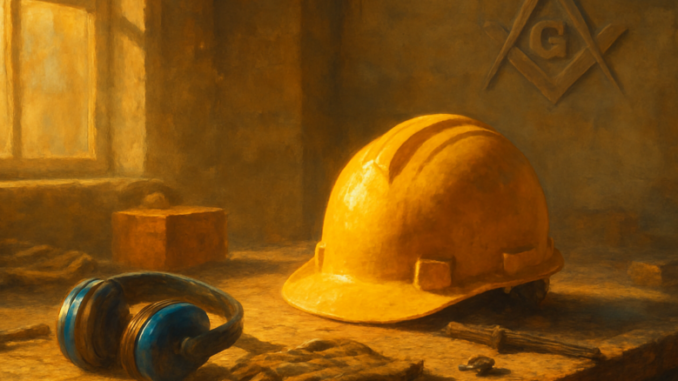
On August 13, 2026, the city of Rotterdam was shaken by a deadly explosion at an industrial site. Six people were injured, and one person lost their life. Early reports point to an industrial accident. As emergency services do their work and investigations get underway, a timeless question presses itself upon us: how does human character reveal itself in moments of crisis? Thinkers have wrestled with this question for centuries — and it lies at the very heart of Freemasonry.
The Forge of Character
In the eighteenth century, James Anderson — compiler of the first Constitutions of Freemasonry — wrote that a brother should distinguish himself by his conduct in all circumstances of life. This was not a novel idea. The Roman Stoic philosopher Seneca had already observed in antiquity that a person’s true nature is not revealed in comfort, but in adversity. An explosion, a fire, a sudden disaster: these are the moments when the façade falls away and the real character emerges.
The Rotterdam explosion reminds us of this ancient truth. As the dust settles and chaos unfolds, we see people act. Some flee; others rush forward to help. First responders set aside their own safety. Colleagues search for one another. In those first minutes after a disaster, character is not demonstrated through words, but through deeds.
Aristotle on Virtue in Practice
The Greek philosopher Aristotle argued in his Nicomachean Ethics that virtue is not an abstraction — it is a habit formed through action. We become courageous by performing courageous acts. We become just by acting justly. This principle resonates deeply within Freemasonry, where brethren are encouraged not merely to imagine their inner edifice, but to actually construct it — stone by stone, deed by deed.
Character is not shaped by what a person claims to believe, but by what a person does when no one is watching — or precisely when everyone is watching.
An industrial accident puts this principle to an unavoidable test. The manager who takes responsibility, the employee who raises the alarm about danger, the passerby who administers first aid — they all demonstrate that character does not reside in titles or intentions, but in concrete actions under pressure.
Responsibility as a Foundation
The history of Freemasonry is interwoven with the medieval craft guilds, where master builders bore responsibility for the safety of their workplaces and the quality of their constructions. Building a cathedral was not an individual undertaking but a collective project in which every stone, every joint, every calculation contributed to the whole. Failure was never merely a personal shortcoming — it was a threat to everyone.
This legacy resonates in contemporary questions about workplace safety. When an explosion occurs, questions arise about protocols, maintenance, training, and oversight. Behind every protocol, however, stands a human being who decides whether or not to follow it. Behind every safety measure stands a personality who either recognizes its importance or ignores it. The operative mason of old, who carefully shaped his limestone blocks, knew that carelessness could cost lives. He carried that knowledge as part of his character.
The Importance of Preparation
Marcus Aurelius, the Stoic emperor-philosopher, wrote in his Meditations that one should consider each morning what difficulties the day might bring — not to become pessimistic, but to be prepared. This mental exercise of visualizing adversity was, for the Stoics, a method of tempering character. Those who have contemplated the unexpected stand firmer when it arrives.
Freemasonry embraces similar principles. The ritual work reminds brethren that life is finite, that adversity will come, and that one must be ready. This is not a morbid fixation — it is practical wisdom. The Rotterdam explosion came without warning for those on site. Yet there were people who knew how to act, because they had prepared themselves, consciously or unconsciously, for moments that demand calm and decisiveness.
Community in the Aftermath
After the initial chaos comes the aftermath. The injured are cared for, the bereaved are supported, investigations are conducted. Here, too, character reveals itself. The way a community handles grief and loss speaks volumes about its collective character. The essayist Michel de Montaigne, whose writings are still read as guides to self-knowledge, observed that our reactions to the suffering of others reveal something about our own soul.
Freemasonry emphasizes brotherhood and mutual support — not as abstract ideals, but as lived practice. When a brother suffers, others extend a hand. This principle transcends the lodge and applies to every human community. The Rotterdam explosion will leave behind survivors and families who need support — not only today, but in the months and years ahead.
What the Past Teaches Us
Every industrial accident invites reflection — not only about safety protocols, but about the human factor that lies behind them. History teaches us that technical progress alone is never enough. The pyramids of Giza, the cathedrals of Europe, the bridges and factories of the Industrial Revolution: they were all built by people of varying character, and their success or failure depended on the virtues those individuals put into practice.
The lesson for today is that character is not a secondary concern in technical environments — it is the foundation on which safety rests. A culture in which people dare to hold each other accountable, in which responsibility is not deflected, in which vigilance is valued — that is a culture capable of preventing accidents. And that culture begins with individuals who are willing to work on themselves.
The Rotterdam explosion is a tragedy that demands practical answers — better protocols, stricter oversight, improved training. But beneath these measures lies something deeper: the character of the people who must uphold them. Freemasonry, drawing on centuries of philosophical and operative tradition, reminds us that self-improvement is never a solitary or abstract pursuit. It is the daily, deliberate practice of virtue — tested most severely in the crucible of crisis. When the dust settles, it is not our words that define us, but our actions. And the time to shape those actions is not after disaster strikes, but long before.
Copyright text & image: devrijmetselaar.nl
Texts are based on the ideas and content of the author of devrijmetselaar.nl, reviewed, corrected, and supplemented with the assistance of OpenAI. Images are created based on the ideas of the author of devrijmetselaar.nl using OpenAI/DALL-E.
Frequently Asked Questions
What does Freemasonry teach about character being revealed in times of crisis?
Freemasonry teaches that true character is not revealed in comfort but in adversity. Drawing from James Anderson's Constitutions and ancient Stoic philosophy, the craft emphasizes that during moments of crisis—such as disasters or emergencies—the façade falls away and real character emerges through deeds rather than words. In these critical moments, people's true nature is demonstrated through their actions, whether they choose to help others or flee.
How does Aristotle's concept of virtue relate to Masonic teachings?
Aristotle's philosophy, central to Masonic thought, teaches that virtue is not an abstraction but a habit formed through action. Masons become courageous by performing courageous acts and just by acting justly. This principle aligns with Freemasonry's encouragement for brethren to construct their inner character stone by stone through concrete deeds, rather than merely claiming beliefs or intentions. Character is built through what people actually do under pressure.
What is the connection between medieval craft guilds and Masonic responsibility?
Freemasonry's history is interwoven with medieval craft guilds, where master builders bore direct responsibility for workplace safety and construction quality. This heritage emphasizes that responsibility is a foundational principle in Freemasonry. The accountability that master builders maintained for their work reflects the Masonic commitment to responsibility as an essential component of character and ethical conduct.

Be the first to comment