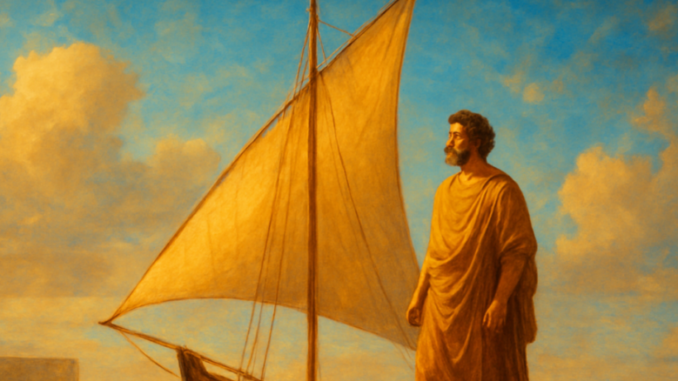
You’re facing a difficult decision. Someone has wronged you, and the urge to strike back burns hot. It’s precisely in moments like these that Book VII of Marcus Aurelius’ Meditations offers concrete guidance. But where did these insights originate? Which philosophical traditions shaped the thinking of this Roman emperor? And more importantly — how can you put this ancient wisdom to work in your life today?
The Stoic Foundation: Mastering Your Reactions
Marcus Aurelius wrote from within a tradition that began three centuries before his time. Around 300 BCE, Zeno of Citium founded the Stoic school in Athens. Its core principle was simple yet powerful: you have no control over what happens to you, but you have full control over how you respond. In Book VII, Marcus Aurelius applies this directly to questions of evil and justice. When someone insults or harms you, the event itself is neutral. It’s your judgment about it that turns it into something painful.
This is not passivity. It’s an active choice to direct your energy toward what you can actually influence. Try it yourself: the next time someone’s behavior irritates you, ask yourself, “Can I change this?” If yes, take action. If not, accept it and move on.
Socrates and the Paradox of Evil
One of the most striking claims in Book VII is that no one does evil willingly. This idea traces directly back to Socrates, who argued that all wrongdoing stems from ignorance. Anyone who truly understands what is good will naturally do good. Marcus Aurelius adopted this view and took it further: if your adversary acts out of ignorance, they deserve compassion rather than anger.
Those who do harm out of ignorance deserve not revenge, but understanding — and, where possible, correction.
This fundamentally changes how you handle conflict. Instead of thinking, “He’s doing this deliberately to hurt me,” you ask yourself, “What misunderstanding or unmet need is driving this behavior?” That shift opens the door to dialogue rather than confrontation.
Epictetus as a Direct Teacher
Marcus Aurelius didn’t learn Stoicism from abstract treatises alone — he received it through direct transmission. His tutor Rusticus introduced him to the writings of Epictetus, a former slave who had distilled Stoic philosophy into practical rules for living. Epictetus drew a strict line between what lies within our power and what does not. Your body, your reputation, your possessions — all vulnerable to external forces. Your character, your choices, your attitude — those belong to you alone.
You can see this influence clearly in Book VII when Marcus Aurelius writes about justice. Acting justly does not depend on how others treat you. It’s an inner disposition you can cultivate regardless of circumstances. Start today: choose one situation that normally frustrates you and make a deliberate decision to respond with fairness and integrity.
Heraclitus and the Cosmic Order
Underlying Stoic ethics is a worldview in which everything is interconnected. Heraclitus — the philosopher famous for declaring that you cannot step into the same river twice — profoundly shaped this way of thinking. Everything flows, everything changes, yet beneath it all runs a logos, a cosmic reason that binds all things together.
Marcus Aurelius draws on this in Book VII to offer perspective. What feels like a great injustice right now is a ripple in an infinite stream. This isn’t a denial of your feelings — it’s an invitation to zoom out. When you’re stuck in a conflict, ask yourself: “How much will this matter in ten years?” More often than not, the answer gives you the space to respond with greater grace.
Practical Application in Daily Life
The philosophical background of Book VII is not an academic exercise. These are tools for real life. Here are three concrete steps you can apply immediately:
Pause before you react. When someone hurts you, take three deep breaths before responding. In that space, you reclaim the power to choose.
Look for the ignorance. Ask yourself what misunderstanding or pain might explain the other person’s behavior. This doesn’t excuse wrongdoing — it humanizes it.
Act justly regardless of the response. Your integrity does not depend on how others treat you. Let your actions reflect your principles, not your circumstances.
These principles resonate deeply within Freemasonry as well. The symbolism of the rough and perfect ashlar points to exactly this process: the shaping of character through conscious choices. Just as the Mason forms his stone with patience and precision, so the student of philosophy shapes his responses with attention and discipline. The working tools of the Craft are, at their heart, instruments of self-improvement — the same self-improvement Marcus Aurelius pursued in his private journal.
From Theory to Transformation
Studying philosophy without applying it is like admiring a toolbox without ever building anything. Marcus Aurelius didn’t write his Meditations for publication — they were personal exercises, daily reminders he wrote to himself because he knew how easily these principles slip from our grasp.
That may be the most important lesson from the philosophical roots of Book VII: wisdom demands repetition. Not because you don’t understand it, but because understanding something is not the same as living it. Choose one insight from this article and apply it consciously today. Then again tomorrow. That’s how philosophy stops being mere knowledge and starts becoming character.
The philosophical traditions behind Book VII of the Meditations are not dusty relics — they are a living wellspring. From Zeno to Socrates, from Epictetus to Heraclitus, each of these thinkers offers tools for the challenges we face today. The question is not whether this wisdom is still relevant — it is whether you are willing to put it into practice. Start small, start now, and discover how ancient thought gains new life in your everyday choices.
Copyright text & image: devrijmetselaar.nl
Texts are based on the ideas and content of the author of devrijmetselaar.nl, reviewed, corrected, and supplemented with the assistance of OpenAI. Images are created based on the ideas of the author of devrijmetselaar.nl using OpenAI/DALL-E.

Be the first to comment