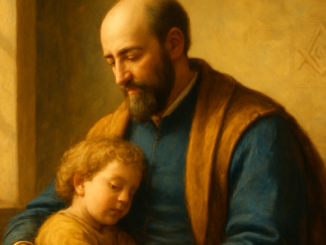
Montaigne on Fatherhood: Philosophical Roots of Essay II,8
In 1580, the first edition of Michel de Montaigne’s Essays appeared in Bordeaux — a work that would permanently reshape Western philosophy. Among the personal reflections and sharp observations lies an essay that, at first glance, seems like an intimate family narrative: the eighth essay of the second book, on the affection of fathers for their children. But look deeper, and you discover a text rooted in ancient philosophical traditions, from Stoicism to Renaissance humanism, with surprising connections to the fraternal ideals that Freemasonry would embrace centuries later. The Tower Library: Where Ancient Wisdom Converged To understand which thinkers influenced Montaigne when he composed his essay on fatherly affection, we must first return to his famous tower library at his château in the Dordogne. On the ceiling beams, he had Latin and Greek maxims engraved — borrowed from the likes of Sextus Empiricus, Lucretius, and Seneca. This was no mere decoration. It was a daily confrontation with the wisdom of antiquity, a form of intellectual exercise that allowed him to test his own thoughts against those of his predecessors. When Montaigne writes about the relationship between father and child in Essay II,8, he is not simply a man recording his […]