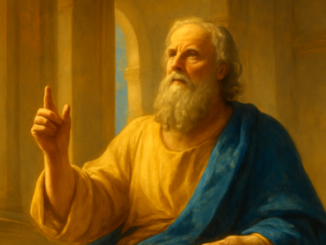
Ancient Greek temple columns symbolizing Plato's philosophy and Masonic ideals
Plato – Freemasonry & Connection

Plato’s Phaedrus: Beauty as a Gateway to the Soul

What actually happens when we perceive something truly beautiful? Does beauty merely please the eye, or does its influence reach far deeper — into the very core of who we are? In his dialogue Phaedrus, Plato has Socrates offer a striking answer: beauty is not a superficial phenomenon but a memory of a higher reality the soul once knew. For Freemasons, who are well-versed in using symbolism as a bridge between the visible and the invisible, this classical work opens a fascinating perspective on their own tradition. What Did Plato Actually Mean by ‘Beauty’? In the Phaedrus, Plato does not describe beauty as something subjective or as mere aesthetic pleasure. For him, beauty is a reflection of an eternal Idea — a Form that the soul recognizes from an existence before it entered a physical body. When we encounter something beautiful — a face, a landscape, a work of art — we experience, according to Plato, a glimpse of that original perfection. It is as though the soul awakens from a deep slumber. This immediately raises a question: is beauty, then, a teacher? Plato would answer with an emphatic yes. In the famous passage about the winged soul, Socrates explains […]
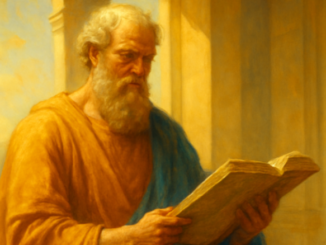
Ancient Greek philosophical scene representing Plato's winged soul and Masonic symbolism
Plato – Philosophical Background

Plato’s Phaedrus: Philosophical Roots of Beauty and the Soul

What if beauty is not merely something we perceive, but a memory of something we once knew? Plato’s dialogue Phaedrus poses this question with a force that has echoed through Western philosophy for over two millennia. But where did Plato’s vision actually come from? What thinkers and traditions formed the intellectual soil from which his ideas about the soul, beauty, and divine madness grew? In this article, we explore the philosophical roots of the Phaedrus and discover why this ancient work still resonates profoundly with anyone searching for deeper truth — including those who walk the path of Freemasonry. Why Did Plato Write About the Soul and Beauty? To understand Plato’s Phaedrus, we first need to understand the world in which he thought and wrote. Fourth-century Athens was a vibrant center of intellectual debate. Sophists like Gorgias and Protagoras had called absolute truths into question. They taught that the power to persuade mattered more than truth itself. Plato saw a danger in this: if everything is relative, what remains worth striving for? His teacher Socrates had shown him that something does exist beyond mere human opinion. There are Forms — Ideas — that are eternal and unchanging. The Phaedrus became […]