
A sealed house. Five small bodies. A home in the southern French town of Orange bearing witness to something unthinkable. The news that reached French police this week shakes us to the very foundation of how we understand human nature. How can a person — a fellow human being — commit such acts? As Freemasons, we are called not to look away, but to seek understanding. Not to excuse, but to honestly confront the human condition. For within the symbolism of the lodge lies an ancient wisdom: every person carries both light and darkness within.
The Chambers We Seal Shut
Every building contains spaces that remain hidden. Windowless basements. Attics no one visits. The architecture of a house mirrors something profound about the human soul: we all have rooms we keep locked. Rooms where we store what we do not wish to show — perhaps not even to ourselves. The Swiss psychiatrist Carl Gustav Jung called this the shadow: that part of our personality we banish to the unconscious because it does not fit the image of who we believe ourselves to be.
The tragic report from Orange confronts us with the ultimate consequence of someone becoming completely estranged from their own shadow. When a sealed chamber remains locked for so long that the evil within it grows undisturbed. This is not a judgment on a single person — it is a mirror held up to us all. Which chambers do we ourselves keep closed?
The Ritual of Honest Self-Reflection
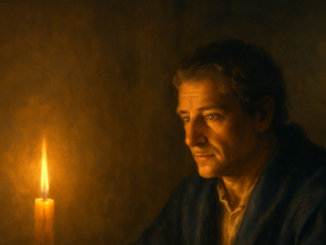
In Freemasonry, every journey begins with the symbolic death of the old self. The candidate is blindfolded and isolated, placed in a darkened room known as the Chamber of Reflection. Here, surrounded by symbols of mortality and impermanence, the seeker is invited to look honestly inward. Not at what is beautiful and noble, but precisely at what we would rather avoid.
This ritual acknowledges a fundamental truth about human personality: we are not merely what we show to the world. Plato wrote about the divided soul, torn between reason, passion, and appetite. Aristotle emphasized that virtue is not a given but requires constant practice. Freemasonry places itself squarely in this philosophical tradition by making the building of character its central purpose — not as a finished product, but as a lifelong process.
Personality is not a given. It is a structure. And every structure has foundations that lie in darkness.
Light and Darkness as Masonry
The Freemason works with rough stone — the ashlar. This symbol represents the unrefined human being, full of imperfections and flaws. The goal is not to deny these flaws but to work on them. The gavel and chisel are tools of self-transformation. But — and this is crucial — even the polished stone retains its original material. We do not destroy the rough stone; we give it form.
Goethe, himself a Freemason, captured this insight in his masterwork Faust: the person who wishes only to see the light does not fully understand himself. It is precisely in acknowledging our darker inclinations that we find the strength to master them. Not through suppression, but through awareness. Freemasonry provides a safe space for this work: the lodge, where brothers help one another with this inner construction.
Brotherhood as a Mirror
What happens when someone becomes entirely isolated? When no community exists to hold up a mirror? The tragedy in Orange raises this haunting question. We live in an era when loneliness is growing at epidemic rates, when people can remain invisible to those around them for years on end. Freemasonry offers a counterweight. The brotherhood functions as a network of mutual responsibility.
In the lodge, people from vastly different backgrounds meet as equals. Titles, professions, and social status disappear behind the apron. What remains is the human being, with all their light and shadow. Through regular meetings and shared ritual, bonds form that reach far deeper than superficial social contacts. Brothers come to know one another beyond the masks we all wear in everyday life.
Regular rituals create moments of genuine reflection. Fraternal conversation breaks through isolation. Symbolic work makes the unspeakable something that can be discussed. Shared values form an ethical compass that helps each brother navigate the complexity of his own inner life.
The Courage to Look
It would be easy, after news like this, to turn away. To reduce the perpetrator to a monster — an exception, someone fundamentally different from us. But Freemasonry asks something far more difficult. It asks us to recognize that the potential for both greatness and ruin exists within every human heart. Not to relativize guilt, but to remain vigilant. Vigilant over our own hidden chambers.
The philosopher Montaigne, whose essays have long been a companion to Masonic thought, wrote that he recognized within himself every possible human quality. This radical honesty is not weakness but strength. Those who know their own darkness can govern it. Those who deny it will one day be ambushed by it.
A sealed house in Orange ultimately tells us something about ourselves. About the necessity of entering our hidden chambers — not to lose ourselves in them, but to bring light. Freemasonry offers no easy answers to the riddle of human personality. What it does offer is a path: a brotherhood of honest mirrors, a tradition of symbolic building, and the courage to look at what we would rather keep hidden. For only those who acknowledge the darkness can truly strive toward the light.
Copyright text & image: devrijmetselaar.nl
Texts are based on the ideas and content of the author of devrijmetselaar.nl, reviewed, corrected, and supplemented with the assistance of OpenAI. Images are created based on the ideas of the author of devrijmetselaar.nl using OpenAI/DALL-E.
Frequently Asked Questions
What does Freemasonry teach about human nature and morality?
Freemasonry teaches that every person contains both light and darkness, and that understanding our complete nature—including our flaws and shadows—is essential to personal growth. Rather than ignoring our darker impulses, Freemasonry encourages honest self-reflection and the lifelong practice of virtue through symbolic work with tools like the gavel and chisel, transforming the rough stone of our character into something refined and purposeful.
What is the Chamber of Reflection in Freemasonry?
The Chamber of Reflection is a symbolic darkened room where candidates during their initiation are invited to look honestly inward at all aspects of themselves, including what they would rather avoid. This ritual acknowledges that true self-knowledge requires confronting both our noble qualities and our imperfections, setting the foundation for a lifetime of character development.
How does Freemasonry use symbolism to teach about self-improvement?
Freemasonry uses powerful symbols like the rough ashlar (unrefined stone) to represent the human being with all their imperfections and potential. Through the symbolic use of tools like the gavel and chisel, Masons learn that self-transformation is not about denying our flaws but rather giving them form and purpose, much like shaping stone into a polished and functional piece.
Why does Freemasonry encourage confronting darkness rather than ignoring it?
Freemasonry teaches that true understanding of oneself and humanity requires acknowledging both light and shadow within us. By confronting our darker impulses through honest reflection rather than denial, we develop genuine virtue and wisdom, preventing the kind of psychological estrangement that can lead to harm in the world.

Be the first to comment