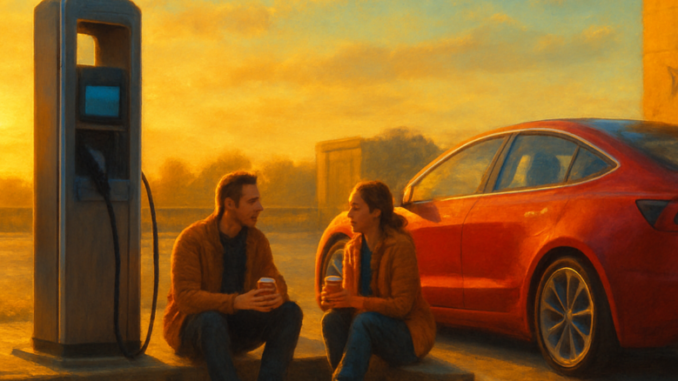
A quiet new ritual is emerging at rest stops along Europe’s motorways. People stand beside their cars, waiting for the charging station to do its work. They nod to one another, exchange tips, share a coffee. In this seemingly mundane act of waiting lies a deeper layer — an unexpected echo of something Freemasons have understood for centuries: that standing still and waiting together plants the seeds of genuine human connection.
The Charging Station as a Meeting Place
More and more drivers are choosing electric vehicles for their long-distance travel. The numbers grow each year, and the charging infrastructure along major routes is expanding to match. But behind the statistics lies a human story that rarely gets told. At every charging station, a temporary community forms. Strangers who share the same destination — not a geographic one, but a shared need: the need for energy to carry on.
In Freemasonry, we speak of the Lodge as a place where people come together stripped of their daily roles and social positions. The charging station functions in a remarkably similar way. It doesn’t matter whether you’re a company director or a nurse, whether you drive a luxury sedan or a modest city car. Everyone waits. Everyone charges. And in that shared waiting, space opens up for real conversation.
The Symbolism of Recharging
Charging a car is more than a technical process. It is a moment of enforced stillness in a culture that worships speed. The philosopher Aristotle wrote about the importance of scholè — a form of fruitful rest essential for contemplation and growth. The charging process compels us into exactly such a moment. We cannot race ahead; we must wait.
For the Freemason, this evokes images of ritual work within the Lodge. There, too, haste has no place. Every element of a meeting demands time and attention — the opening of the Lodge, the symbolic acts, the shared reflection. These are all moments of deliberate deceleration. Not because there is nothing to do, but because the slowing down itself holds value.
Brotherhood does not arise despite the waiting, but precisely because of it: in the silence between two acts, connection grows.
Dependence as a Unifying Force
The electric car makes visible something we could easily forget in the age of the combustion engine: our dependence on infrastructure, on others, on the greater whole. At a petrol station, we fill up in three minutes and drive on. At a charging station, we rely on the willingness of others to make room, on the reliability of the network, and on the shared agreement that we treat scarce charging points with respect.
Johann Wolfgang von Goethe — himself a Freemason — wrote of humanity as a species that only truly flourishes in connection with others. The modern electric road trip confirms this insight in unexpected ways. We no longer travel as isolated units but as nodes in a network of mutual dependence. We plan our route not only by destination but also by where we will encounter fellow travelers at charging points along the way.
From Stranger to Brother
A striking phenomenon unfolds at charging stations: the speed at which strangers begin talking to each other. In other settings, we instinctively reach for our phones to avoid contact. But at the charging point, openness prevails. Perhaps it is the shared novelty of the technology, or perhaps a sense of pioneering spirit. Whatever the cause, the effect is unmistakable — people talk.
This touches the very heart of what brotherhood means in Freemasonry. It is not about blood ties or pre-existing friendship. It is about the willingness to see the other as an equal — a fellow traveler on the same journey. In the Lodge, this is cultivated through ritual and symbolism. At the charging station, it arises spontaneously, carried by circumstance.
Consider what happens in these moments: shared waiting breaks down social barriers; practical help creates unexpected bonds; dependence makes us receptive to the other; and delay opens the door to genuine encounter.
The Journey as a Metaphor for Life
Every journey is also an inner journey. The road we travel mirrors the path we walk within ourselves. The electric car adds a new dimension: the necessity of making stops along the way, of reflecting, of gathering energy before we can continue. It is a lesson in self-knowledge. How much energy do I have left? Where must I stop? What do I need to reach my destination?
Montaigne, the great essayist, wrote about travel as a means of coming to know oneself. The detour, the unexpected, the encounter with a stranger — these are all mirrors in which we catch a glimpse of who we truly are. The electric road trip, with its planned stops and inevitable encounters, offers precisely such mirrors.
Patience as a Masonic Virtue
In a world that rewards speed, patience is a radical choice. The Freemason practices patience in the Lodge, where actions are deliberately slowed and where personal growth is allowed to take its time. The electric traveler practices patience at the charging point, where technology sets the pace and haste becomes counterproductive. Both forms of patience lead to the same insight: some things cannot be rushed, and the value lies in the waiting itself.
The rise of the electric vehicle for long-distance travel is more than a technological or ecological development. It is an invitation to travel differently — to seek connection where we once sped past, and to recognize in the stranger a fellow traveler on the same road. Standing at the charging station, waiting for the energy to flow again, we can rediscover something Freemasonry has cherished for centuries: the art of being together, the value of slowing down, and the knowledge that we are stronger together than alone.
Copyright text & image: devrijmetselaar.nl
Texts are based on the ideas and content of the author of devrijmetselaar.nl, reviewed, corrected, and supplemented with the assistance of OpenAI. Images are created based on the ideas of the author of devrijmetselaar.nl using OpenAI/DALL-E.


Be the first to comment