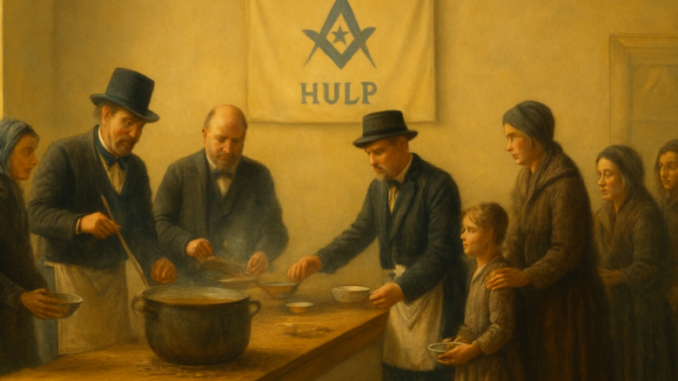
In the 19th century, as poverty and economic inequality gripped much of Europe, soup kitchens became a lifeline for thousands of desperate families. These kitchens — offering free or affordable meals to the destitute — often meant the difference between survival and starvation. What many people don’t realize is that Freemasons, driven by their deep-rooted ideals of solidarity and charity, were among the pioneers who established and sustained these vital food relief efforts, particularly in the Netherlands.
The Origins of Soup Kitchens
The Industrial Revolution brought unprecedented economic growth, but it also widened the gap between rich and poor to alarming extremes. Urban areas swelled with workers who faced chronic unemployment, appalling living conditions, and persistent hunger. The concept of communal soup kitchens emerged as a practical response to these dire circumstances — a way to alleviate the worst consequences of widespread poverty.
Freemasons, who had long been involved in charitable endeavors, were among the first to take organized action. Their lodges served as natural hubs for coordinating food relief, mobilizing funds, recruiting volunteers, and securing the resources needed to prepare and distribute meals to those in greatest need. For these Brethren, feeding the hungry was not merely an act of charity — it was a direct expression of their core values of brotherhood and humanity put into practice.
The Philanthropic Character of Masonic Food Relief
The commitment of Freemasons to soup kitchens was deeply rooted in their philosophical principles. Three key values drove their efforts:
Brotherhood: Freemasons believe in the unity of humanity and feel a profound responsibility to help those less fortunate. Feeding the hungry was seen as an extension of the fraternal bond that connects all people, not just lodge members.
Practical Philanthropy: Masonic teaching has always emphasized that ideals must be translated into action. It is not enough to speak of compassion — one must actively work to relieve suffering. Soup kitchens provided a tangible, immediate way to do exactly that.
Dignity and Respect: Crucially, these kitchens were established with the explicit goal of preserving human dignity, even in times of severe hardship. Freemasons understood that how aid is given matters just as much as the aid itself.
For Freemasons, food relief was never just an emergency measure. It was a means of offering hope and strengthening communities from the ground up.
The Role Freemasons Played
The Masonic contribution to soup kitchens was substantial and multi-faceted. Lodge members organized fundraising efforts to purchase food supplies and cooking equipment. Many Brothers volunteered their own time, working directly in the kitchens — preparing meals, serving food, and cleaning up afterward.
Beyond hands-on labor, Freemasons leveraged their extensive networks to ensure these operations ran efficiently. They coordinated with other civic organizations, charitable societies, and local authorities to maximize their impact. This combination of strong local networks and deep personal involvement made Masonic-supported soup kitchens remarkably effective at reaching those who needed help most.
It is worth noting that these efforts were not isolated acts of generosity but part of a sustained, organized campaign. Lodges maintained their involvement over years and even decades, adapting to changing conditions and growing needs.
From Soup Kitchens to Modern Food Banks
While the original soup kitchens of the 19th century have largely given way to modern food banks and structured aid programs, the influence of Freemasonry‘s early efforts can still be felt today. The philosophy of practical, hands-on assistance — combined with an unwavering respect for human dignity — helped shape how food relief is organized in the modern era.
Today’s food banks carry forward many of the traditions established by those early soup kitchens. Their emphasis on community collaboration, inclusivity, and treating recipients with respect echoes values that have always been central to Masonic thought. The model of combining charitable intent with efficient organization remains as relevant now as it was two centuries ago.
A Legacy of Hope
The involvement of Freemasons in establishing and running soup kitchens stands as a powerful example of how philosophical ideals can be transformed into tangible, life-changing action. In an era when poverty and food insecurity are once again on the rise across much of the world, this historical legacy offers both inspiration and a practical blueprint for supporting vulnerable communities.
Freemasons demonstrated that even the simplest solutions — such as providing a warm meal to someone in need — can have an enormous impact on people’s lives. Their example reminds us that small acts of kindness, when carried out with consistency and conviction, have the power to create meaningful and lasting change.
The story of Freemasonry and soup kitchens is ultimately a story about what happens when principles are put into practice. It reminds us that charity is not an abstract concept but a living commitment — one warm meal, one helping hand, one act of brotherhood at a time. As we face the challenges of our own era, the Masonic legacy of food relief continues to light the way forward, proving that compassion in action remains one of the most powerful forces for good in any society.
Copyright text & image: devrijmetselaar.nl
Texts are based on the ideas and content of the author of devrijmetselaar.nl, reviewed, corrected, and supplemented with the assistance of OpenAI. Images are created based on the ideas of the author of devrijmetselaar.nl using OpenAI/DALL-E.
Frequently Asked Questions
What role did Freemasons play in establishing soup kitchens during the 19th century?
Freemasons were among the pioneers who established and sustained soup kitchens across Europe, particularly in the Netherlands, using their lodges as hubs to coordinate food relief efforts. They mobilized funds, recruited volunteers, secured resources, and worked directly in the kitchens preparing and distributing meals to the destitute. For Freemasons, this work was a direct expression of their core values of brotherhood and humanity, translating their philosophical ideals into practical action.
Why were Freemasons committed to helping the poor through food relief?
Freemasonry's commitment to soup kitchens was rooted in three fundamental principles: Brotherhood (belief in the unity of humanity and responsibility to help the less fortunate), Practical Philanthropy (translating ideals into action), and Dignity and Respect (ensuring aid was given in a way that preserved human dignity). For Freemasons, feeding the hungry was not merely charity but a sacred expression of their fraternal values and commitment to strengthening communities.
How did Freemasons contribute their time and resources to soup kitchen operations?
Masonic lodge members organized fundraising efforts to purchase food and equipment, while many Brothers volunteered directly in the kitchens preparing meals, serving food, and cleaning. Beyond hands-on labor, Freemasons leveraged their extensive networks and coordinated with other civic organizations to ensure efficient operations. Their multi-faceted involvement made soup kitchens sustainable and effective in serving those facing chronic unemployment and hunger.
Did Freemasonry view soup kitchens as temporary relief or a long-term commitment?
For Freemasons, food relief was never merely an emergency measure but rather a means of offering hope and strengthening communities from the ground up. They understood that helping the hungry was a fundamental expression of their philosophical principles and a way to address the root causes of poverty and suffering in their communities, demonstrating their long-term commitment to social welfare.

Be the first to comment