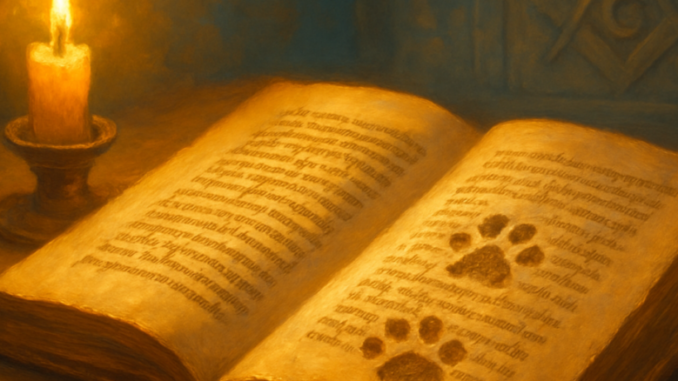
Picture a monk hunched over a sheet of parchment in a European monastery, centuries ago. He sets down his quill, waiting for the ink to dry. Moments later, a cat strolls across his workspace and leaves indelible paw prints behind. What may have caused irritation at the time fascinates us today. These tiny traces connect us to people who lived and worked seven centuries ago — people who, it turns out, tolerated the same pets we do. For Freemasons, such discoveries provoke deeper questions: how do we pass on what is valuable? And what remains of our work once we are gone?
The Cat as an Accidental Witness to History
Libraries around the world preserve manuscripts bearing cat paw prints. From Dubrovnik to Deventer, from Italy to England — wherever monks wrote, cats roamed. Scholars have documented dozens of examples, some dating back to the thirteenth century. The prints are often clearly visible, pressed into still-wet ink or stamped right across carefully written text.
These paw prints tell us more than just that cats are curious creatures. They reveal the human context behind the written word. Cats were apparently welcome in the scriptorium, most likely to chase away mice that could damage precious parchment. And when a monk noticed the paw prints, he chose not to discard the page — parchment was far too expensive. In this way, an accidental time capsule was created, one that still moves us today.
The Transmission of Knowledge as a Sacred Duty
For Freemasons, the transmission of knowledge is a central theme. The medieval monks who copied manuscripts fulfilled a role remarkably similar to that of the operative stonemasons who passed their craft skills on to the next generation. Both groups understood that individual work only gains true meaning when it lives on beyond its maker. The Constitutions of Anderson of 1723, compiled by James Anderson and John Theophilus Desaguliers, enshrined this very principle for Freemasonry: knowledge must be preserved, shared, and transmitted.
What practical lessons can we draw from this? First, that daily work — no matter how humble — leaves traces. The monk almost certainly was not thinking about future generations when he copied his text. Yet his work reaches us today, cat paw and all. Second, that we should take care with what we create and pass on. Not everything needs to be monumental. Sometimes it is precisely the small and unintended that endures.
Concrete Lessons for Today
How do you translate these historical insights into your own life? Here are three practical reflections inspired by those medieval paw prints:
Document what you do. Not for fame, but so others can build on your work. A Freemason records what he learns in lodge, shares insights with his brethren, and in doing so contributes to a living tradition.
Accept imperfection. The monk could have scraped away the paw print or destroyed the page entirely. He did neither. Sometimes it is precisely the imperfections that make something human and valuable.
Be aware of your context. Just as a cat’s paw print offers a glimpse into daily life in a medieval monastery, your surroundings reveal something about who you are. Cherish that context — it gives meaning to your work.
The Traces We Leave Behind
In Freemasonry, we speak of building the temple of humanity. Every brother contributes a stone, however small. The question is not whether your contribution will be noticed, but whether you work sincerely on something greater than yourself. The medieval copyist had no idea that his manuscript would be studied seven hundred years later. He worked in faith that his effort had meaning — even if he would never see that meaning himself.
What we create with care outlives us. Not in spite of its imperfections, but often precisely because of those small, human traces.
This applies equally to the work done in a lodge. The rituals Freemasons practice are hundreds of years old, passed down orally and in writing. Like those ancient manuscripts, they carry the fingerprints of everyone who has worked on them. Sometimes those marks are unintentional — a small variation in a text, a local adaptation. But the whole remains alive because people continue to care for it.
From Scriptoria to Lodges
The parallel between medieval scriptoria and Masonic lodges is striking. Both are spaces where knowledge is preserved and transmitted. Both have rituals and customs that give structure to the work. And both accept that human beings are fallible. A monk made copying errors; an apprentice cuts a stone at the wrong angle. What matters is the intention and the ongoing effort to improve.
The cat that wandered through the scriptorium reminds us that we are part of a world larger than our plans. We cannot control everything. What we can do is work with attention, care for what we make, and trust that our efforts will leave traces that inspire others — even if those traces look nothing like what we had envisioned.
The next time you open an old book or examine a historical document, think of the cat paw prints. They tell us that history is not only made up of great names and grand events, but also of small, everyday moments that were preserved by accident. For Freemasons, this is an invitation: work with care, share what you know, and trust that even the smallest contribution can live on.
The traces you leave behind may not be the traces you planned. But they are yours — and they matter. In Freemasonry, as in those ancient scriptoria, it is the steady, faithful work and the willingness to pass something on that truly endures. So lay your stone with care, accept the paw prints life stamps upon your efforts, and trust that what you build in sincerity will outlast you in ways you may never imagine.
Copyright text & image: devrijmetselaar.nl
Texts are based on the ideas and content of the author of devrijmetselaar.nl, reviewed, corrected, and supplemented with the assistance of OpenAI. Images are created based on the ideas of the author of devrijmetselaar.nl using OpenAI/DALL-E.
Frequently Asked Questions
What do cat paw prints in medieval manuscripts have to do with Freemasonry?
Cat paw prints in ancient manuscripts remind us that Freemasons, like the monks who preserved knowledge before them, have a sacred duty to pass on what is valuable to future generations. Both groups understood that individual work gains true meaning only when it lives on beyond its maker. These accidental marks across centuries show us that even humble, imperfect work can leave a lasting legacy that inspires others.
How does Freemasonry view the transmission of knowledge?
The transmission of knowledge is a central theme in Freemasonry, formally enshrined in the Constitutions of Anderson of 1723. Like medieval monks who copied manuscripts or operative stonemasons who taught their craft, Freemasons understand that knowledge must be preserved, shared, and transmitted to successive generations. This principle ensures that the wisdom and teachings of the fraternity remain alive and meaningful throughout time.
What practical lessons can Freemasons learn from medieval monks?
Freemasons can learn that daily work, no matter how humble, leaves traces and contributes to something greater than oneself. The article teaches us to document what we learn, share insights with our brethren, and accept that imperfections often make our contributions authentically human. By embracing these lessons, we ensure that our participation in the fraternity becomes part of a living tradition that will benefit future Masons.
Why did monks keep manuscripts with cat paw prints instead of destroying them?
Monks preserved these manuscripts because parchment was extremely valuable and expensive, making it wasteful to discard pages. This practical decision has given us a wonderful historical gift—an accidental time capsule that connects us across centuries to the people who lived and worked in medieval scriptoriums. For Freemasons, this teaches us that sometimes our most impactful contributions come not from grand gestures, but from the simple choice to preserve and pass forward what matters.

Be the first to comment