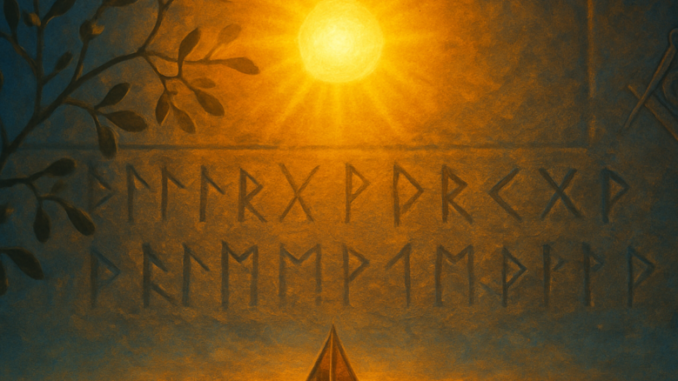
Imagine a god so radiant that every living thing loves him, yet whose fate ends in darkness. The Norse myth of Balder has captivated imaginations for centuries, but it also contains themes that will feel strikingly familiar to anyone acquainted with Masonic ritual. Both traditions grapple with the same fundamental questions about light and darkness, death and rebirth. In this article, we place these two worlds side by side and discover what they share.
The Norse Myth: Who Was Balder?
Balder was the son of the All-Father Odin and the goddess Frigg in Norse mythology. The ancient Edda texts, recorded by Icelandic poets in the thirteenth century, describe him as the god of light, purity, and beauty. His name likely means “the shining one” or “the bold one.” Everything in nature loved him — plants, animals, and humans alike. Even the gods themselves regarded him as the purest being among them.
The myth tells how Frigg made every creature and element swear never to harm Balder. She overlooked, however, one humble plant: the mistletoe. The cunning trickster god Loki discovered this weakness and persuaded the blind god Höðr to shoot an arrow of mistletoe wood at Balder. The radiant god fell dead, and the entire world mourned. His death was seen as a harbinger of Ragnarök — the twilight of the gods — but also as a promise of renewal beyond it.
A Masonic Perspective on the Same Themes
Any Freemason reading this myth will immediately recognize familiar elements. The central Hiram Abiff narrative in the Master Mason degree likewise revolves around a virtuous figure who dies through betrayal. Hiram, the legendary architect of King Solomon’s Temple, is murdered by three Fellow Crafts who seek to steal his secrets. Like Balder, Hiram represents an ideal brought down by jealousy and ignorance.
An outsider might see nothing more than old stories. The Freemason, however, recognizes a universal pattern: symbolic death as a necessary step toward deeper knowledge. In the lodge, the candidate does not witness this narrative as a spectator — he lives it as a participant. He experiences firsthand what it means to pass through darkness before the light can shine again.
Light and Darkness: What Both Traditions Share
Both Norse mythology and Freemasonry place light at the center of their symbolism — as an emblem of wisdom, truth, and the divine. Balder literally embodies light; his death plunges the world into darkness. In the lodge, the Entered Apprentice begins his journey in symbolic darkness, blindfolded, and is led step by step toward the light.
The light that follows darkness shines brighter than light that was never threatened.
This shared insight explains why death in both traditions is not an ending but a passage. Balder returns after Ragnarök into a renewed world. The Master Mason symbolically rises from Hiram’s grave. The message is identical: transformation requires letting go of a former state of being.
Practical Lessons for Daily Life
How do you translate these ancient ideas into your own life? Both the myth of Balder and Masonic ritual offer practical guidance:
Recognize your own “mistletoe”: What seemingly small weakness are you ignoring, even though it makes you truly vulnerable? We all have blind spots — identifying them is the first step toward genuine self-knowledge.
Embrace necessary endings: Sometimes an old belief, habit, or identity must die before real growth becomes possible. Resisting that process only prolongs the suffering.
Seek the light actively: Don’t wait for enlightenment to find you. Work toward it through study, reflection, and brotherhood. Illumination is earned, not bestowed.
Share your vulnerability: Balder’s apparent invulnerability became his downfall. True strength lies in acknowledging your limitations — to yourself and to the brothers around you.
Historical Connections
Eighteenth-century Freemasonry emerged during a period of intense fascination with ancient myths and mystery traditions. James Anderson, who compiled the first Constitutions of the Free-Masons in 1723, lived in an intellectual climate where scholars like Isaac Newton studied the wisdom of ancient civilizations. While Norse mythology was not directly incorporated into early Masonic ritual, there was a shared conviction that ancient narratives contained timeless truths.
Later Freemasons — particularly in Scandinavia — drew more explicit connections. The Swedish Rite, which developed during the eighteenth century, integrated elements from local traditions. The universal themes of death and rebirth proved recognizable everywhere, regardless of their cultural packaging.
Two Worlds, One Wisdom
The Norse myth and Freemasonry come from different times and places, yet they speak the same language. Both acknowledge that life is cyclical, that light and darkness need each other, and that true wisdom comes through experience. The outsider sees old stories; the initiate recognizes a living truth.
What makes this relevant to you? Perhaps you are standing before a symbolic death of your own — the end of a relationship, a career, a self-image. The question is not whether such endings will come, but how you meet them. Balder taught the gods that even the purest light can be extinguished. Freemasonry teaches that after that darkness, you can rise stronger than before.
The myth of Balder and the symbolism of Freemasonry together offer a powerful message: darkness is not a dead end but a doorway. Whether you are familiar with ancient Norse texts or with the rituals of the lodge, the core truth remains the same. Light only gains its full value once you have known its absence. That understanding is something you can apply today — in every situation where the darkness seems to close in around you.
Copyright text & image: devrijmetselaar.nl
Texts are based on the ideas and content of the author of devrijmetselaar.nl, reviewed, corrected, and supplemented with the assistance of OpenAI. Images are created based on the ideas of the author of devrijmetselaar.nl using OpenAI/DALL-E.
Frequently Asked Questions
Who was Balder in Norse mythology?
Balder was the son of Odin and the goddess Frigg, known as the god of light, purity, and beauty. His name means 'the shining one' or 'the bold one.' Everything in nature loved him, and he was considered the purest being among the gods. According to the myth, he was killed by an arrow made of mistletoe wood, which was the only thing capable of harming him.
What are the similarities between the Balder myth and Freemasonry?
Both traditions feature a virtuous figure who dies through betrayal or treachery. Balder's death in Norse mythology parallels the Hiram Abiff narrative in the Masonic Master Mason degree. In both cases, symbolic death represents a necessary step toward deeper knowledge and renewal. Both also emphasize light as a central symbol representing wisdom, truth, and the divine.
What do light and darkness symbolize in both Norse mythology and Freemasonry?
In both traditions, light serves as an emblem of wisdom, truth, and the divine, while darkness represents ignorance or a state before enlightenment. Balder's death literally plunges the world into darkness in Norse mythology, while in Freemasonry, candidates begin their journey in symbolic darkness before experiencing illumination, reflecting the universal pattern of passing through darkness to achieve greater understanding.

Be the first to comment