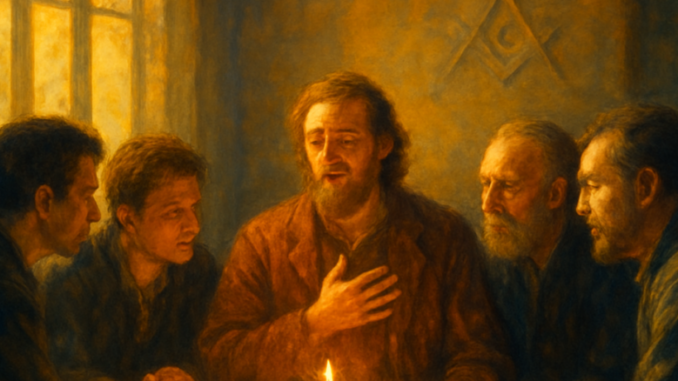
This personal account of a Masonic comparition on the theme of love remains remarkably relevant, even more than two years after the event. The openness with which brothers spoke about what love means to them strikes a universal, timeless chord. What follows is an honest reflection on selflessness, vulnerability, and the extraordinary power of brotherly connection.
What Is a Comparition?
I was told afterward that I had just experienced a real comparition — a traditional Masonic discussion in which brothers openly share their thoughts following the presentation of a paper. That said, the remark was quickly qualified. The previous comparition had been about the concept of the Daimon and had taken the form of a guided group discussion after an introduction by two brothers. This evening was different because the originally planned event had been cancelled at the last moment. Fortunately, one of the brothers had a Tracing Board paper — what we call a “Bouwstuk” — far enough along that he could present it. The subject: love.
Love Is Everywhere
Love is everywhere, and without it, there is really no life. You see love in all its forms — between partners, in the devotion someone shows to a pet, or in the countless acts people perform simply out of love for others. There is even the possibility of covering something with the cloak of love, choosing compassion over judgment. The brother who presented the paper explored these many dimensions, drawing on a wide range of sources to illustrate just how deeply love is woven into the human experience.
The Bible and Love
The presenting brother drew heavily on passages from the Bible. Now, I have to be honest — I have no personal connection to the Bible. I didn’t grow up with it, and the various books and verses are largely unfamiliar to me. I had even worried that encountering so many biblical references in Freemasonry might make me feel out of my depth. And truthfully, following the specific passages was sometimes challenging. But the underlying ideas? Those resonated deeply. That’s what I find so beautiful about Masonic work — it’s never really about the source material itself, but about the universal truths that lie beneath it.
When Brothers Open Their Hearts
After the brother delivered his paper, the actual comparition began — and it didn’t unfold entirely by the book. Instead of the traditional format of questions and answers directed at the presenter, the discussion was opened up to the entire Lodge. One by one, brothers began sharing what love meant to them personally and how it manifested in their lives.
For some, emotions ran high. And that is not only permitted in the Lodge — it is welcomed. It was moving to watch how other brothers responded: offering comfort, a hand on the shoulder, a quiet presence. This is one of the great gifts of Freemasonry. Everything said within the Lodge stays within the Lodge, protected by what we call the “indented border” — the symbolic boundary that separates the sacred space of the Lodge from the outside world. This confidentiality creates an environment where conversations can become deeply personal, where men can be genuinely vulnerable without fear of judgment.
Selfless Love Versus Self-Serving Love
A particularly thought-provoking part of the discussion centered on the distinction between selfless love and self-serving love. Is there such a thing as truly altruistic love, or does every act of love carry some element of personal gratification? The conversation didn’t yield easy answers, but it set something in motion within me — a memory that surfaced with startling clarity.
A Father’s Quiet Love
I thought of my father, an optician by trade, who used to visit people in the hospital to fit them with new glasses. His reasoning was simple: even in their final days, people deserved to watch television clearly or see the faces of their loved ones one last time. He did this often without sending a bill, and always in his own free time.
But there was another side to his quiet service that struck me even more. On his days off, my father would visit a maximum-security prison to provide glasses to the most hardened inmates. He insisted that the guards leave the room while he worked. It’s something almost unimaginable today. He didn’t see those men as criminals — he saw them as human beings who deserved their dignity and the simple gift of clear sight. He never talked about any of this. He simply did what felt right: helping his fellow human beings regardless of their background and without any expectation of return.
That, to me, is what selfless love looks like. It asks for nothing. It announces nothing. It simply acts, quietly and without condition. And it is precisely this kind of love that Freemasonry encourages us to cultivate — not through grand gestures, but through consistent, humble service to others.
This comparition reminded me that love, in all its forms, is both the simplest and the most complex force in our lives. Within the safe and sacred space of the Lodge, brothers can explore its depths with a honesty that is rare in the outside world. Whether selfless or imperfect, spoken or silent, love remains the foundation of true brotherly connection — and perhaps the most important building stone any Freemason can lay.
Copyright text & image: devrijmetselaar.nl
Texts are based on the ideas and content of the author of devrijmetselaar.nl, reviewed, corrected, and supplemented with the assistance of OpenAI. Images are created based on the ideas of the author of devrijmetselaar.nl using OpenAI/DALL-E.
Frequently Asked Questions
What is a Comparition in Freemasonry?
A comparition is a traditional Masonic discussion where brothers openly share their thoughts and reflections following the presentation of a paper or topic. Rather than a formal question-and-answer session, it creates a space for meaningful dialogue where members can vulnerably explore ideas together and learn from one another's perspectives.
Do I need to be religious or familiar with the Bible to join Freemasonry?
No, you don't need to be religious or have biblical knowledge to be part of Freemasonry. While Masonic teachings may reference various sources including religious texts, the focus is always on the universal truths and principles underlying these materials, not on any specific religious doctrine or background.
What happens during emotional or vulnerable moments in a Masonic Lodge?
Freemasonry welcomes emotional authenticity and vulnerability as brothers share their personal experiences and feelings. When emotions arise, other members respond with compassion and support—offering comfort, presence, and a listening ear—creating a safe, brotherly space for genuine human connection.
Is what is shared in a Masonic Lodge kept confidential?
Yes, everything shared within the Lodge is protected by what Freemasons call the "indented border," a symbolic boundary that ensures the sacred space of the Lodge remains confidential. This protection allows brothers to speak openly and authentically without fear of their words leaving the Lodge.
What makes Freemasonry's approach to discussing topics like love unique?
Freemasonry creates a special environment where brothers can explore profound topics through both intellectual discussion and personal reflection, while maintaining mutual respect and emotional support. This combination of thoughtful inquiry, authentic sharing, and brotherly care makes Masonic discourse uniquely meaningful and transformative.


Be the first to comment