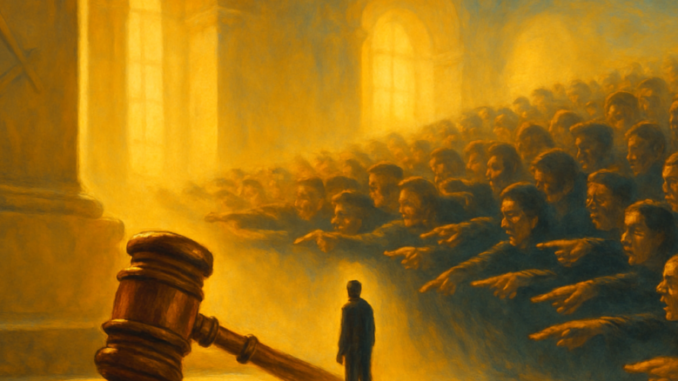
When news breaks that a public figure has been accused of a serious crime, society often delivers its verdict long before any judge has spoken. We have seen this pattern play out time and again: allegations become public, and within hours a collective judgment has already formed. This phenomenon touches on fundamental questions about justice, human dignity, and how we as a society deal with guilt and innocence. And it is precisely on these matters that Freemasonry — with its centuries-old tradition of moral reflection — has a surprising amount to offer.
The Court of Public Opinion
In our age of instant news and social media, the court of public opinion is permanently in session. The moment an accusation becomes public, millions of people begin forming their judgment. This happens without access to the evidence, without hearing both sides, and without the nuance that a proper trial demands. Social condemnation moves at lightning speed and is often irreversible — even when an acquittal follows later.
This raises an uncomfortable question: what does this rush to judgment say about us? Freemasonry teaches its members that forming a judgment about a fellow human being is one of the gravest responsibilities a person can bear. Within the lodge, Masons practice the art of suspending judgment — of seeking understanding before arriving at a conclusion.
The Level: A Symbol of Equality
One of the most powerful symbols in Freemasonry is the level. This working tool reminds the Mason that all people — regardless of status, wealth, or fame — are equal in their human dignity. A celebrity does not deserve more condemnation than an unknown person, but neither do they deserve less protection under the presumption of innocence.
The level asks us to recognize that both the accuser and the accused are human, with all the vulnerability that entails. When we as a society condemn someone before the facts have been established, we violate this principle of fundamental equality. We place ourselves above another person and claim a moral superiority that belongs to no one.
Silence as a Virtue in a Screaming World
In Masonic lodges, silence plays a distinctive role. New members are taught to remain silent and listen before they speak. This practice stands in stark contrast to our current culture, where everyone has a platform and silence is mistaken for weakness. Yet there is profound wisdom in keeping quiet when one does not know enough.
True judgment requires knowledge, and knowledge requires time. He who speaks without knowing builds upon loose sand.
This ancient wisdom still holds. When the news confronts us with serious allegations, our first impulse is often to take a side. Freemasonry suggests a different path: acknowledge the gravity of the situation, show compassion for potential victims, but guard yourself against a definitive verdict until the truth has been established.
Shadow and Light
Freemasons work symbolically in a space between darkness and light. This represents the human condition: we all carry both shadow and light within us. When allegations surface against public figures, society is forced to confront this duality. Someone who was admired may also have committed acts that are reprehensible.
This symbolism also invites self-reflection. Our eagerness to condemn others can sometimes serve as a distraction from our own shadows. By pointing a finger at someone else, we avoid having to look at ourselves. Freemasonry warns against this tendency: know yourself before you presume to judge others.
The Importance of Institutions
This is precisely why civilized societies created systems of justice. Not because judges are infallible, but because a structured process of establishing truth is far better than the arbitrary judgment of a crowd. Freemasons have contributed to the development of thinking about the rule of law and civil rights throughout history. The principle that a person is innocent until proven guilty is a cornerstone of this tradition.
Consider what is at stake: the right to a fair trial protects everyone; victims deserve a thorough and careful pursuit of truth; the accused deserve the chance to mount a defense; and society as a whole deserves confidence in its institutions. When we bypass these safeguards through premature public condemnation, we weaken the very structures designed to protect us all.
Compassion as a Compass
How, then, do we navigate these difficult waters? Freemasonry offers a compass: compassion. This does not mean choosing sides, nor does it mean trivializing serious allegations. It means recognizing that in every such case, human suffering is present. Potential victims deserve our empathy and support. At the same time, the presumption of innocence reminds us that the accused remains a human being.
This balance is not easy. It requires us to hold multiple truths at once without falling into oversimplification. Yet it is precisely within this complexity that growth becomes possible. A society that learns to judge with nuance ultimately becomes more just than one that reacts on emotion alone.
The social condemnation we witness daily in response to public accusations holds up a mirror to who we are. Freemasonry, with its emphasis on self-knowledge, equality, and reflection, offers no ready-made answers — but it does offer a method. It invites us to slow down our rush to judgment, to show compassion to all involved, and to trust the institutions we have built as a society. In short, it asks us not to be less but to be more human in an age that rewards speed over wisdom.
Copyright text & image: devrijmetselaar.nl
Texts are based on the ideas and content of the author of devrijmetselaar.nl, reviewed, corrected, and supplemented with the assistance of OpenAI. Images are created based on the ideas of the author of devrijmetselaar.nl using OpenAI/DALL-E.
Frequently Asked Questions
What does Freemasonry teach about judging others?
Freemasonry teaches that forming judgment about a fellow human being is one of the gravest responsibilities a person can bear. Masons practice the art of suspending judgment and seeking understanding before arriving at a conclusion, recognizing that true judgment requires knowledge and time.
How does the Masonic symbol of the Level relate to fairness?
The Level is a powerful Masonic symbol that reminds members that all people—regardless of status, wealth, or fame—are equal in their human dignity. It teaches us to recognize both the accuser and the accused as vulnerable human beings deserving equal protection under the presumption of innocence.
Why does Freemasonry value silence?
In Masonic lodges, silence is taught as a distinctive virtue, with members encouraged to listen before they speak. This practice reflects the wisdom that true judgment requires knowledge, and rushing to verdict without understanding builds upon loose sand.
How can Freemasonry's principles help us respond to public accusations?
Freemasonry suggests that when serious allegations emerge, we should acknowledge their gravity and show compassion for potential victims, but guard ourselves against a definitive verdict until the truth has been established through proper evidence and due process. This approach honors both human dignity and justice.


Be the first to comment