Imagine that the most valuable friendship in your life is one you never sought out — one that fits no category, defies every label, and forces you to reconsider all your definitions of human connection. Wouldn’t that be precisely the kind of bond that reveals the most about who you truly are?
The Paradox of the Unnameable
Some relationships resist classification. Not because they lack significance, but because they are so essential that every label falls short. Acquaintance? Too shallow. Friend? Too loaded with the expectations and conditions we unconsciously attach to the word. And yet, there is that person — someone with whom every conversation immediately plunges into depth, someone in whose presence the mask slips away and the real face emerges. Someone you met through chance, through loss, through a chain of circumstances no one could have planned. It is precisely this unplanned quality that makes the connection so pure.
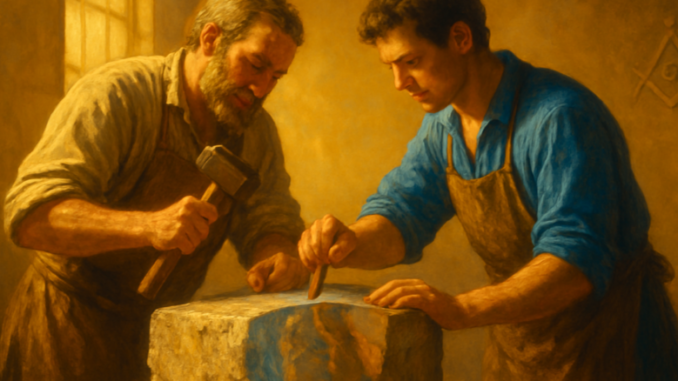
In Freemasonry, this experience finds expression in an ancient and powerful symbol: the rough ashlar that must be shaped. Not in isolation, but through interaction. The other person acts as chisel and mallet at once — not to wound, but to help us give form to who we might become. The extraordinary friend, that person who falls outside every category, may be the most effective sculptor of our inner life.
Beyond Judgment: The Mirror Without Distortion
What makes a relationship truly special? Not its duration, not the frequency of contact, and not even a shared history. What makes a relationship genuinely extraordinary is the absence of judgment. The philosopher Martin Buber described the difference between an “I-It” relationship and an “I-Thou” relationship. In the first, we approach the other as an object, a means, a category. In the second, we encounter the other in their full humanity — without agenda, without reduction. That second encounter is rare. It arises when two people are willing to lay down their defenses and truly listen.
In the Masonic tradition, the lodge is described as a space where brethren meet “on the level” — as equals, stripped of social rank and status. This principle is not merely a formality. It is an exercise in releasing judgment. When you approach another person without predetermined standards, space opens for something greater than either individual. That is precisely what happens in a friendship that defies definition: nothing is measured; instead, a genuine meeting takes place.
Loss as the Bond That Connects
Many of the deepest human connections are forged in the fire of loss. A death, a crisis, a shared vulnerability. It is a strange truth that death sometimes brings the living closer together than any celebration ever could. In Masonic symbolism, this paradox is represented by the sprig of acacia — a sign of immortality that grows upon the grave. From farewell, new life emerges; from grief, connection is born.
The extraordinary friend who appears on your path after an experience of loss is not a coincidence. Or rather, it doesn’t matter whether it is. What matters is the willingness to be truly present in that moment of shared vulnerability. Freemasonry teaches that life is a series of initiations — moments when the veil is lifted and a deeper layer of reality becomes visible. An encounter that grows from loss can be exactly such an initiation.
“True friendship is not based on similarity, but on the willingness to embrace difference without seeking to eliminate it.”
Difference as Enrichment: The Mosaic of Opposites
In every Masonic lodge lies the mosaic pavement — a pattern of black and white tiles symbolizing the unity of opposites. Light and dark, day and night, joy and sorrow. They exist not in spite of each other, but because of each other. The same is true of the extraordinary friend: it is precisely the difference in background, perspective, and life experience that makes the encounter fruitful. When two people think and feel exactly the same way, conversation loses its direction. It is friction that generates warmth, contrast that brings clarity.
The true art — and here we touch the very core of the Masonic ideal — is to let that difference exist without attaching a value judgment to it. Not wanting to change the other person, not seeking to confirm your own rightness, but being genuinely curious about what the other sees that you have not yet perceived. It is a practice that lasts a lifetime and is never fully mastered, but one that enriches us with every attempt.
The Unfinished Temple
In Freemasonry, the building is never complete. The temple we construct — both within ourselves and in our relationships — is by definition unfinished. This is not a flaw; it is the very nature of the endeavor. The extraordinary friend reminds us that growth does not occur in isolation but in dialogue. Every encounter is a stone laid, every honest exchange a joint filled with mortar.
Perhaps we do not need to give the extraordinary friend a name, a category, or a place in our carefully constructed system of relationships. Perhaps it is enough to acknowledge that some connections derive their value from precisely that which cannot be captured in words. The square and compasses — those central symbols of Freemasonry — remind us that there is always a tension between measure and the immeasurable, between structure and that which transcends all structure.
And so the question remains open, as every truly important question should: Is it possible to fully encounter another person without needing to name that encounter? Can the friendship that has no label be, for that very reason, the purest of all? And what does it say about us if we are willing to endure that uncertainty — to stand in the unnameable and remain there, without judgment, without resolution, simply present?
Copyright text & image: devrijmetselaar.nl
Texts are based on the ideas and content of the author of devrijmetselaar.nl, reviewed, corrected, and supplemented with the assistance of OpenAI. Images are created based on the ideas of the author of devrijmetselaar.nl using OpenAI/DALL-E.
Frequently Asked Questions
What does Freemasonry teach about the meaning of true friendship?
Freemasonry teaches that the deepest friendships transcend labels and categories, arising when two people meet without judgment or predetermined expectations. The Masonic principle of meeting 'on the level' as equals emphasizes genuine human connection stripped of social status, allowing for authentic encounters that reveal our truest selves. These extraordinary bonds act as mirrors for personal growth and self-discovery.
What is the significance of the rough ashlar symbol in Freemasonry?
The rough ashlar represents the unfinished state of the self that must be shaped and refined through interaction with others. In Freemasonry, this symbol teaches that personal development is not a solitary journey but occurs through our relationships and encounters with others, who serve as instruments of our growth and transformation.
How does Freemasonry view the connection between loss and human bonding?
Freemasonry recognizes that profound human connections are often forged through shared experiences of loss and vulnerability. The Masonic symbol of the sprig of acacia demonstrates this paradox—representing immortality and new life emerging from grief—teaching that our deepest bonds and spiritual growth frequently arise from moments of farewell and shared sorrow.
What does 'meeting on the level' mean in Masonic philosophy?
Meeting 'on the level' means approaching others as equals without regard to social rank, status, or worldly distinctions. This Masonic principle is an exercise in releasing judgment and preconceived notions, creating sacred space where genuine human encounter can occur and both individuals can be fully seen and accepted.

Be the first to comment