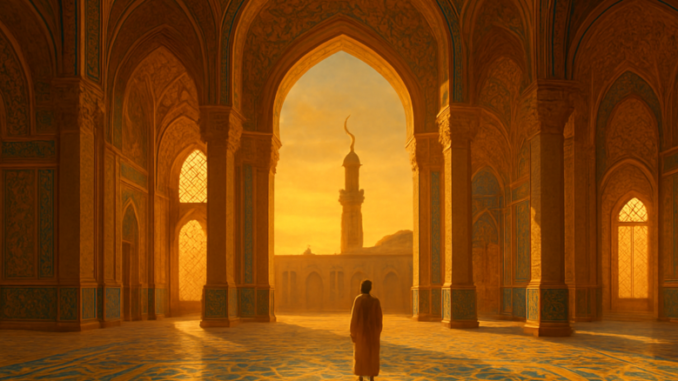
A candle flickers in the silence of the lodge. A Freemason opens an ancient book and reads words about light separating darkness, about truth distinguishing itself from illusion. For a brief moment, everything falls into place: this power of discernment — this ability to see clearly — is precisely what he seeks within these walls. In the twenty-fifth Surah of the Quran, known as Al-Furqan or The Criterion, we encounter a theme that runs through all spiritual traditions and resonates deeply with the inner journey of the Freemason.
The Heart of The Criterion
Surah Al-Furqan takes its name from the Arabic word that denotes the ability to separate truth from falsehood, good from evil, light from darkness. The Surah opens with praise for the Creator who bestowed this power of discernment upon humanity as a gift. This is no trivial matter: the capacity to truly distinguish what is true and good forms the foundation of every spiritual quest.
In the Islamic tradition, this criterion refers to divine revelation itself — the standards by which a person can determine the course of their life. But its meaning reaches far beyond any single religious context. At its core lies a universal human struggle: how do we navigate a world filled with contradictory signals, half-truths, and seductive illusions?
The Perspective of the Believer
For the Muslim, The Criterion serves as a reminder of the divine guidance available to those who open themselves to it. The Surah describes how prophets throughout the ages were mocked, rejected, and opposed — precisely because they drew distinctions that the established order found uncomfortable. Yet they remained faithful to their calling. Discernment here is not merely intellectual; it demands courage, steadfastness, and a certain solitude.
The Surah also speaks of creation itself as a sign of divine wisdom: the alternation of day and night, the water that brings life, the wind that blows freely. In these natural rhythms, the believer perceives a pattern, an order pointing to something far greater than the human mind alone can grasp.
The Masonic Perspective
The Freemason recognizes something deeply familiar in this theme of discernment. The entire ritual work of the lodge revolves around the movement from darkness to light, from rough ashlar to perfect cube, from ignorance to insight. The candidate who first enters the lodge does so blindfolded, only to then receive the light. This is no accidental symbolism — it is the dramatization of precisely this capacity to discern.
Johann Wolfgang von Goethe, himself a Freemason and lifelong seeker of wisdom, wrote about the necessity of inner discernment. He saw it as the essence of self-knowledge: only those who truly know themselves can distinguish between what serves them and what leads them astray. Isaac Newton, likewise connected to the tradition of searching minds, devoted his life to uncovering the hidden laws behind the visible world.
Discernment is the inner compass that helps the seeker navigate between truth and illusion, between what elevates and what diminishes.
Where Both Perspectives Meet
Despite their different forms and languages, the Islamic approach and the Masonic tradition share a profound respect for the search for truth. Both acknowledge that humankind is imperfect but possesses the capacity to grow. Both view the world as a place of trial and opportunity, where the distinction between good and evil is not always simple but is always essential.
Both traditions emphasize the value of inner reflection. Both regard light as a symbol for knowledge and truth. Both recognize that genuine insight requires courage and perseverance. And both warn against the temptation of appearances and superficiality.
It is striking how the description in Al-Furqan of the servants of the Most Merciful — those who walk humbly upon the earth and seek peace — echoes the Masonic ideal. These servants refuse to be swept away by anger or vengeance. They seek balance, temperance, and purity of heart. These are virtues pursued in every lodge around the world.
A Lesson for the Modern Seeker
In an age of information overload, where facts and opinions blur together and algorithms determine what we see, the power of discernment may be more valuable than ever. The question posed by both Surah Al-Furqan and the Masonic tradition is ancient, yet it remains urgent: how do you know what is true? How do you recognize genuine wisdom amid the noise?
The answer lies not in a formula or a system but in an attitude. It requires silence, reflection, and the willingness to question your own assumptions. Whether you are a believer opening the Quran or a Freemason entering the lodge, both take a moment to leave the outside world behind and turn inward. It is in that interior space that true discernment becomes possible.
A Shared Journey
Freemasonry does not claim to possess religious truth. It invites people of all backgrounds to seek, build, and grow together. When a Freemason reads a text like Al-Furqan, he does so not as a competitor to the believer but as a fellow seeker. The forms differ, but the direction is unmistakable: from darkness to light, from confusion to clarity, from rough stone to finished edifice.
Surah Al-Furqan reminds us that the ability to discern is not a luxury — it is a necessity for anyone who wishes to lead a meaningful life. Whether you draw from the wisdom of the Quran, the rituals of the lodge, or the insights of thinkers like Goethe and Newton, the invitation is the same: develop your inner compass. Learn to separate appearance from reality. And walk, with humility and determination, toward the light.
Copyright text & image: devrijmetselaar.nl
Texts are based on the ideas and content of the author of devrijmetselaar.nl, reviewed, corrected, and supplemented with the assistance of OpenAI. Images are created based on the ideas of the author of devrijmetselaar.nl using OpenAI/DALL-E.


Be the first to comment