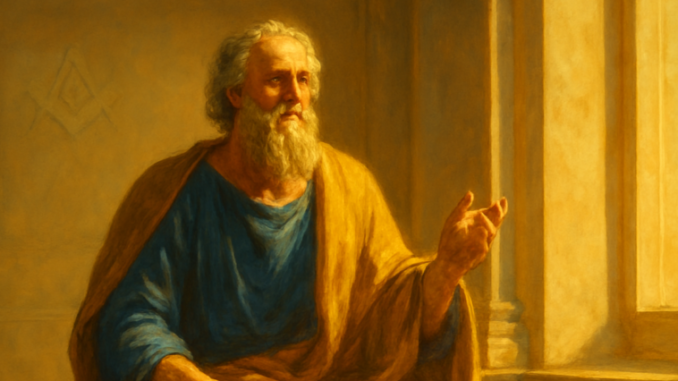
You may have wondered where that deep human urge for connection truly comes from — that pull toward something greater than yourself, toward beauty, toward truth. Plato asked the same question more than two thousand years ago, and his answer in the Symposium has shaped generations of thinkers. But Plato didn’t write in a vacuum. His ideas about love were nourished by a rich philosophical tradition reaching back to the earliest Greek thinkers. Let’s explore the intellectual sources that gave shape to this masterwork — and discover why it resonates so profoundly with the Masonic tradition.
The Legacy of the Presocratic Philosophers
Before Plato ever put pen to paper, thinkers like Parmenides and Heraclitus had already posed fundamental questions about the nature of reality. Parmenides taught that behind the ever-changing world lies an unchanging truth. This idea echoes powerfully in Plato’s vision of love as a ladder leading upward to the eternal and immutable Beautiful. Heraclitus, by contrast, emphasized the constant flux of existence — the perpetual state of becoming. In the Symposium, both influences are clearly at work: love as a dynamic force that sets us in motion, yet directed toward something that transcends all change.
Empedocles, another early thinker, introduced the concept of Love and Strife as the two cosmic forces that order the universe. For him, love was literally the power that draws the elements together. Plato refined this idea and made it deeply personal: it is not only atoms but also human souls that are driven by a longing for unity.
Socrates as the Living Source
The most important philosophical influence on the Symposium is, of course, Socrates himself — Plato’s teacher. Socrates stands at the center of the dialogue, and his method of questioning, the famous maieutic technique, structures the entire conversation. But there is more. Socrates represents a fundamentally new approach to philosophy: it is not about accumulating knowledge, but about self-examination. “Know thyself,” the inscription at the temple of Delphi, became his life’s motto.
In the Symposium, Socrates reveals that he learned his wisdom about love from Diotima, a mysterious priestess. Through her, Plato presents the theory of love as an ascending movement: from the desire for a beautiful body, through beautiful souls and beautiful knowledge, to the direct contemplation of Beauty itself. This is no dry theory — it is an invitation to inner transformation.
Love in Plato’s vision is not a possession, but a movement of the soul toward that which makes it complete.
Pythagoras and the Harmony of the Soul
Another crucial influence is the Pythagorean tradition. Pythagoras and his followers believed that reality is structured according to mathematical proportions and that the soul is immortal, journeying through successive lives. These ideas seeped deeply into Plato’s thought. The notion that the soul remembers what it once beheld in a higher realm plays a central role in his philosophy of love.
When you read about the longing for unity and completeness in the Symposium, you can hear echoes of Pythagorean harmony. Love brings the soul back to its original state of wholeness. This is not a sentimental notion but a cosmological vision in which the individual is part of a greater whole — a concept that will feel immediately familiar to anyone who has reflected on the meaning of the Masonic lodge as a microcosm of the universe.
The Mysteries of Eleusis
Plato’s description of love as a path of initiation is strongly reminiscent of the Eleusinian Mysteries — the secret religious rites celebrated in ancient Greece. Initiates passed through stages of purification and revelation, culminating in a vision of the divine. The language Diotima uses to describe the highest experience of love contains unmistakable references to this mystery tradition.
This aspect makes the Symposium far more than a philosophical treatise. It is a text that invites you on an inner journey, comparable to the path a candidate walks during an initiation ritual. You begin in darkness and ignorance, and through dedication and insight, you draw ever closer to the light. For Freemasons, this parallel hardly needs elaboration — the journey from darkness to light is the very heart of the Craft.
Aristophanes and the Myth of Original Wholeness
In the Symposium, the comic playwright Aristophanes tells a famous myth about the origin of love. Once, he says, human beings were double creatures — whole and complete. But the gods split them in two, and ever since, we have been searching for our other half. Though told with playful wit, this story touches on deep philosophical and religious traditions concerning the original unity of humankind.
Plato places this myth alongside the more abstract teaching of Diotima, offering the reader multiple perspectives on love. One emphasizes the yearning for personal completion; the other points toward the universal and eternal. Together, they create a rich and layered portrait of what it means to be human — incomplete, searching, and driven by a desire for something beyond the self.
From Athens to the Lodge Temple
The philosophical background of the Symposium helps explain why this work resonates so deeply with Freemasonry. The emphasis on step-by-step initiation, on the search for light and truth, on the transformation of the soul — these themes sound remarkably familiar within the lodge. Just as the participants in Plato’s symposium gathered to seek insight together, each from their own perspective, so too do Brethren assemble to pursue understanding, united by a common aspiration.
Plato shows us that love is not a destination but a continuous movement. That thought is worth carrying into your own life. Where are you on your journey toward the higher? What beauty is drawing you forward?
Plato’s Symposium is no isolated masterpiece. It is the flowering of a rich philosophical tradition stretching back to the earliest Greek thinkers. From Parmenides to Pythagoras, from the Eleusinian Mysteries to the maieutic method of Socrates, all these sources flow together in Plato’s vision of love as a transformative force. By understanding this background, you can read the text more deeply and recognize how these same themes remain vibrantly alive in traditions that seek wisdom and brotherhood — not least in the living tradition of Freemasonry itself.
Copyright text & image: devrijmetselaar.nl
Texts are based on the ideas and content of the author of devrijmetselaar.nl, reviewed, corrected, and supplemented with the assistance of OpenAI. Images are created based on the ideas of the author of devrijmetselaar.nl using OpenAI/DALL-E.
Frequently Asked Questions
What is the connection between Plato's Symposium and Freemasonry?
The article suggests that Plato's Symposium resonates profoundly with the Masonic tradition. Both explore the deep human urge for connection, self-examination, and the ascent toward higher truths and beauty. The Platonic vision of love as a ladder leading toward eternal and immutable Beauty parallels Masonic teachings about spiritual transformation and enlightenment.
How did earlier Greek philosophers influence Plato's ideas about love?
Plato's Symposium was shaped by Presocratic philosophers including Parmenides, who taught that unchanging truth lies behind the changing world; Heraclitus, who emphasized constant flux and becoming; and Empedocles, who introduced love and strife as cosmic forces that order the universe. Plato synthesized these ideas to create his vision of love as a dynamic force directed toward eternal Beauty.
What role did Socrates play in Plato's understanding of love?
Socrates was the most important philosophical influence on the Symposium. Through his maieutic (questioning) method and emphasis on self-examination, Socrates structures the entire dialogue. In the text, Socrates reveals that he learned his wisdom about love from Diotima, a priestess, presenting the theory of love as an ascending movement from desire for physical beauty to the contemplation of Beauty itself—a journey of inner transformation.

Be the first to comment