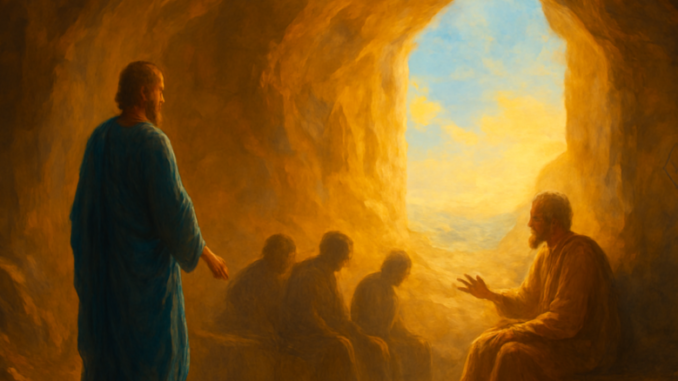
You probably know the feeling. You experience an insight that changes your life — a moment of clarity that shifts everything. And then comes the real challenge: how do you share it with others? How do you help someone else see the same light? This is precisely the question Plato posed more than two thousand years ago in his famous cave allegory. And it is precisely the question that Freemasonry answers anew every day within its lodges.
The Prisoner Who Returns
In Book VII of The Republic, Plato describes a group of prisoners chained inside a cave. All they can see are shadows flickering on the wall, and they mistake these shadows for reality. When one prisoner is freed and steps outside, he discovers sunlight and the real world for the first time. But here is the crucial point: he goes back into the cave. Not because he has to, but because he chooses to. He feels a responsibility to help the others.
This is not some abstract philosophical thought experiment. It is a practical calling you can act on today. The freed prisoner chooses to seek connection with those still in darkness. He could have stayed outside, basking in the light alone. But true wisdom, Plato teaches us, demands to be shared.
Connection as Masonic Practice
In Freemasonry, we recognize this pattern immediately. The Master Mason has traveled a path from darkness to light. He has gained insights into virtue, self-reflection, and moral growth. But his journey does not end with personal enlightenment. The very heart of brotherhood is this: returning to the cave — figuratively speaking — to guide others along their own path.
Wisdom that is not shared is like a candle that burns only for yourself: it illuminates, but it warms no one.
This is not a theoretical consideration. You can see this principle in action in every lodge. Experienced brethren mentor newcomers — not by preaching, but by working together, sharing in ritual, and reflecting side by side. True connection does not arise from transferring knowledge. It comes from standing beside someone while he finds his own way toward the light.
Three Practical Steps Toward Connection
How can you apply this in your own life? Plato’s allegory offers a surprisingly practical framework. The freed prisoner does three things that we can all adopt.
First, he accepts discomfort. Returning to the cave is painful. Your eyes must readjust to the darkness. Seeking connection with people who think differently requires you to step outside your comfort zone. Growth rarely happens in familiar territory.
Second, he does not expect immediate appreciation. The prisoners in the cave laugh at him and call him foolish. Yet he stays. Genuine connection demands patience and the willingness to be misunderstood or even rejected.
Third, he shows rather than tells. He does not try to describe the sun in words. Instead, he invites others to come and see for themselves. In Freemasonry, we call this letting the ritual speak. The experience itself becomes the teacher.
Recognizing the Cave in Everyday Life
You do not need to be a Freemason to apply these principles. The cave is everywhere. It is the meeting room where everyone seems to agree, but no one truly listens. It is the family dinner table where sensitive topics are carefully avoided. It is the circle of friends where superficiality has become the unspoken norm.
Seeking connection in these settings means having the courage to start a different kind of conversation. Not by declaring that everyone else is wrong, but by asking a question that invites deeper reflection. By showing your own vulnerability. By demonstrating that there is more to life than the shadows on the wall.
Why Returning Is the Ultimate Act
Plato makes a fundamental point in The Republic that is often overlooked. The philosopher who does not return to the cave is no true philosopher. Wisdom without compassion is incomplete. Knowledge without connection is sterile. This resonates deeply with the Masonic values of brotherhood and the pursuit of moral perfection.
The search for truth is not a solitary endeavor — it is a shared journey. Aristotle, Plato’s student, would later develop this idea further in his writings on friendship and community. Freemasonry builds on this classical tradition by providing a concrete structure within which connection can flourish: the lodge as a training ground for brotherhood.
Start Today
The cave allegory is not a story about the distant past. It is an invitation for today. Look around you. Where can you seek connection? Who in your life would benefit from someone standing beside them? You do not need grand gestures. An honest conversation, a listening ear, an outstretched hand — these are the first steps out of the cave.
Freemasonry teaches us that inner growth and connection with others are not opposing forces. They reinforce each other. The more you grow, the more you have to share. The more you share, the more you grow. Plato understood this. Today’s lodges put it into practice.
Plato’s cave allegory is far more than a philosophical thought experiment. It is a handbook for connection — a call to return to the places where darkness prevails and to bring light. Not by blinding others, but by inviting them. Not by preaching, but by being present. In this practical wisdom, classical philosophy and Freemasonry meet on common ground. The question is not whether you have seen the light. The question is: with whom will you share it today?
Copyright text & image: devrijmetselaar.nl
Texts are based on the ideas and content of the author of devrijmetselaar.nl, reviewed, corrected, and supplemented with the assistance of OpenAI. Images are created based on the ideas of the author of devrijmetselaar.nl using OpenAI/DALL-E.

Be the first to comment