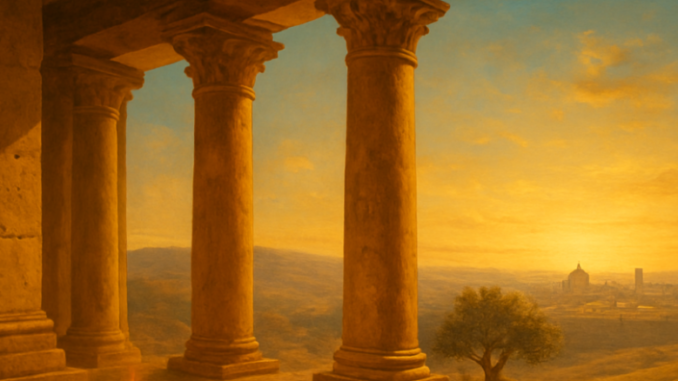
Somewhere around the year 62 AD, a man sat in a Roman prison cell, chained to a soldier, uncertain of his fate. Yet from that confinement he produced one of the most joyful texts in Western history. Paul of Tarsus wrote to the faith community in Philippi — a Roman colony in northern Greece — and the letter he composed would be read for centuries as a masterwork on inner freedom amid outer constraint. For Freemasons, devoted to building the inner temple, this ancient text contains remarkably timely insights.
A Letter From a Roman Dungeon
The city of Philippi owed its name to Philip II of Macedon, father of Alexander the Great. By the first century, it had become a thriving Roman veterans’ colony on the Via Egnatia — the great trade route connecting East and West. It was here, around 50 AD during his second missionary journey, that Paul established a small community. The Philippians remained loyal supporters, even after he was imprisoned in Rome. They sent him gifts and dispatched a trusted companion named Epaphroditus to care for him.
The letter Paul wrote in return is remarkably personal in tone. Unlike his other epistles, Philippians contains almost no doctrinal polemics. Instead, he shares his inner state: his acceptance of uncertainty, his joy despite captivity, his hope without guarantees. The Roman guards assigned to watch him became, he writes, unwitting carriers of his message. Even in chains, he continued to build something that no prison could contain.
The Paradox of Freedom in Captivity
At the heart of Philippians lies a paradox that Freemasons will readily recognize: true freedom does not depend on outward circumstances. Paul writes that he has learned to be content in every situation, whether in abundance or in want. This is not Stoic indifference but an active choice for inner sovereignty. The philosopher Seneca — Paul’s contemporary, and himself no stranger to Roman imprisonment — would have recognized this posture immediately.
For the Freemason, this calls to mind the symbolism of the rough and perfect ashlars. The rough ashlar represents the human being in an unworked state, subject to impulses and circumstances. The perfect ashlar symbolizes the person who has shaped themselves — who has found inner stability regardless of what fortune delivers. Paul, writing from his cell, demonstrates this ideal not as abstract theory but as lived reality.
True freedom is not achieved by removing chains, but by building an inner space that no dungeon can confine.
The Hymn of Kenosis
The most celebrated passage in Philippians is the so-called Christ Hymn in chapter two. Many biblical scholars believe Paul was quoting an older hymn already sung in the earliest communities. The text describes a downward movement: from divine heights to human depths, from sovereignty to servanthood, from life to death. Then follows the upward movement: exaltation and restoration.
This pattern of descent and ascent resonates profoundly with initiation rituals that humanity has known for millennia. The candidate entering a sanctuary must first descend — literally in some ancient mystery cults, symbolically in other traditions. Humiliation precedes elevation. In Freemasonry, the candidate knows this pattern intimately: the symbolic darkness that precedes the light, the divesting that precedes the conferring of new garments, the state of not-knowing that precedes insight. Paul’s hymn captures in poetic form a universal truth about transformation: one must be emptied before one can be filled.
Brotherhood Across Boundaries
Philippi was a melting pot of cultures: Greek colonists, Roman veterans, Eastern traders, Jewish minorities. The community Paul founded there reflected this diversity. Throughout his letter, he repeatedly emphasizes the unity of spirit that transcends differences. He calls for humility, for regarding others as more important than oneself, for striving together toward a common purpose.
This ideal of brotherhood across cultural and social boundaries is precisely what early Freemasonry sought to realize in the eighteenth century. James Anderson, who drafted the first Constitutions in 1723, and John Theophilus Desaguliers, the natural philosopher who helped shape the early Grand Lodge, envisioned a brotherhood in which religious and political division gave way to shared values. Paul’s letter to the Philippians, written eighteen centuries earlier, demonstrates that this ideal has ancient roots.
The Work That Is Never Finished
Paul tells the Philippians that he does not consider himself to have already reached the goal. He compares himself to a runner pressing on toward what lies ahead, forgetting what lies behind. This image of perpetual motion — of a work that is never fully complete — stands at the very center of Masonic symbolism. The cathedral is always under construction. The inner temple knows no final stone.
The rough ashlar is worked, but the labor does not end. The light is received, but there is always more to discover. Brotherhood is experienced, but deeper connection remains possible.
Philippians reminds us that this unfinished quality is not a shortcoming but the very essence of a living tradition. Paul — the prisoner who was freer than his guards, the apostle who confessed he was not yet perfect — offers a model that Freemasons can recognize: not the pretense of completion, but the humility of continual growth.
What Philippians Teaches Us Today
Nearly two thousand years after it was written, the Letter to the Philippians continues to speak with remarkable clarity. In an age when external circumstances so often seem to define us, this text points to the possibility of inner sovereignty. In a time of division, it directs us toward a brotherhood built not on uniformity but on shared aspiration. In a culture obsessed with arrival and achievement, it celebrates the journey itself — the never-ending work of becoming.
For Freemasons, Paul’s letter serves as a powerful reminder that the tools of the Craft are not merely symbolic ornaments but instruments for real inner work. The rough ashlar awaits the chisel every single day. The light we seek is not a destination but a direction. And the bonds of brotherhood grow strongest not in comfort but in the shared willingness to keep building — even, and especially, when the world around us feels like a prison cell.
Paul of Tarsus, chained to a Roman guard and facing an uncertain future, chose joy. He chose inner freedom. He chose to keep building. In doing so, he left behind not just a letter but a living testament to the power of the human spirit — a testament that Freemasons, fellow builders of the inner temple, can read with fresh eyes and renewed purpose. The work is never finished. The light never stops calling. And that, perhaps, is exactly the point.
Copyright text & image: devrijmetselaar.nl
Texts are based on the ideas and content of the author of devrijmetselaar.nl, reviewed, corrected, and supplemented with the assistance of OpenAI. Images are created based on the ideas of the author of devrijmetselaar.nl using OpenAI/DALL-E.
Frequently Asked Questions
What is the connection between Paul's Letter to the Philippians and Freemasonry?
Both Paul's writings and Masonic teachings emphasize the development of inner freedom and spiritual growth regardless of external circumstances. The article highlights how Paul's message of finding joy and inner sovereignty while imprisoned mirrors the Masonic journey of self-improvement and building one's inner temple through the symbolism of the rough and perfect ashlars.
What does the article mean by 'true freedom does not depend on outward circumstances'?
The article explains that Paul demonstrated how genuine freedom comes from inner strength and personal choice rather than external conditions. This concept aligns with Masonic teaching that a person's true advancement comes through self-development and spiritual growth, not through wealth, status, or physical liberation.
How do the rough and perfect ashlars relate to Paul's message in Philippians?
The rough ashlar represents an unworked human being subject to impulses and circumstances, while the perfect ashlar symbolizes someone who has shaped themselves and found inner stability. Paul's life in captivity exemplifies the perfect ashlar—someone who achieved inner peace and purpose regardless of external constraints, demonstrating the Masonic ideal in practice.
Why would Freemasons find Paul's letter meaningful today?
Freemasons are devoted to building their inner temple and achieving personal transformation, values that Paul exemplified while imprisoned in Rome. His message about finding joy, acceptance, and inner sovereignty amid challenging circumstances provides timely wisdom for anyone pursuing spiritual and moral development.


Be the first to comment