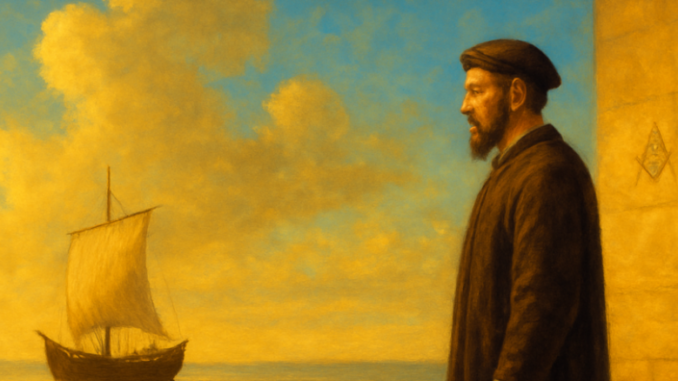
In the eighth essay of the first book of his Essays, Michel de Montaigne takes on the subject of idleness. But where a modern reader might expect a case for relaxation, what emerges instead is a profound reflection on the dangers of an unoccupied mind. This short but powerful piece reveals how deeply Montaigne was rooted in the classical philosophical traditions of his era — and how his thinking built a bridge between ancient wisdom and Renaissance humanism, with insights that still resonate within traditions devoted to inner work and self-knowledge.
The Stoic Legacy: Idleness as Moral Danger
For the Stoics, whose writings Montaigne studied thoroughly, idleness was no innocent pastime. Seneca, one of the authors Montaigne returned to most often, repeatedly warned against the dangers of a mind without direction. In his Letters to Lucilius, he stressed that an empty mind becomes susceptible to anxiety, restlessness, and destructive thoughts. Montaigne takes this warning to heart when he writes that an unoccupied mind, much like fallow land, produces all manner of weeds.
The Stoic tradition drew a sharp distinction between two kinds of rest. On one hand, there was valuable contemplation, directed toward self-knowledge and moral progress. On the other, there was pernicious idleness, in which the mind drifts without anchor. Montaigne inherited this distinction and applied it to his own situation when he retired to his estate. He discovered that his mind, once freed from public duties, did not settle into tranquility but instead grew wilder and more restless than before.
The Skeptic’s Perspective: Distrusting the Untamed Mind
Alongside Stoicism, Montaigne was deeply influenced by Pyrrhonian skepticism, which reached the Renaissance through thinkers such as Sextus Empiricus. This skeptical tradition taught him to distrust what the mind produces in isolation. While the Stoic still believed in the possibility of true wisdom through contemplation, the Skeptic questioned whether the human mind can be trusted at all when left to its own devices.
Montaigne himself wrote: “The mind that has no fixed aim loses itself in vague fields of imagination.” This line reflects a fundamentally skeptical stance. He did not take his own thoughts at face value. He observed how his mind, deprived of external focus, generated fantasies and worries that, upon closer inspection, turned out to be groundless. Writing his essays became his remedy — by committing his thoughts to paper, he could examine them, weigh them, and put them into perspective.
Renaissance Humanism: Rediscovering the Self
Renaissance humanism formed the broader intellectual context in which Montaigne wrote. This movement rediscovered classical texts and applied their insights to human life. Plutarch, whose Moralia Montaigne devoured, wrote extensively about the art of living and the perils of an undisciplined mind. Cicero, with his reflections on civic duty and the value of otium — purposeful leisure — was another significant influence.
But humanism also introduced something new: a focus on the individual self as a subject of study. Where the ancients often wrote about humanity in general terms, Montaigne turned his gaze inward. He used classical wisdom not merely as an appeal to authority, but as a mirror for his own experience. His essay on idleness is therefore not an abstract treatise — it is a personal testimony of what happens when a particular, concrete mind comes to a standstill.
Two Perspectives on Idleness
We can read Montaigne’s essay through two contrasting lenses. The ordinary citizen of his time — perhaps a hardworking merchant or craftsman — viewed idleness as simply sinful or unproductive. The Church condemned acedia, spiritual sloth, as one of the deadly sins. Rest had to be earned, and it must never devolve into aimless idling.
The philosopher, on the other hand, recognized gradations. Seneca praised otium cum dignitate — dignified leisure directed toward wisdom. Montaigne positioned himself between these two worlds. He acknowledged the moral dangers of idleness that the Church emphasized, but he refused to condemn rest as such. His critique was not aimed at the absence of work, but at the absence of direction.
From Stoicism, Montaigne learned that a directionless mind torments itself. From Skepticism, he gained the habit of doubting the value of unexamined thoughts. Humanism gave him the language to investigate his personal experience. And the Christian tradition reinforced his awareness that idleness carries genuine moral risks.
What Both Perspectives Share — and Why It Matters
Despite their differences, the Stoic philosopher and the medieval moralist share a fundamental insight: the human mind needs direction. Whether that direction comes from philosophical contemplation, prayer, labor, or the writing of essays, an unoccupied mind poses a risk to itself and to others. Montaigne discovered this firsthand when he withdrew from public life and found his thoughts running wild.
This shared insight also resonates powerfully within traditions that work with symbolism and ritual. The regular act of gathering together, the careful practice of established forms, the focusing of attention on meaningful symbols — all of these can be understood as ways of anchoring the mind. Not to suppress thought, but to give it a channel through which it can flow productively. For the Freemason, the lodge room itself serves this purpose: a structured space where contemplation is not idle but intentional, not aimless but guided by shared symbolism and purpose.
Montaigne’s essay on idleness is not a call for busyness for its own sake. It is a clear-eyed observation of what happens when the mind lacks focus — an observation grounded in Stoic warnings, Skeptic caution, and Humanist self-examination. The strict moralist and the nuanced philosopher meet in their shared recognition that rest becomes valuable only when it is directed.
For anyone who works with symbolism and meaningful forms — whether in Freemasonry or in other contemplative traditions — Montaigne’s essay offers a quiet but powerful affirmation: structure is not a limitation, but a precondition for true contemplation. The mind needs a working ground, not an empty field. And the discipline of ritual, like the discipline of writing, transforms idle thought into purposeful reflection.
Copyright text & image: devrijmetselaar.nl
Texts are based on the ideas and content of the author of devrijmetselaar.nl, reviewed, corrected, and supplemented with the assistance of OpenAI. Images are created based on the ideas of the author of devrijmetselaar.nl using OpenAI/DALL-E.
Frequently Asked Questions
What is the connection between Montaigne's essay on idleness and Masonic philosophy?
Montaigne's distinction between contemplative rest and pernicious idleness directly parallels Masonic teachings on inner work and self-knowledge. Freemasonry, like Montaigne's philosophical approach, emphasizes the disciplined cultivation of the mind through focused reflection and study, recognizing that true progress requires intentional mental engagement rather than passive drift.
How does Montaigne's Stoic influence relate to Masonic practice?
Montaigne's reliance on Stoic philosophy—particularly Seneca's warnings against an unanchored mind—echoes the Masonic emphasis on moral development and self-examination. Both traditions teach that the mind requires direction and purpose to achieve virtue, making Montaigne's essay a valuable philosophical foundation for understanding Masonic degrees and their focus on personal transformation.
Why would Freemasons find value in Montaigne's reflections on contemplation?
Montaigne's careful distinction between genuine contemplation aimed at self-knowledge and mere idleness reflects core Masonic principles about the nature of productive inner work. His skeptical approach to examining one's own thoughts without bias aligns with Masonic practice of honest self-reflection and the pursuit of truth through disciplined study.
What role does Renaissance humanism play in understanding Masonic philosophy?
Montaigne's grounding in Renaissance humanism—with its recovery of classical texts on human virtue and purposeful living—mirrors Freemasonry's own commitment to preserving and transmitting ancient wisdom. Both traditions value the integration of classical philosophical insights with contemporary practice to illuminate the path of human development and brotherhood.

Be the first to comment