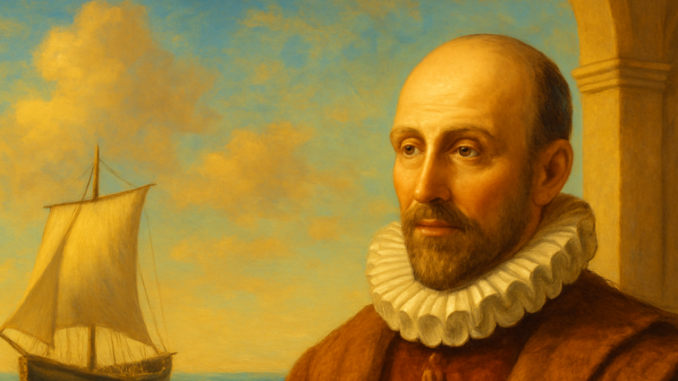
Custom is a second nature, wrote Michel de Montaigne in the sixteenth century, and it is no less powerful than the first. But what happens when we follow this thought into the realm of brotherhood, shared ritual, and traditions that span generations? Freemasonry, with its centuries-old practices and symbolic language, offers a remarkable framework for exploring Montaigne’s insights about custom and law — not as dogma, but as an invitation to reflect on what binds us, what shapes us, and what we are willing to change.
The Paradox of Custom
Montaigne confronts us with an unsettling truth: we believe ourselves free in our judgments, yet our customs have shaped us long before we ever began to think critically. In his essay “Of Custom, and Not Easily Changing an Accepted Law,” he examines how deeply cultural practices take root within us. He gathers examples from distant lands and bygone eras to demonstrate that what seems self-evident to one person can be utterly unthinkable to another. Marriage customs, eating habits, attitudes toward death — all of it is sculpted by habit.
This is where Montaigne touches on something essential to Freemasonry. The lodge is, after all, a space where men from vastly different backgrounds come together, each carrying their own customs, convictions, and unconscious prejudices. The question Montaigne implicitly raises is precisely the question every Freemason must ask himself: to what extent am I willing to examine my own assumptions?
Tradition as a Binding Force
Yet Montaigne also warns us against hasty change. An accepted law, he argues, should not be cast aside lightly — not because it is necessarily just, but because the fabric of society is partly held together by it. The stability that custom provides creates a foundation upon which trust can grow. This insight resonates powerfully with Freemasonry, where ritual and tradition are not regarded as fossilized relics but as living vessels of meaning.
Shared rituals create connection not despite their repetition, but precisely because of it. They form the common language that links one generation to the next.
The Masonic lodge has its fixed forms, its repeated gestures, its time-honored words. To an outsider, this may seem archaic. But for those who participate, these repetitions create a space of familiarity — not to silence thought, but to make it possible. Within the certainty of the known, there arises room for the unknown.
Self-Reflection as a Counterweight
Montaigne was no blind defender of the status quo. His entire philosophical project revolved around self-examination — the honest investigation of one’s own limitations. Custom may be powerful, but awareness of its power is the first step toward genuine freedom. Here, the philosopher touches on a core value of Freemasonry: the work on the rough ashlar, the continual refining of one’s own character.
The brotherhood does not ask its members to adopt beliefs uncritically; it asks them to actively question those beliefs. A Freemason who merely performs the rituals without reflecting on their meaning misses the essence entirely. Montaigne would likely have put it this way: custom is our teacher, but we must remain students who dare to question even their teacher.
The Tension Between Preservation and Renewal
A productive tension emerges when we think through Montaigne’s ideas about changing laws. He does not advocate for stagnation, but for caution. Change for the sake of change disrupts equilibrium without necessarily bringing improvement. Yet he also acknowledges that some customs are reprehensible and that reason compels us to name injustice, even when it is deeply rooted.
Freemasonry knows this tension from its own experience. Over the centuries, it has adapted to changing circumstances without abandoning its core values. The Constitutions of Anderson from 1723, drafted by James Anderson and Jean Théophile Desaguliers, laid a foundation flexible enough to sustain diverse interpretations. Not because the document was vague, but because it articulated principles that left room for growth.
Connection Through Shared Inquiry
What Montaigne and Freemasonry ultimately share is a deep respect for the act of searching together. The philosopher from Bordeaux wrote his essays not as definitive answers but as attempts — essais, literally “trials.” The Freemason enters the lodge not with the pretension of possessing truth, but with the willingness to seek it alongside others.
Custom, Montaigne teaches us, is the thread that connects us to one another. Without shared practices there is no community, without community no conversation, without conversation no growth. But the connection that truly endures is one that leaves room for critical reflection — not a brotherhood that demands blind agreement, but one that invites thoughtful engagement.
A Question Left Open
Montaigne does not end his essay with a firm conclusion but with a gesture of humility. He knows that he himself has been shaped by custom just as much as those he writes about. This awareness of one’s own limitations is perhaps the deepest connection between his work and Freemasonry: both traditions recognize that wisdom begins with acknowledging one’s own ignorance.
The question that lingers is this: how do we distinguish the customs that sustain us from those that confine us? Montaigne offers no definitive answer, and perhaps that is precisely the point. The search itself — the ongoing inquiry carried out in conversation with others — is what binds us and shapes us into better people.
Michel de Montaigne teaches us that custom both chains and connects. For Freemasons, this paradox is not merely philosophical — it is lived experience. Every time a brother enters the lodge, he steps into a tradition that holds him and challenges him in equal measure. The ritual provides the ground; reflection provides the wings. And in the space between the two, something genuinely transformative becomes possible.
Copyright text & image: devrijmetselaar.nl
Texts are based on the ideas and content of the author of devrijmetselaar.nl, reviewed, corrected, and supplemented with the assistance of OpenAI. Images are created based on the ideas of the author of devrijmetselaar.nl using OpenAI/DALL-E.
Frequently Asked Questions
What is Montaigne's main point about custom and how does it relate to Freemasonry?
Montaigne argues that custom is a 'second nature' that shapes us profoundly, often without our conscious awareness. In Freemasonry, this insight is particularly relevant because the lodge brings together men from different backgrounds, each with their own customs and prejudices. Montaigne's work invites Freemasons to critically examine their own assumptions and recognize how deeply their customs have shaped them, fostering self-awareness within the brotherhood.
Why does Montaigne caution against hastily changing established customs and laws?
Montaigne believes that accepted laws and customs, while not necessarily just, provide stability and hold society together by creating a foundation of trust. He warns that casting them aside lightly can destabilize the social fabric. This perspective resonates with Freemasonry's approach to ritual and tradition—viewing them not as outdated relics but as living vessels of meaning that connect generations and create the common language necessary for genuine connection.
How do Masonic rituals and traditions serve a purpose beyond mere repetition?
According to the article, shared rituals create connection precisely because of their repetition, not despite it. They form the common language linking one generation to the next. Within the certainty and familiarity provided by these repeated forms and time-honored words, there is paradoxically room for the unknown and for deeper thought. The rituals create a foundation of certainty that enables meaningful reflection rather than silencing it.


Be the first to comment