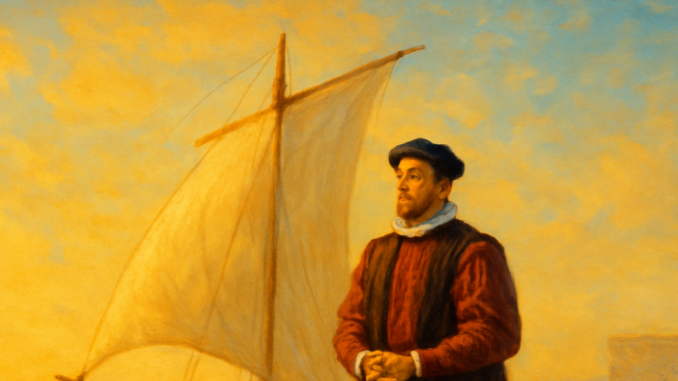
In 1580, Michel de Montaigne published a remarkable essay on the diversity of human customs. His observations on how different peoples perform the same acts in entirely different ways touched upon fundamental questions that had occupied thinkers for centuries. What philosophical traditions shaped his view of human diversity? And what can we — nearly five centuries later — still learn from his intellectual legacy, particularly as Freemasons?
The Skeptical Tradition as Foundation
Montaigne’s approach to human customs is deeply rooted in Pyrrhonian Skepticism, a philosophical school tracing back to the Greek thinker Pyrrho of Elis. This tradition held that absolute certainty about the world is unattainable and that we must suspend judgment. Montaigne immersed himself in the works of Sextus Empiricus, whose writings were being rediscovered and recirculated during his lifetime, and was profoundly influenced by his arguments against dogmatic thinking.
In his essay on customs, Montaigne applies this skeptical stance consistently. He observes how what one culture considers civilized, another may regard as barbaric. Who, then, gets to determine what is truly right? By placing customs side by side without passing judgment, he invites the reader toward intellectual humility. This is not relativism — it is a call to self-examination.
Seneca and the Stoic Influence
Alongside Skepticism, Montaigne drew extensively from the Stoic tradition, particularly the works of Seneca. The Roman philosopher emphasized that external circumstances — including social conventions — need not govern our inner freedom. Montaigne quoted Seneca frequently and considered him one of his most important intellectual guides.
The Stoic teaching that we must distinguish between what lies within our control and what does not resonates powerfully in Montaigne’s reflections on customs. After all, habits are learned, not innate. By recognizing this, a person can free himself from the tyranny of convention and seek his own path toward wisdom. Montaigne masterfully combines the Stoic emphasis on autonomy with the Skeptic’s acknowledgment of human fallibility.
Plutarch and the Art of Comparison
Another crucial source for Montaigne was Plutarch, the Greco-Roman writer whose Lives and Moralia ranked among his favorite reading. Plutarch excelled at comparing lives and characters, bringing similarities and differences between people into sharp relief. Montaigne adopted this comparative method in his treatment of customs and cultures.
True wisdom begins not with condemning others, but with questioning our own certainties.
By placing peoples and their customs alongside one another — without elevating one above the other — Montaigne followed Plutarch’s example. This approach does not lead to moral nihilism; quite the opposite. It leads to deeper understanding. For anyone who surveys the diversity of human practices will also discover the universal humanity that lies behind them.
Renaissance Humanism and the Rediscovery of Antiquity
Montaigne wrote during an era when Renaissance Humanism was transforming Europe. The rediscovery of classical texts — from Cicero to Aristotle, from Plato to Marcus Aurelius — opened new perspectives on humanity and society. Montaigne was a product of this intellectual revolution and, at the same time, one of its most original voices.
The humanistic ideal of the homo universalis — the well-rounded, broadly educated individual — echoes in Montaigne’s curiosity about every aspect of human existence. His essay on customs is no dry catalogue; it is a vivid exploration of what it means to be human in a world full of diversity. The classical authors were not dead authorities to him — they were living conversation partners.
The Connection to Masonic Thought
The philosophical traditions that nourished Montaigne find a remarkable echo in Freemasonry. The Skepticism that encourages humility, the Stoicism that places inner freedom first, the Humanism that centers human dignity — these elements also form pillars of Masonic thinking.
In the Lodge, people of different backgrounds, convictions, and traditions meet as equals. It is precisely the awareness that our own customs are not absolute that makes this brotherhood possible. Montaigne’s message — that we must question our certainties before judging others — is a lesson that resonates in every Lodge room.
The Building Block of Tolerance
Freemasonry rests on the foundation of tolerance — not as superficial indifference, but as an active effort to understand another’s perspective. Montaigne, who lived through the devastating French Wars of Religion, witnessed firsthand how destructive absolute certainties can be. His essay on customs is therefore a plea for a deeper kind of tolerance: not ignoring differences, but appreciating them as expressions of human ingenuity.
Consider the core values at work here: Skepticism teaches us intellectual humility. Stoicism frees us from the tyranny of convention. Humanism celebrates the dignity of every person. And the Lodge offers a space where these values can be practiced in daily life.
The symbolism of Freemasonry — in which the rough ashlar is shaped into a perfect cube — mirrors Montaigne’s vision of self-improvement. We are not born as finished beings; we shape ourselves through study, reflection, and encounter with others. The diversity of customs that Montaigne described thus becomes a mirror in which we can recognize our own rough edges.
Michel de Montaigne stood on the shoulders of giants: Pyrrho, Seneca, Plutarch, and countless other thinkers from antiquity. His essay on the diversity of customs is not an isolated observation but a synthesis of centuries of philosophical thought about human diversity and the limits of certainty. For Freemasons, this heritage offers a rich wellspring of insight. It reminds us that the work of self-knowledge is never complete, that the encounter with difference is not a threat but an invitation, and that the pursuit of wisdom requires, above all, the courage to question what we think we know.
Copyright text & image: devrijmetselaar.nl
Texts are based on the ideas and content of the author of devrijmetselaar.nl, reviewed, corrected, and supplemented with the assistance of OpenAI. Images are created based on the ideas of the author of devrijmetselaar.nl using OpenAI/DALL-E.
Frequently Asked Questions
What philosophical tradition most influenced Montaigne's views on human customs?
Montaigne's approach to human customs is deeply rooted in Pyrrhonian Skepticism, a Greek philosophical school tracing back to Pyrrho of Elis. This tradition held that absolute certainty about the world is unattainable and that we must suspend judgment. Montaigne was profoundly influenced by the rediscovered works of Sextus Empiricus, whose arguments against dogmatic thinking shaped his skeptical stance on examining customs across different cultures.
How does Montaigne's work connect to Freemasonry?
Montaigne's intellectual legacy, particularly his emphasis on intellectual humility, self-examination, and questioning absolute certainty, aligns with Masonic principles of seeking wisdom and personal enlightenment. His method of placing customs side by side without judgment invites readers toward the kind of reflective, open-minded inquiry that Freemasonry encourages among its members.
What role did Stoic philosophy play in Montaigne's thinking about customs?
Montaigne drew extensively from the Stoic tradition, particularly the works of Seneca, whom he considered one of his most important intellectual guides. The Stoic teaching that we must distinguish between what lies within our control and what does not resonates in Montaigne's recognition that habits are learned, not innate. This insight allowed him to combine Stoic emphasis on personal autonomy with the Skeptic's acknowledgment of human fallibility.


Be the first to comment