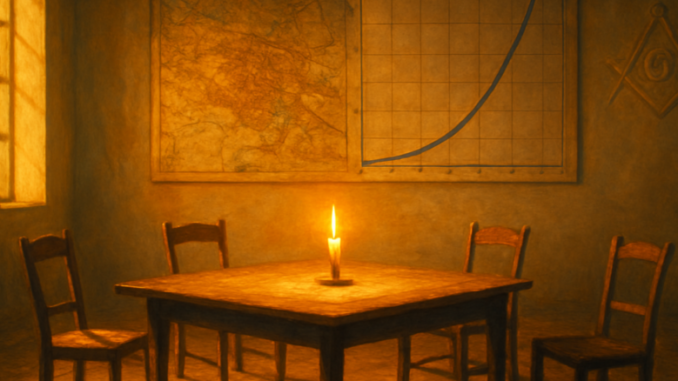
A rising line on a graph. Numbers climbing. Experts issuing warnings. When reports of potential disease outbreaks begin to circulate, something shifts in our collective consciousness. But what do these moments truly reveal about our society? And what can Freemasons — with their centuries-old emphasis on brotherhood and civic responsibility — contribute to the conversation about crises that affect us all?
Why Do Predictions Unsettle Us So Deeply?
It’s a question that demands attention every time we’re confronted with alarming charts and expert analyses. Why does our pulse quicken at the sight of an upward-trending curve? The answer may not lie solely in our fear of illness, but in something far more fundamental: our connection to one another.
In these moments, we realize we are not isolated islands. What strikes one person can strike us all. That awareness, however uncomfortable, contains a profound truth that Freemasons have recognized for centuries: humanity forms one great chain, and every link matters.
What Does History Teach Us About Brotherhood in Times of Crisis?
Consider the great plague epidemics of the Middle Ages. Social structures collapsed. Fear drove people apart. And yet, some communities held firm — places where people continued to care for one another despite the danger. Guilds and brotherhoods often played a crucial role in these efforts. They provided not only material support, but something equally indispensable: the feeling of belonging when everything else becomes uncertain.
Freemasonry, though it took its modern form in the eighteenth century, draws deeply from this tradition of fraternal care. The rituals of the Lodge remind us that we carry a responsibility — not only to ourselves, but to the community of which we are a part.
When the storm rages, we do not merely seek shelter for ourselves — we build a roof together that can protect all.
How Do We Face Uncertainty Without Falling Into Panic?
This is perhaps the most urgent question. When experts speak of potential outbreaks and graphs reveal troubling patterns, how do we maintain our composure? Freemasonry offers no magic answers, but it does offer an attitude — a mindset — that can help.
In the Lodge, one learns to reflect before acting. To weigh information carefully, to question sources, and above all, to resist the pull of the first emotional impulse. This does not mean ignoring warnings. Quite the opposite. It means taking them seriously without losing our reason.
Practical wisdom for uncertain times includes seeking reliable information from recognized health authorities, staying in dialogue with others without spreading fear, taking concrete steps where possible, and acknowledging your own vulnerability as well as that of those around you.
The Role of Ritual in Times of Collective Tension
It may seem surprising to discuss ritual in the context of epidemics, but the connection is more relevant than it first appears. Rituals — whether religious, Masonic, or secular — offer something we desperately need in uncertain times: structure and meaning. They remind us that there is something larger than the present moment, that humanity has walked through dark valleys before and emerged on the other side.
In Freemasonry, ritual serves as an anchor. It is not an escape from reality, but a way of placing reality within a larger narrative. When Brethren come together, even in difficult times, they affirm that connection is stronger than isolation, and that hope is more powerful than fear.
What Can We Do, Here and Now?
Perhaps this is the most important question of all. Not what experts predict, not what graphs display, but what we as individuals and as a community can contribute. Freemasonry teaches that every Brother is a building stone — not passively waiting, but actively shaping the temple of humanity.
In practice, this can mean sharing information responsibly without seeking sensation. It can mean giving extra attention to vulnerable people in our lives. It can mean supporting organizations working globally on health and prevention. These may seem like small actions, but together they form the cement that holds our society together.
Why Brotherhood Is More Relevant Than Ever
In a world that seems to spin faster every day — where news floods in relentlessly and uncertainty often dominates — the concept of brotherhood is not an outdated ideal. It is a necessity. When we face threats that cross every border, we are reminded of a fundamental truth: we are connected to one another, whether we choose to be or not.
Freemasonry has never claimed to hold all the answers. But it offers a space where questions may be asked, where uncertainty is acknowledged openly, and where the hand of the Brother beside you can be a genuine source of strength. In that sense, every crisis is also an invitation — to strengthen our bonds, to reflect on what truly matters, and to build together a world better equipped to weather the storms ahead.
Rising lines on graphs will always cause unease. That is simply human nature. But within that unease lies a possibility — the possibility of remembering who we can be for one another. As Brothers, as neighbors, as fellow human beings. Freemasonry invites us to embrace that possibility, not with naïve optimism, but with thoughtful engagement. Because in the end, it is not the graph that defines who we are. It is how we respond, how we act, and how we hold on to each other when the ground beneath our feet begins to shift.
Copyright text & image: devrijmetselaar.nl
Texts are based on the ideas and content of the author of devrijmetselaar.nl, reviewed, corrected, and supplemented with the assistance of OpenAI. Images are created based on the ideas of the author of devrijmetselaar.nl using OpenAI/DALL-E.
Frequently Asked Questions
What can Freemasonry teach us about handling crises like disease outbreaks?
Freemasonry teaches that humanity is interconnected and that we share a collective responsibility to care for one another during times of crisis. Through centuries of tradition, Masonic brotherhoods have emphasized the importance of supporting our communities and maintaining composure through careful reflection rather than panic. This mindset helps us respond to crises with both compassion and reason.
How do Freemasons approach uncertainty and fear during epidemics?
Freemasons are taught to reflect carefully before acting, to seek reliable information from trusted authorities, and to resist emotional impulses that lead to panic. Rather than ignoring warnings, Masons take them seriously while maintaining their reason and encouraging dialogue with others. This balanced approach helps preserve both individual wellbeing and community trust during uncertain times.
What historical role did brotherhoods play during medieval plagues?
During medieval epidemics, guilds and brotherhoods provided crucial material support and, equally important, a sense of belonging when fear threatened to isolate people. These fraternal organizations demonstrated that communities could hold firm and care for one another despite danger. Freemasonry continues this noble tradition of fraternal care and collective responsibility.
Why does Freemasonry emphasize civic responsibility during health crises?
Freemasonry recognizes that we are all connected as part of one human community, and that crises affecting others ultimately affect us all. The organization's rituals and teachings remind members that building protection and support together strengthens the entire community. This emphasis on shared responsibility has guided Masonic lodges for centuries in responding to collective challenges.


Be the first to comment