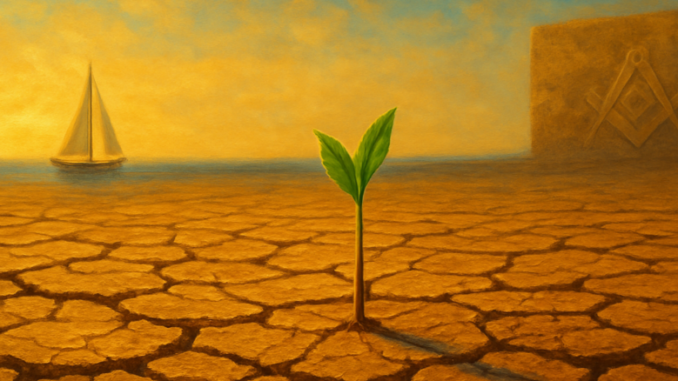
You may have seen the images: shipwrecks suddenly exposed on the riverbed, barren banks where water once flowed freely, and the mighty Rhine — Europe’s great artery — reduced in places to little more than a stream. Water levels dropped to historic lows. While meteorologists and economists debated the consequences, a different question lingered beneath the surface: what does a dried-up river reveal about ourselves? And what can an ancient fraternity like Freemasonry teach us about the deeper meaning of this crisis?
A River as a Mirror of Society
The Rhine is far more than a waterway. Since Roman times, it has served as the backbone of trade, culture, and community across Western Europe. Poets like Goethe described the river as a symbol of continuity and life itself. When such an essential flow literally runs dry, it transcends logistics problems for shipping or water shortages for industry.
You could say that the condition of a river reveals something about the condition of the civilization that depends on it. How do we treat what has been given to us? Do we take more than we return? These questions may sound abstract, but they touch on something fundamental. Freemasonry has engaged with precisely this kind of reflection for centuries — examining the relationship between the individual, society, and the greater order of things.
The Masonic Virtue of Temperance
One of the cardinal virtues in Freemasonry is temperance. This is not rigid moralism, but a living practice of seeking balance. In the eighteenth century, when modern Freemasonry took shape under the influence of thinkers like James Anderson and Jean Théophile Désaguliers, this idea of equilibrium was deeply rooted in Enlightenment thought. The belief was that a harmonious society is only possible when individuals can temper their own inclinations and align them with the greater whole.
Aristotle, whose philosophy profoundly influenced early Masonic tradition, spoke of the “golden mean.” Too much or too little of anything disrupts the balance. This applies to personal virtues, but also to how communities manage their resources. A dried-up river is, in that sense, a warning sign: somewhere, the equilibrium has been broken.
Temperance is not a lack of ambition. It is the understanding that true progress is only sustainable when it exists in harmony with its surroundings.
Responsibility as a Fraternal Duty
Freemasons often speak of the “chain of union” — the idea that we are connected to one another and to those who will come after us. This concept of responsibility extends far beyond the walls of the lodge. It invites you to consider the legacy you leave behind. What kind of world are you passing on to your children and grandchildren?
The Enlightenment philosophers, many of whom were Freemasons, emphasized the importance of stewardship. Voltaire and Montesquieu, though with different emphases, wrote about humanity’s duty to leave society in a better state than they found it. Even earlier, Michel de Montaigne reflected on the natural limits that human beings must respect. This stewardship is not a burden but an honor. It asks us to look beyond the self-interest of the present moment.
What Can You Learn from This?
You don’t need to be a Freemason to apply these insights. The dry Rhine offers a tangible occasion to ask yourself some honest questions:
Where in my own life am I taking more than I need? How do I contribute to balance in my immediate environment? What small adjustments could I make that would have a larger effect? Do I consider the consequences of my choices for future generations?
The power of this kind of self-reflection lies not in grand gestures but in consistent action. It is the sum of small choices that ultimately fills a river — or lets it run dry.
The River as a Metaphor for the Soul
In many spiritual traditions, water symbolizes purification, renewal, and the flow of life. Marcus Aurelius wrote in his Meditations about how everything flows and changes, and how the wise person finds their way within that current without resisting the natural order. A river that runs dry forces us to pause and reflect on what happens when that flow is disrupted.
For Freemasons, the dry Rhine can serve as a powerful metaphor. Just as a river must be fed by mountain springs, the human soul must be nourished through inner work, reflection, and genuine connection with others. Drought sets in when we stop nourishing what sustains us.
An Invitation to Inner Work
The current drought is not an abstract problem to be solved solely by governments and corporations. It is also a mirror, reflecting who we are and how we live. Freemasonry does not offer ready-made answers, but it does offer a method: one of continuous self-reflection, of working on yourself in service of others, and of seeking balance in all things.
The next time you walk along a river or drive across a bridge, pause for a moment. Ask yourself what you are contributing to the flow — not just the flow of water, but the flow of society. Because ultimately, every single drop is part of the greater whole.
The record-low water levels of the Rhine are more than a headline about drought. They are an invitation to reflect on temperance, responsibility, and the legacy we leave behind. Freemasonry teaches us that true progress begins within — in the inner landscape of the individual. When we find balance there, it flows outward into everything around us. Perhaps that is the most important lesson a dry river can teach.
Copyright text & image: devrijmetselaar.nl
Texts are based on the ideas and content of the author of devrijmetselaar.nl, reviewed, corrected, and supplemented with the assistance of OpenAI. Images are created based on the ideas of the author of devrijmetselaar.nl using OpenAI/DALL-E.

Be the first to comment