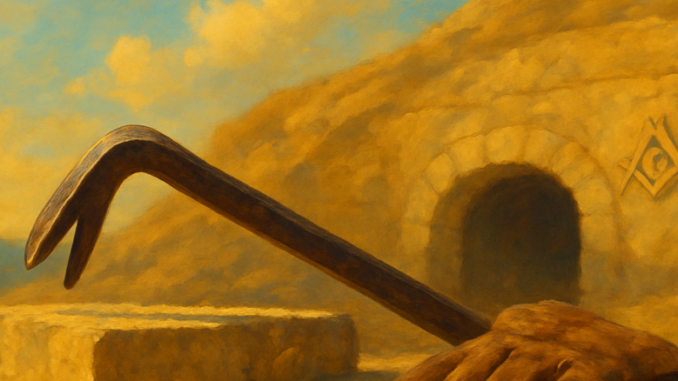
Among the oldest lever instruments known to humanity, the crowbar carries a symbolic weight that far exceeds its physical function. In the tradition of Freemasonry, where every tool holds a moral lesson, the crowbar stands as a compelling emblem of breakthrough — the art of opening what has become sealed, of creating passage where none existed before. But like every tool in the symbolic workshop, its meaning depends entirely on the hands that wield it and the intention behind the act.
The Crowbar in Historical Perspective
The crowbar belongs to the most ancient class of lever tools. Builders and craftsmen in antiquity relied on it to move massive stones and pry open tightly sealed joints. The English word “crowbar” itself derives from the tool’s split tip, which resembles a crow’s foot — a detail that reveals something essential about its nature. This is not a sledgehammer designed to shatter. It is an instrument of intelligence, one that seeks the right gap, the vulnerable point where minimal effort produces maximum effect.
By the nineteenth century, the crowbar had become a symbol of the working class. Miners, railroad laborers, and construction workers carried it as their daily companion. It represented honest labor — the work of hands that build and break, of people who laid the literal foundations of modern society. This deep association with physical work and civic construction makes the crowbar a particularly interesting symbol for anyone reflecting on the relationship between the individual and the community.
A Metaphor for Meaningful Change
Every society reaches moments when existing structures no longer serve their purpose. Laws grow outdated, institutions calcify, and customs become chains. In such times, people search for instruments of change. The crowbar offers a striking metaphor here. Unlike the wrecking ball, which destroys indiscriminately, the crowbar works through precision and patience. It finds the seam, the weak spot, the exact point where a small force can generate great movement.
This approach to transformation resonates deeply within the Masonic tradition. In the symbolic workshop, Brothers and Sisters learn that real change never comes through brute force, but through understanding the structure of the material one works with. Whether that material is stone, one’s own character, or society at large, the principle remains the same: understand the whole before you intervene.
The Art of Opening, Not Destroying
A crowbar does not destroy — it opens. This distinction is essential. When a carpenter needs to remove an old door, he does not use the crowbar to splinter the wood. Instead, he uses it to separate the bond between door and frame. The goal is access, not annihilation. Seen in this light, the crowbar becomes a lesson in creating openings where there was once only closure.
The secret of the lever lies not in force, but in finding the right point of engagement.
We see this principle at work in every meaningful social reform. The most enduring changes rarely emerge from violent revolution, but from the patient prying open of rigid assumptions. A single well-timed question can unlock doors that seemed permanently sealed. An unexpected perspective can shift an entire debate. The crowbar teaches us that breakthrough is not about the amount of energy applied, but about where and when that energy is directed.
The Tool and the Craftsman: Responsibility and Intent
Every tool is morally neutral; it is the hand that holds it that determines its purpose. A crowbar can be used to enter a burning building and save lives, or it can be used to break in where one is not welcome. This duality makes the crowbar a powerful symbol of moral responsibility. The question is never simply what one can pry open, but whether one has the right to do so — and with what intention one acts.
Freemasons recognize this principle from their own symbolic language. The tools of the Mason — the square, the compasses, the gavel, the chisel — are all morally neutral in themselves. Their meaning arises only in the context of the work and the character of the craftsman. The same is true of the crowbar: it invites reflection on when it is justified to break through existing structures and when it is wiser to build something new alongside them.
The Lever as a Universal Principle
At its core, the crowbar is an application of the lever principle — one of the fundamental mechanical laws described by Greek thinkers millennia ago. A small force, applied at the right place and with the proper leverage, can move mountains. This principle extends far beyond the physical world. In society, small groups of people, strategically positioned and united in purpose, can bring about changes that far exceed what their numbers alone would suggest.
The lever principle teaches us several enduring truths. It demands knowledge of the system one is working on. It reveals that timing often determines the difference between success and failure. It demonstrates that patience and precision will always outperform brute force. And perhaps most importantly, it shows that the point of engagement matters more than the amount of energy applied.
A Symbol of Hope and Discernment
In an age when social divisions sometimes seem unbridgeable, the crowbar offers a surprisingly hopeful symbol. It reminds us that even the sturdiest barriers cannot hold indefinitely when one finds the right point of leverage. At the same time, it counsels restraint: not every wall deserves demolition, not every door needs to be forced. Wisdom lies in discernment — in knowing the difference between a barrier that must be removed and a boundary that deserves respect.
For those who feel a connection to the Masonic tradition, the crowbar carries an enduring mandate. It is not about collecting tools, but about developing the insight to know when and how to use each one. In the hands of a Master, the crowbar serves to open what has become unjustly sealed. In the hands of an Apprentice, it can just as easily cause damage. The journey from Apprentice to Master is the journey from impulse to insight, from force to precision, from breaking to opening.
The crowbar, humble and ancient as it is, holds a mirror to our deepest aspirations and responsibilities. It asks us not merely whether we possess the strength to break through, but whether we have cultivated the wisdom to know where, when, and why. In the Masonic tradition, every tool is ultimately a teacher — and the crowbar’s lesson is among the most vital: true breakthrough is not an act of destruction, but an act of opening. The path forward lies not in shattering what stands before us, but in finding the precise point where a gentle, knowing pressure creates a doorway into something better.
Copyright text & image: devrijmetselaar.nl
Texts are based on the ideas and content of the author of devrijmetselaar.nl, reviewed, corrected, and supplemented with the assistance of OpenAI. Images are created based on the ideas of the author of devrijmetselaar.nl using OpenAI/DALL-E.
Frequently Asked Questions
What does the crowbar symbolize in Freemasonry?
In Freemasonry, the crowbar represents breakthrough and the art of opening what has become sealed, creating passage where none existed before. It symbolizes meaningful change through precision and patience rather than brute force, reflecting the Masonic principle that real transformation comes through understanding the structure of what one works with.
Why is the crowbar considered a symbol of intelligence rather than destruction?
The crowbar is a lever tool that finds the vulnerable point where minimal effort produces maximum effect, rather than using brute force like a sledgehammer. This approach to problem-solving—seeking the right gap and working with precision—embodies the intelligent, thoughtful methodology that Freemasonry teaches its members.
How does the crowbar relate to social change in Masonic teaching?
The crowbar serves as a metaphor for meaningful social reform, demonstrating that lasting change comes through understanding existing structures and finding the right points of intervention. Unlike indiscriminate destruction, the crowbar's principle of opening without annihilating aligns with the Masonic value of creating positive transformation through wisdom and care.
What is the historical significance of the crowbar in relation to Freemasonry?
The crowbar has ancient roots as a tool of builders and craftsmen, and by the nineteenth century became a symbol of the working class and honest labor. This deep association with those who build and construct makes it a meaningful symbol within Freemasonry, which values the dignity of work and the individual's contribution to community.
What moral lesson does the crowbar teach Freemasons?
The crowbar teaches that the secret of achieving real change lies not in force, but in finding the right point of engagement and understanding the whole before intervening. This lesson applies whether one is working with stone, developing one's own character, or contributing to society—all requiring patience, precision, and respect for the material at hand.



Be the first to comment