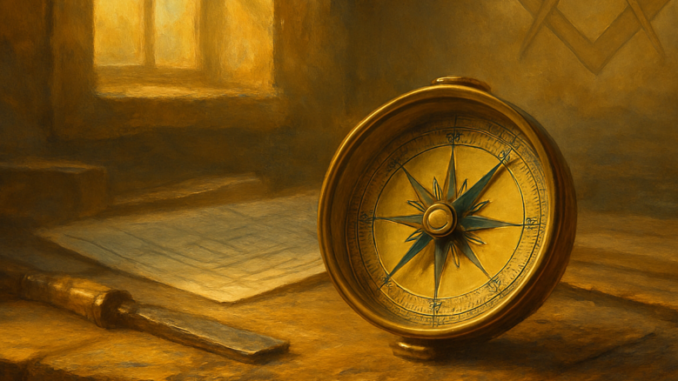
In a world that glorifies mobility — where success is measured by the next step, the bigger opportunity, or the better offer — the declaration “this is my home” sounds almost rebellious. When a world champion in motorsport chooses to stay where he was shaped, it touches something far deeper than sporting sentiment. It touches an ancient spiritual principle that Freemasons have understood for centuries: the power of conscious commitment.
The Historical Roots of Loyalty to a Community
The history of Western spirituality is filled with examples of individuals who deliberately chose commitment over unlimited freedom. In the medieval building lodges — the direct predecessors of modern Freemasonry — loyalty to one’s workshop was not a limitation but a prerequisite for growth. A journeyman who drifted from lodge to lodge without ever settling lacked the depth that only sustained commitment can provide. The great cathedrals of Europe were not built by roaming adventurers but by generations of craftsmen who dedicated their entire lives to a single structure.
Johann Wolfgang von Goethe, himself a Freemason and author of the celebrated novel about Wilhelm Meister’s formative years, described this principle with eloquence. For Goethe, true freedom was not the ability to go anywhere but the capacity to be fully present somewhere. In his Masonic poetry, he spoke of the lodge as a place where the soul finds its home base — not as a prison, but as fertile ground for growth.
The Spiritual Meaning of Home
In Freemasonry, the concept of the lodge plays a central role. The word itself derives from the Old French “loge,” meaning shelter or workshop. But its spiritual significance extends far beyond architecture. A lodge is the place where a person learns to know himself, where he is confronted with his own rough ashlar, and where, in the company of brethren, he builds his inner temple. This labor demands time, patience, and above all: presence.
Coming home is not a geographical act but a spiritual choice — it is the courage to be fully present somewhere and to grow there.
Aristotle wrote in his Nicomachean Ethics about the virtue of steadfastness. For him, the ability to remain true to a choice — even when other options beckon — was a sign of strength of character. This aligns seamlessly with what Freemasons understand as working the rough ashlar: not jumping from project to project, but patiently shaping one and the same stone until it fits within the greater structure.
The Lure of the New Versus the Wisdom of Staying
Our modern culture harbors an almost religious veneration of mobility and flexibility. Anyone who stays where they are is quickly seen as someone who is missing out or stuck in a rut. Yet the spiritual tradition offers an entirely different perspective. The Desert Fathers of early Christianity, whose practices later influenced various esoteric traditions, knew the concept of stabilitas loci — the discipline of remaining in one place as part of spiritual formation.
Marcus Aurelius, the Stoic emperor whose Meditations continue to inspire Freemasons to this day, wrote about the art of accepting the place where fate has set you. For him, true freedom was not escaping your circumstances but fully embracing and making the most of them. This thought resonates powerfully when someone, at the very height of success, declares: this is where I belong — this is where I want to keep building.
What Contemporary Choices Can Teach Us
When we overlay this historical and philosophical framework onto current events, a surprising perspective emerges. An elite athlete who chooses continuity over adventure is, in essence, making a profoundly spiritual choice. He acknowledges that growth does not always mean starting over somewhere new. Sometimes growth means digging deeper right where you stand — deepening the relationships you already have, continuing to strengthen the community you already know.
This principle is woven into Masonic ritual itself. A Freemason is not asked to constantly pursue new degrees or seek out new lodges. The heart of the work lies in repetition, in deepening understanding, in beholding the same symbols again and again with ever-maturing eyes. Just as a rough stone is not polished in a single day, a human being is not formed by a single experience.
The Lesson for the Seeking Soul
For anyone seeking spiritual depth, this insight offers a powerful counterweight to modern restlessness. The question is not merely: where can I go next? The deeper question is: where can I truly come home? And more fundamentally still: am I willing to be fully present somewhere, with all my shortcomings and all my potential?
Coming home takes courage — it is easier to leave than to stay. Commitment is not a limitation but a prerequisite for depth. True growth arises through repetition and patience, not through constant change. A community that shapes you also deserves your shaping presence in return.
The historical wisdom of master builders, philosophers, and spiritual seekers all points in the same direction: the sacred is not found in some distant place, but in the nearness we are willing to truly see. A workshop only becomes a home when we decide to stay — not because we must, but because we recognize that this is where our work lies.
In an age of infinite possibilities, the choice to stay may be the most radical spiritual act of all. It reminds us that Freemasonry is not a quest for something spectacular elsewhere, but a pursuit of depth right here and now. Whoever dares to say “this is my home” speaks not from limitation, but from the richest form of freedom: the freedom to be fully present and, in silence and perseverance, to build the inner temple stone by stone.
Copyright text & image: devrijmetselaar.nl
Texts are based on the ideas and content of the author of devrijmetselaar.nl, reviewed, corrected, and supplemented with the assistance of OpenAI. Images are created based on the ideas of the author of devrijmetselaar.nl using OpenAI/DALL-E.
Frequently Asked Questions
What does Freemasonry teach about the concept of 'home' and commitment?
In Freemasonry, home is not merely a geographical location but a spiritual choice representing the courage to be fully present somewhere and grow there. The lodge serves as a place where individuals learn to know themselves, confront their limitations (represented by the 'rough ashlar'), and build their inner temple through patient, sustained commitment to a community of brethren.
How do medieval building lodges relate to modern Freemasonry's understanding of loyalty?
Medieval building lodges, the direct predecessors of modern Freemasonry, viewed loyalty to one's workshop as essential for growth rather than a limitation. The great cathedrals of Europe were built by generations of craftsmen who dedicated their lives to single structures, demonstrating that true mastery and spiritual development require sustained commitment rather than constant mobility.
What is the Masonic concept of 'working the rough ashlar' and how does it relate to personal growth?
Working the rough ashlar refers to the patient process of shaping and refining oneself through continued dedication to a single path and community, rather than constantly pursuing new opportunities. This principle aligns with Aristotle's virtue of steadfastness, emphasizing that true strength of character comes from remaining true to one's choice and gradually perfecting oneself to fit within a greater structure.

Be the first to comment