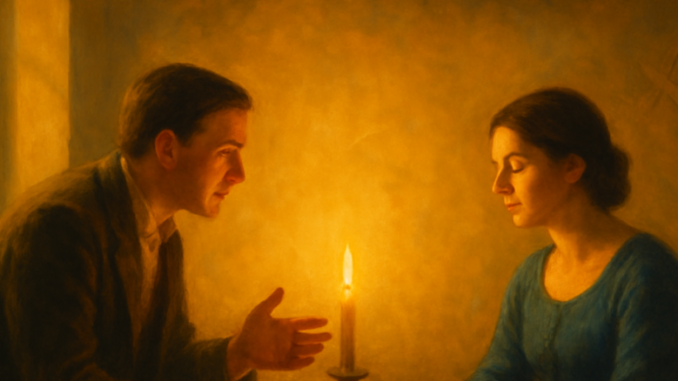
The lodge rests in half-light. A brother has just shared a viewpoint that stands in direct opposition to what another deeply believes. For a moment, silence hangs heavy, charged with unspoken emotion. Then a calm voice breaks through: “Tell me more about how you arrived at that thought.” In that single sentence lies a world of wisdom that reaches far beyond the walls of the temple — into a society where conversations increasingly fall silent before they have truly begun.
When Debate Suffocates
A troubling wind is blowing through public discourse. More and more often, disagreements don’t lead to deeper understanding — they lead to silence. The reflex to dismiss an opponent as someone who simply “hates” or “doesn’t get it” has become pervasive. It’s a mechanism that smothers debate before it can even take root. Instead of engaging with arguments, we question motives. Instead of listening, we wait for an opening to interrupt.
This phenomenon is hardly new, but it seems to carry particular urgency in our time. When we reduce another person to a caricature of their opinions, we don’t just lose the chance at understanding — we lose a part of ourselves. Because whoever refuses to listen robs themselves of the possibility of growth.
The Lodge as a Training Ground for Conversation
Within Freemasonry, there exists an ancient tradition that directly counters this suffocating dynamic. During ritual work, members do not speak over one another. They listen, reflect, and only then respond. This is no mere formality — it is a deeply rooted practice that shapes character. The lodge functions as a training ground where brothers from vastly different backgrounds, beliefs, and political convictions come together around shared values.
The true Freemason does not seek to be right — he seeks light. And light often comes from the most unexpected sources.
What makes this setting remarkable is that discussion of politics and religion is traditionally avoided — not out of fear of conflict, but to create space for a deeper kind of conversation. A conversation about what it means to be human, about ethics, about how we can live together despite our differences. By keeping certain subjects outside the door, a safe space for genuine encounter is created within.
Character as an Inner Compass
What does all of this have to do with character? In Freemasonry, character is not viewed as something fixed, but as a structure under constant development. The rough ashlar we begin as is gradually worked into a perfect ashlar that fits within a greater whole. This work does not happen in isolation — it happens through confrontation with others and with ourselves.
When we dismiss someone in a conversation with a simple “you just hate,” we deny ourselves the chance to test our own convictions. True character is not built by shielding yourself from criticism, but by opening yourself to it and emerging stronger on the other side. The Freemason learns that mastery lies not in winning debates, but in maintaining calm and openness when the conversation becomes difficult.
The Courage to Keep Listening
It takes courage to truly listen to someone whose views you find deeply objectionable. Not the kind of courage associated with physical acts, but a subtler variety: the courage to temporarily suspend your own certainties. To ask yourself whether the other person’s perspective might contain something you hadn’t yet considered.
Listening without immediately judging. Asking questions instead of making proclamations. Acknowledging that your own perspective has limits. Seeking the human being behind the position.
These are not signs of weakness — they are marks of a mature and developed character. The eighteenth-century philosophers who helped shape Freemasonry understood that the Enlightenment was not merely about spreading knowledge. It was equally about cultivating a particular attitude toward knowledge and toward one’s fellow human beings.
Beyond the Trenches
Today’s polarization invites trench warfare thinking. Which side are you on? Who do you identify with? But Freemasonry reminds us that our deepest identity does not lie in the group we belong to, but in the way we relate to others. The question is not so much what you believe, but how you treat those who believe something different.
In an age when conversations are smothered by accusations about motives, there is a pressing need for people who continue to practice the art of listening. Not naively, not without critical thinking, but with the willingness to look beyond the first impression. The lodge offers a practice space for this, but the real challenge lies outside its walls — in everyday life, where the silent stone of character takes its shape.
Back in that quiet lodge, where a brother has just shared an uncomfortable truth, the question “tell me more” is not a trick — it is a way of life. It is the choice to let the conversation continue, even when it would be easier to shut it down. In that choice, made again and again, character is not merely displayed but forged. And perhaps that is the humble contribution every seeker of light can offer to a world in danger of falling silent: the courage to keep listening.
Copyright text & image: devrijmetselaar.nl
Texts are based on the ideas and content of the author of devrijmetselaar.nl, reviewed, corrected, and supplemented with the assistance of OpenAI. Images are created based on the ideas of the author of devrijmetselaar.nl using OpenAI/DALL-E.
Frequently Asked Questions
What does Freemasonry teach about handling disagreements with others?
Freemasonry teaches that genuine listening and thoughtful reflection are essential to understanding different viewpoints. Rather than seeking to win arguments, Masons are trained to ask genuine questions and listen carefully, recognizing that true wisdom and personal growth come from engaging respectfully with perspectives different from our own. This practice transforms disagreements into opportunities for deeper understanding and character development.
Why does Freemasonry avoid discussing politics and religion in the lodge?
These topics are traditionally kept outside the lodge not out of fear, but to create a safe space where men from diverse backgrounds can connect on deeper, more fundamental human values. By focusing on shared principles of ethics and brotherhood rather than divisive subjects, the lodge becomes a unique setting where genuine dialogue and mutual respect can flourish regardless of political or religious differences.
How does the lodge help build character in its members?
Freemasonry views character as something that develops through constant refinement, much like shaping a rough stone into a perfect ashlar. Members develop character by engaging with others, testing their own convictions, and remaining open to criticism and new perspectives. This process of working alongside brothers with different backgrounds and beliefs strengthens character far more effectively than avoiding challenge or dismissal of opposing views.
What can society learn from the way Freemasonry approaches conversation?
Freemasonry demonstrates that meaningful dialogue requires patience, genuine curiosity, and respect for others' experiences. By practicing careful listening and asking sincere questions rather than making assumptions about motives, Masonry shows how communities can bridge deep differences. In our polarized world, this Masonic approach offers a practical model for how people can disagree while still honoring each other's humanity and learning together.

Be the first to comment