Michel de Montaigne - Verschillende methodes kunnen tot hetzelfde
General

Montaigne on Courage and Humanity

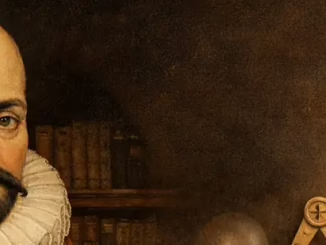
In the opening chapter of his Essays, Michel de Montaigne immediately shows what kind of thinker he is. He offers no rules, no instructions, and no moral conclusions. He observes. He compares. And he invites the reader to think for themselves. His central idea is simple, yet unsettling: completely different attitudes can sometimes lead to the same outcome. Humility may work. Fearless courage may also work. But just as often, neither does. With that, Montaigne sets the tone. Anyone looking for fixed answers will not find them here. No fixed formula for right action Montaigne describes situations in which people seek mercy from a victor. Sometimes by pleading and submitting. Sometimes by standing firm and refusing to show weakness. At times this evokes compassion. At other times, respect. And sometimes it provokes even greater cruelty. His point is clear: human behavior cannot be reduced to rules. What moves one person may irritate another. What inspires admiration today may provoke jealousy tomorrow. For those interested in Freemasonry, this feels familiar. Freemasonry does not promise ready-made answers but teaches how to deal with complexity. Not by judging, but by understanding. Compassion and admiration One of the most striking moments is Montaigne’s honesty […]


Gnosis
General

The Meaning of Gnosis in the West

Gnosis is a word derived from Greek that simply means ‘knowledge.’ However, it is not ordinary knowledge, such as facts you learn in school. Gnosis refers to a deeper, spiritual form of knowledge. Moreover, it is a direct experience or insight into the divine and the truth of existence. It is an inner knowing that cannot be acquired through books or teachings but through personal experience and self-exploration. In the Western world, Gnosis is often associated with esoteric traditions like Gnosticism. This is a religious-philosophical tradition that emerged in the early centuries after Christ. Therefore, the Gnostics believed that the material world is imperfect. They proposed that there is a deeper, spiritual reality that we can access through self-knowledge and inner development. What does Gnosis mean for the Western individual? In the West, Gnosis has often been linked to mystical and esoteric traditions throughout history. Think of groups like the Cathars in the Middle Ages and Hermetic philosophy during the Renaissance. Furthermore, even Freemasonry and other symbolic societies have connections to Gnosis. These traditions emphasize that Gnosis is about self-discovery and finding inner truth. Today, Gnosis does not always carry a religious connotation. It is often seen as a path […]

The Soul’s Code
Psychology

The Soul’s Code with James Hillman’s, Discover Your Blueprint

A Deeper Look at The Soul’s Code James Hillman’s groundbreaking work, The Soul’s Code, offers a revolutionary perspective on human nature and the purpose of our existence. This book is more than a psychological treatise; it’s an invitation to uncover our inner calling and embrace the power of our unique potential. Hillman’s concepts of the “acorn” and the “daimon” provide a fresh take on how we find meaning in our lives. Let’s delve into the key insights and explore how you can use this book to discover your own life’s purpose. The Core of Hillman’s Philosophy: The “Acorn” Hillman introduces the metaphor of the “acorn” as a symbol for the soul. Just as an acorn holds the potential to grow into a mighty oak tree, every individual carries a unique blueprint from birth. This blueprint is not a rigid plan but rather an inner calling that guides our life’s direction. The idea suggests that we are not solely shaped by upbringing or external influences but by a deeper essence that defines our destiny. The Role of the “Daimon” According to Hillman, the “daimon” is an inner guide that helps us discover the blueprint of our soul. This idea is drawn […]