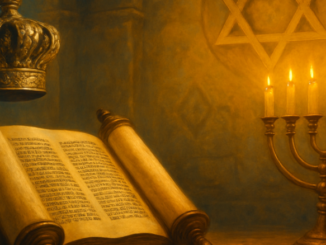
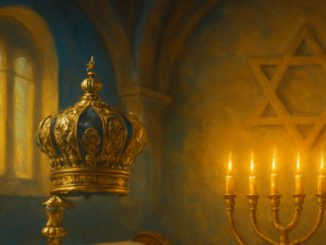
A lit candle symbolizing light, reflection, and Masonic tradition
Symbolism & Rituals

The Candle – Light as a Symbol of Reflection and Connection

There is something timeless and deeply enchanting about a candle. The gentle flicker of its flame draws the eye, quiets the mind, and stirs feelings of peace and introspection. Yet a candle is far more than a simple source of light — it is a profound symbol that has carried meaning across centuries, woven into religion, ritual, and the fabric of everyday life. A Small Flame, A Powerful Symbol The candle represents illumination in every sense of the word. It brightens dark rooms, yes — but it also illuminates the depths of the human soul. Small though it may be, a single candle flame is a powerful beacon, reminding us of the enduring value of simplicity, stillness, and reflection. Throughout history, civilizations have recognized this duality, using the candle as both a practical tool and a vessel of spiritual meaning. The Candle in Ritual and Ceremony Candles play a prominent role in rituals and ceremonies across the world. In religious traditions, they often serve as representations of divine light guiding the faithful along their path. Think of the candles burning steadily in churches, temples, and memorial services — each flame a quiet testament to something greater than ourselves. Within Freemasonry, […]

Golden oliebollen on a plate symbolizing Masonic tradition and brotherhood
Symbolism & Rituals

The Oliebol: Tradition, Symbolism and Masonic Brotherhood

There is no Dutch New Year’s Eve without the irresistible aroma of freshly fried oliebollen — golden, round balls of dough that mark the turn of the year. This humble pastry is a symbol of tradition, abundance, and togetherness. For Freemasons, however, the oliebol can carry an even deeper meaning: a celebration of brotherhood and the cyclical nature of life itself. A Rich History The oliebol — literally “oil ball” — traces its roots back to at least the 17th century in the Netherlands. During the cold, dark winter months, this nourishing fried dough provided warmth and energy in harsh times. In Freemasonry, where symbolism plays a central role, the round shape of the oliebol can remind us of the circle of life and the eternal quest for perfection. Just as Freemasons work on the rough ashlar to shape it into a perfect cube, the oliebol invites us to transform the ordinary — a simple batter of flour, yeast, and milk — into something extraordinary. It is a small but powerful metaphor for the transformative work at the heart of the Craft. The Ritual of Baking Baking oliebollen is remarkably similar to performing a ritual. The batter must be carefully […]

Ancient open book with symbolic garden imagery representing Masonic wisdom
Christianity

Song of Solomon & Symbolism: Love, Wisdom, and Freemasonry

Why would a Freemason spend time studying an ancient love poem from the Bible? The Song of Solomon contains no moral law, no historical narrative, no prophecy. It is pure poetry — brimming with longing, beauty, and mysterious imagery. And yet, hidden within that imagery are symbols that touch the very heart of Freemasonry. Let’s explore this remarkable book and the surprising connections it holds for the Craft. What Is the Song of Solomon? The Song of Solomon — sometimes called the Song of Songs or Canticles — is the twenty-second book of the Old Testament. It consists of lyrical dialogues between a bridegroom and a bride, interspersed with choruses and interludes. On the surface, it reads as a collection of love poems filled with sensory descriptions: the fragrance of myrrh, the taste of wine, the sight of blossoming vineyards. But is that really all there is? For centuries, scholars and theologians have searched for deeper layers beneath the poetic language. In the Jewish tradition, it was read as an allegory for the relationship between the Eternal and His people. In Christian circles, the bride was seen as the Church, the soul, or humanity itself seeking union with the Divine. […]

Open book of Ecclesiastes with Masonic symbols representing wisdom and light
Christianity

Ecclesiastes and Freemasonry: Wisdom in the Face of Impermanence

You probably know the feeling. You work hard toward a goal, finally reach it, and then find yourself wondering: was that really it? That quiet doubt, that subtle emptiness after an achievement — it has been described for thousands of years. The Book of Ecclesiastes confronts you with exactly this experience. And surprisingly, this ancient wisdom text touches on something that has occupied Freemasons for centuries: the question of what truly matters in a life defined by impermanence. An Ancient Voice That Still Resonates Ecclesiastes stands apart within the Old Testament. Where other books offer direction and certainty, Ecclesiastes asks questions. The author, who presents himself as a wise teacher, examines what life really means. He tries everything — wealth, pleasure, labor, knowledge. And each time, he arrives at the same conclusion: all is vanity, or as the Hebrew puts it, hevel. The word literally means vapor, breath — something that vanishes the moment you try to grasp it. Consider how radical that message was in an era when success and prosperity were seen as signs of divine favor. The Preacher dares to say aloud that the wise man dies just like the fool. That your efforts may disappear without […]

Open Book of Proverbs with Masonic square and compasses symbolizing wisdom
Christianity

Proverbs and Freemasonry: Wisdom as a Building Block of Character

The Book of Proverbs has spoken to seekers of wisdom for millennia. For some, it is a collection of practical rules for living from an ancient world. For others, it is a timeless mirror reflecting moral principles that remain as relevant today as when they were first written. But how does a Freemason approach these ancient texts? And what does someone discovering the symbolic richness of this book for the first time see in its pages? In this exploration, we examine two perspectives on wisdom as raw material for the inner life. The Perspective of the Traditional Reader For many readers, Proverbs is primarily a collection of practical advice attributed to wise kings and teachers of ancient Israel. The book belongs to what scholars call wisdom literature, and it contains short, pithy statements about honesty, diligence, humility, and justice. The tone is direct, sometimes stern, and always oriented toward daily life. A father speaks to his son, a teacher to his student. The wisdom conveyed is concrete: avoid the foolish, seek the righteous, guard your tongue. From this perspective, the book is essentially a manual for right conduct. The reader is encouraged to listen, to learn, and to improve their […]

Open book of Psalms with Masonic square and compasses symbolizing wisdom
Christianity

Psalms and Masonic Symbolism: Practical Wisdom for Daily Life

We all know those moments — a chaotic day spiraling out of control, a difficult decision that refuses to resolve itself, or a stretch of uncertainty that just won’t lift. The Psalms, a collection of 150 songs from the Old Testament, offer surprisingly practical guidance for exactly these situations. In Freemasonry, these ancient texts serve as a rich source of symbolism that can help you take concrete steps in your personal development. This article explores how to translate the imagery of the Psalms into everyday application. The Psalms as a Toolbox for Life Written over the course of centuries, the Psalms contain songs for every human experience: joy, sorrow, fear, gratitude, and wonder. For Freemasons, this is especially relevant because the Volume of the Sacred Law holds a central place in the lodge. The Psalms are often found open upon it as a symbol of wisdom and direction. But how do you translate ancient poetry into something meaningful for your life today? The answer lies in recognizing universal patterns. When a psalmist sings of walking through a dark valley, you may recognize your own season of uncertainty. When the text speaks of building a house upon a rock, you can […]

Open ancient book with Masonic rough ashlar stone symbolizing inner growth
Christianity

The Book of Job: Suffering as a Building Block for Inner Growth

You know the feeling: a season when everything falls apart. Loss, setback after setback, and the people around you don’t seem to understand. In moments like these, a question surfaces — one that humanity has grappled with for thousands of years: why is this happening to me? The Book of Job from the Old Testament confronts us with exactly this question. But it also offers a surprisingly practical framework for anyone willing to look deeper. For Freemasons in particular, this ancient book of wisdom contains symbols that speak directly to the inner journey every Brother or Sister undertakes. The Heart of the Story: A Righteous Man Put to the Test Job is a prosperous, upright man who loses everything — his possessions, his children, his health. His friends insist he must have done something wrong to deserve such misfortune. But Job knows he is innocent. The book isn’t really about whether suffering is a punishment. It’s about how you respond when life hits you with incomprehensible adversity. Job refuses to surrender his integrity, even when everything is stripped away from him. That is the first practical lesson: character stands firm when comfort disappears. The Symbolism of the Rough Ashlar In […]

Open Book of Esther with Masonic square and compasses symbolizing hidden wisdom
Christianity

Esther: Courage and Hidden Wisdom in Freemasonry

In 478 BCE, a drama unfolded in the Persian Empire that is still commemorated to this day. A young woman, seemingly powerless at the court of an all-powerful king, changed the course of history through her courage and wisdom. The Book of Esther is unique within the Hebrew Bible: God’s name is never once mentioned, yet the divine is palpably present in every twist of the narrative. For Freemasons, this remarkable book offers a treasure trove of symbolism about hidden wisdom, moral courage, and the power of acting at precisely the right moment. A Historical Turning Point in Persia The story of Esther takes place at the court of King Ahasuerus, who ruled an empire stretching from India to Ethiopia. The historical backdrop is the Persian exile — a period when the Jewish people lived scattered under foreign rule. In this context, a young woman named Hadassah, later known as Esther, becomes queen. Her uncle Mordecai warns her to keep her heritage hidden. This element of concealment is not merely a practical survival strategy; it touches on a deeper truth about identity and the right moment of revelation. When the courtier Haman hatches a plot to annihilate all Jews in […]

Symbolic representation of Nehemiah rebuilding the wall of Jerusalem
Christianity

Nehemiah and the Symbolism of the Rebuilt Wall

Picture an ancient city wall, neglected for generations, lying in ruins. Stones scattered, gates burned, the outline of what once offered protection barely recognizable. Then someone arrives — not merely to stack stones, but to restore an entire community. The story of Nehemiah, the sixteenth book of the Old Testament, tells exactly this. Beneath the historical narrative lies a rich vein of symbolism that touches the very heart of what Freemasons strive for: building something greater than oneself, stone by stone, shoulder to shoulder. The Wall as a Boundary Between Chaos and Order A wall is more than stacked stones. In everyday life, we experience walls as unremarkable dividers — things that simply exist. But look deeper, and you discover that every wall represents a decision: here one thing ends, and there another begins. The wall of Jerusalem that Nehemiah rebuilt was literally the boundary between the holy city and the disordered world beyond it. Symbolically, it marked the transition from chaos to order, from decay to restoration. In Freemasonry, this theme of demarcation plays an essential role. The temple we build also has walls — not of stone, but of principles, of ethical boundaries that define who we aspire […]

Ancient temple ruins symbolizing the Masonic journey of inner rebuilding
Christianity

Ezra and the Rebuilding of the Temple: A Symbolic Journey

In 538 BCE, something remarkable happened. After decades of exile in Babylon, thousands of people returned to Jerusalem with a single sacred purpose: to rebuild the destroyed temple. The biblical Book of Ezra tells this story of return and reconstruction. But beneath the historical narrative lies a deeper layer — a symbolic journey that still resonates within Freemasonry and in the heart of every person striving for inner renewal. The Historical Context of Ezra The Book of Ezra describes a pivotal period in the history of the Jewish people. King Cyrus of Persia issued a remarkable decree in 538 BCE: the exiles were permitted to return to their homeland and rebuild their temple. This was no ordinary political maneuver — the returning exiles experienced it as divine intervention. Ezra, a scribe and priest, played a key role in this return and the spiritual reformation that followed. The returning exiles found a desolate landscape. The temple, once the spiritual center of their existence, lay in ruins. What followed was a years-long process of reconstruction, plagued by opposition, doubt, and internal conflict. Yet they persevered. Stone by stone, the sanctuary rose once more from the dust. It is this image of patient, […]

Symbolic representation of the 33rd Degree in Scottish Rite Freemasonry
Symbolism & Rituals

The Truth Behind the 33rd Degree in Freemasonry

Few topics in Freemasonry generate as much curiosity and speculation as the 33rd Degree. For outsiders, it often conjures images of secretive power, exclusive hidden knowledge, or a shadowy elite pulling strings behind closed doors. These narratives, however, are far removed from reality. Let’s separate the facts from the fiction and explore what the 33rd Degree truly represents. What Is the 33rd Degree? The 33rd Degree belongs to the Scottish Rite, a supplementary system of degrees within Freemasonry. Contrary to popular belief, it is not a rank that one achieves by passing through a series of rituals or examinations. Instead, it is an honorary degree — a recognition bestowed upon Brethren who have demonstrated exceptional dedication to the Order and to their communities. Think of it as a tribute to service and commitment, rather than a step on a ladder of power. No Power, No Conspiracy One of the most persistent misconceptions about the 33rd Degree is that it confers some kind of authority or influence, either within Freemasonry or in the wider world. In reality, Freemasons who hold this degree have no additional power or control — not within the Lodge, and certainly not in society at large. Freemasonry […]

A rough ashlar stone and gavel symbolizing Masonic personal transformation
Symbolism & Rituals

The Sledgehammer Blow: A Masonic Moment of Revelation

In Freemasonry, we work on ourselves. The idea is simple yet profound: by chipping away at our own rough stone, we strive to become better human beings. Every now and then, a presentation or discussion in Lodge strikes so deeply that it changes something inside you. I experienced such a moment — a sledgehammer blow of emotion that came from nowhere and left me transformed. Working on the Rough Stone Freemasonry is often described as a journey of self-improvement. We see ourselves as rough ashlar stones, and through reflection, ritual, and fellowship, we gradually shape ourselves into something more refined. Some Lodge meetings pass quietly, offering gentle lessons. Others hit you like a sledgehammer. The meeting I want to share with you was very much the latter. Some time earlier, I had attended a presentation about the concept of the Daimon — an idea I will write about separately another time. That earlier talk planted a seed in my mind, one I didn’t fully understand at the time. But seeds have a way of growing in the dark, and what happened next proved exactly that. The Blow That Came from Nowhere During a subsequent Lodge meeting, we had a round […]

Vrijmetselarij - De Symboliek van Februari: Een Tijd voor Verbinding en Groei
Symbolism & Rituals

The Symbolism of February: A Time for Connection and Growth

February, The Bridge Between Winter and Spring February is a month of transition. It is the shortest month of the year but also one full of meaning. Its name is derived from the Latin word ‘februare,’ which means to purify. This month invites us to reflect and prepare for spring, a time of rebirth. For the Freemason, this is a period to seek balance between introspection and action. Symbolism in February February represents duality: cold winter days that point to the warmth of the approaching spring. This tension between opposites is a familiar theme in Freemasonry, where light and darkness, labor and rest, and knowledge and mystery go hand in hand. It is a month that encourages us to build a bridge between the old and the new. The Fellowcraft and the Bridge The Fellowcraft in Freemasonry is often associated with building bridges, both literally and figuratively. February offers an opportunity to strengthen connections, both in our personal lives and within our communities. Which relationships deserve more attention? Which goals can you solidify? Building these bridges requires reflection but also determination. The Rhythm of Nature Although February is still winter, we begin to see subtle changes in nature. The days […]

Vrijmetselarij - Het Symbolische Begin: Januari en de Weg naar Verlichting
Symbolism & Rituals

The Symbolic Beginning: January and the Path to Enlightenment

January, The Gateway to the New Year January, the first month of the year, marks a new beginning. Its name is derived from Janus, the Roman god with two faces: one looking to the past, the other to the future. This makes January the quintessential month of reflection and intentions. During this period, many reflect on the previous year and set goals for the future. For the Freemason, this strongly resonates with the idea of self-examination and growth. Symbolism in January January’s duality reflects a core principle in Freemasonry: duality. Light and darkness, past and future, knowledge and ignorance — all are intrinsically linked. The transition to a new year symbolizes entering a new phase, a renewed opportunity to build the inner temple. Just as a Fellowcraft continues to develop through lessons from the past, January offers us the chance to apply the lessons of the previous year. The Stone of Renewal Freemasons work with the image of the rough and the polished stone. In January, the universe invites us to reassess our rough stone. What can we smooth out? Which facets need strengthening? This month calls for introspection, not perfection, but the intention to become a better person. Winter: […]

Vrijmetselarij - De Reis van de Tijd: Geschiedenis, Betekenis en Toekomst
Symbolism & Rituals

The Journey of Time: History, Meaning, and Future

Time: an elusive concept connecting us to the stars and the seasons. From the moment humans observed the movements of the sun, moon, and stars, time became a tool for organizing, planning, and understanding. But it is more than just a clock or a calendar. It is a flow that shapes and guides us, sometimes pressuring and at other moments liberating us. Time Through History In ancient civilizations, time was cyclical. The Egyptians, Mayans, and Chinese thought in terms of repetition: day and night, seasons, and life cycles. This view shifted with the invention of the mechanical clock during the Middle Ages. Time became linear and measurable—an instrument of control and precision, essential for navigation and science. The 19th-century industrialization era amplified this shift. Time became money; clocks dictated work and rest. While this approach fueled progress, it also turned time into a master of schedules. Ironically, in today’s tech-driven world, we are more obsessed with time than ever. How It Affects Us Time can heal and hurt, connect and separate. It structures our lives but also confronts us with our mortality. For many, time feels like an enemy—too little, too fast, or too slow. But what if we viewed […]